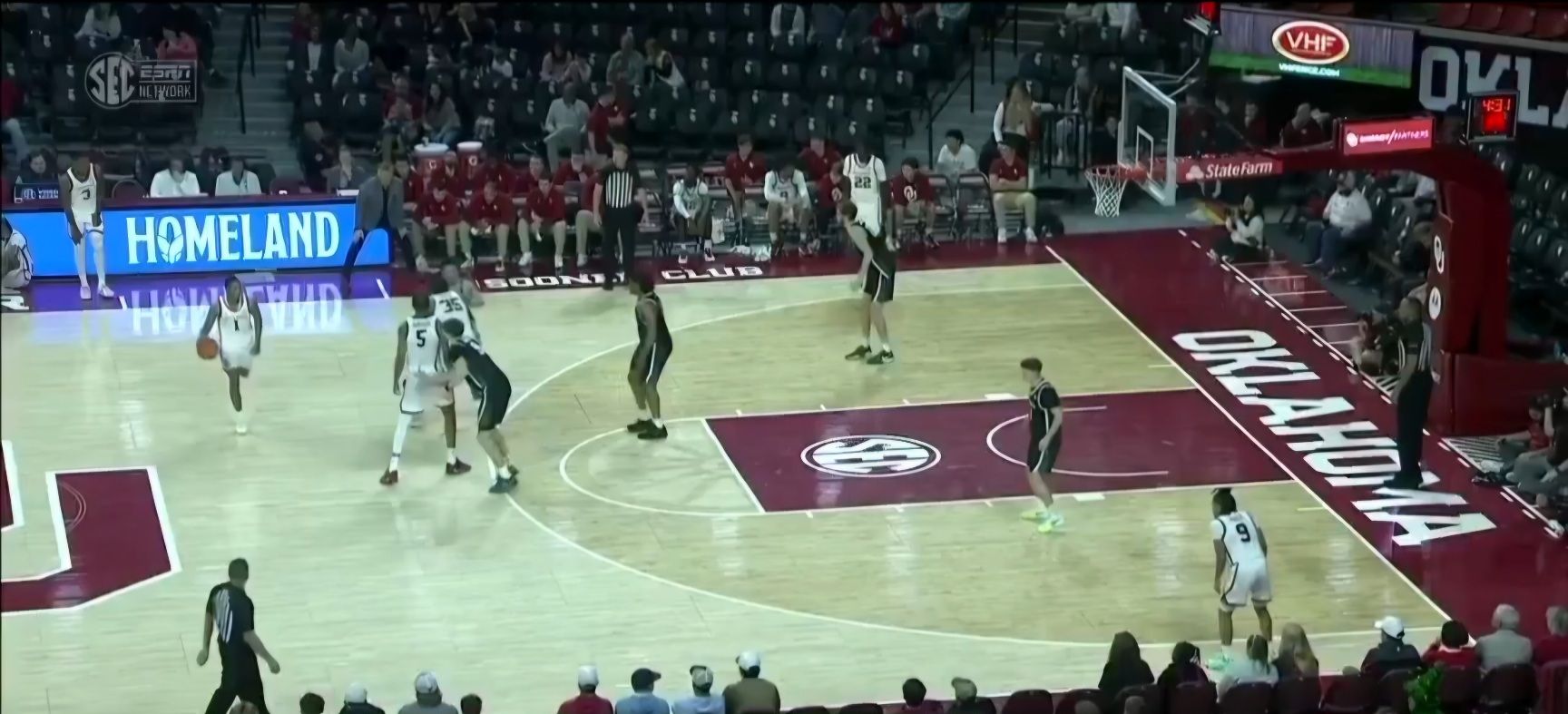
There are blowouts, and then there are statements. Oklahoma’s 107–54 dismantling of Stetson on Monday night fell squarely into the latter category, not because of the opponent, but because of how the Sooners went about their business.
This wasn’t empty calories. This wasn’t a night where one guy got hot and the rest followed along for the ride. This was Oklahoma playing with clarity, precision, and — most importantly — intent. And as the calendar flips toward conference play, that intent may matter far more than the 53-point margin of victory.
The box score will tell you plenty: a program-record shooting night, six players in double figures, domination in the paint, and complete control from start to finish. But the real takeaway lives deeper than percentages and point totals. What Oklahoma showed against Stetson was a team that understands its identity — and is starting to trust it.
This Wasn’t About Hot Shooting — It Was About Shot Selection
Yes, Oklahoma shot nearly 68 percent from the field, the best single-game mark in program history. That’s eye-popping. That jumps off the page. That gets national attention.
But what made the performance meaningful wasn’t that the shots went in — it was why they went in.
The Sooners weren’t settling. They weren’t bailing themselves out late in the shot clock. They weren’t hunting hero ball possessions. Instead, Oklahoma consistently generated advantages: paint touches, kick-outs, cuts behind ball-watching defenders, and open rhythm looks created by ball movement.
When a team shoots that well, it’s tempting to chalk it up to a “special night.” In reality, special nights are often earned through discipline. Oklahoma’s offense flowed because players trusted the pass, trusted spacing, and trusted that the next action would produce something better than the first.
That’s not accidental. That’s structure.
Balance Is No Longer a Buzzword — It’s a Weapon
Derrion Reid led the way with a career night, Xzayvier Brown continued his strong stretch, Mohamed Wague controlled the interior, and Nijel Pack quietly orchestrated everything without forcing himself into the spotlight. Add in contributions from Tae Davis, Kuol Atak, and others, and you’re looking at a roster that’s learning how to function as a collective.
This version of Oklahoma doesn’t need a single player to be great every night. It needs multiple players to be solid — and that’s a far more sustainable formula.
What stood out most was how seamlessly the scoring shifted based on what the defense allowed. When Stetson packed the paint, Oklahoma spaced the floor and knocked down threes. When perimeter defenders overplayed, the Sooners attacked downhill and punished switches inside. When help came early, cutters were rewarded.
That adaptability hasn’t always been there under Porter Moser. On Monday, it was undeniable.
Defense Fueled Everything — Even the Offense
The offensive fireworks were flashy, but the defensive foundation deserves equal billing. Oklahoma didn’t just score efficiently — it dictated terms.
Stetson struggled to initiate offense, struggled to get second chances, and struggled to find any rhythm against Oklahoma’s physicality and positioning. The Sooners won the rebounding battle decisively and took away easy looks at the rim. When Stetson settled for perimeter shots, Oklahoma was comfortable living with the results.
Defense doesn’t always show up in highlight packages, but it shows up in flow. When stops lead to early offense, confidence grows. When confidence grows, passing sharpens. When passing sharpens, shot quality skyrockets.
That chain reaction was on full display.
Depth Is Starting to Matter — And That’s New
Perhaps the most encouraging sign of the night was how comfortable Oklahoma looked going deeper into its rotation. Minutes were spread out. Roles were defined. Nobody looked rushed trying to “prove” something in limited time.
Freshman Kai Rogers’ increased role wasn’t just symbolic — it was practical. He played with energy, rebounded, finished around the rim, and didn’t overthink his opportunities. That kind of contribution may not swing games in December, but it absolutely matters in February when foul trouble, fatigue, and scouting reports test depth.
Even the unfortunate injury to Dayton Forsythe highlighted something important: Oklahoma didn’t flinch. The structure held. The system absorbed the loss without unraveling.
That’s the difference between a team and a collection of players.
The Home Court Is Becoming an Edge Again
Oklahoma remains unbeaten at home, and nights like this explain why. The Lloyd Noble Center fed off early dominance, and the players responded by keeping their foot down instead of easing off.
In previous seasons, big early leads sometimes came with second-half drift. Against Stetson, there was no drift. The Sooners didn’t need to chase points, but they also didn’t coast. The standard remained intact from opening tip to final buzzer.
That’s how you build a home-court identity — not with noise alone, but with consistency.
Perspective Still Matters — But So Does Momentum
No one is mistaking Stetson for an SEC opponent. This game won’t define Oklahoma’s season on its own, and it shouldn’t. The Sooners will face defenses that are longer, more physical, and far more prepared than what they saw Monday night.
But dismissing this performance as meaningless would be lazy analysis.
What matters is trajectory. Oklahoma has now won six of its last seven games. The offensive process looks cleaner. The defensive attention has sharpened. The rotation is stabilizing. The Sooners aren’t just winning — they’re learning how to win without chaos.
That matters as much as any résumé line.
The best nonconference games aren’t about survival. They’re about preparation. They’re about testing habits under low pressure so they hold under high pressure later.
Against Stetson, Oklahoma passed that test emphatically.
The Sooners showed that they can:
- Start fast
- Share the ball
- Defend without fouling
- Win the rebounding battle
- Maintain focus with a large lead
- Get production from multiple lineup combinations
Those are the traits that translate when the margin for error disappears.
Monday night wasn’t about running up the score. It was about Oklahoma confirming that its recent progress isn’t a mirage.
This team is still evolving. It will still have uneven nights. But performances like this suggest that the foundation is finally firm enough to support real expectations.
Oklahoma didn’t just beat Stetson by 53 points.
It showed that it knows exactly who it wants to be — and that realization may end up being the most important win of the season.
Follow us on Instagram & Facebook