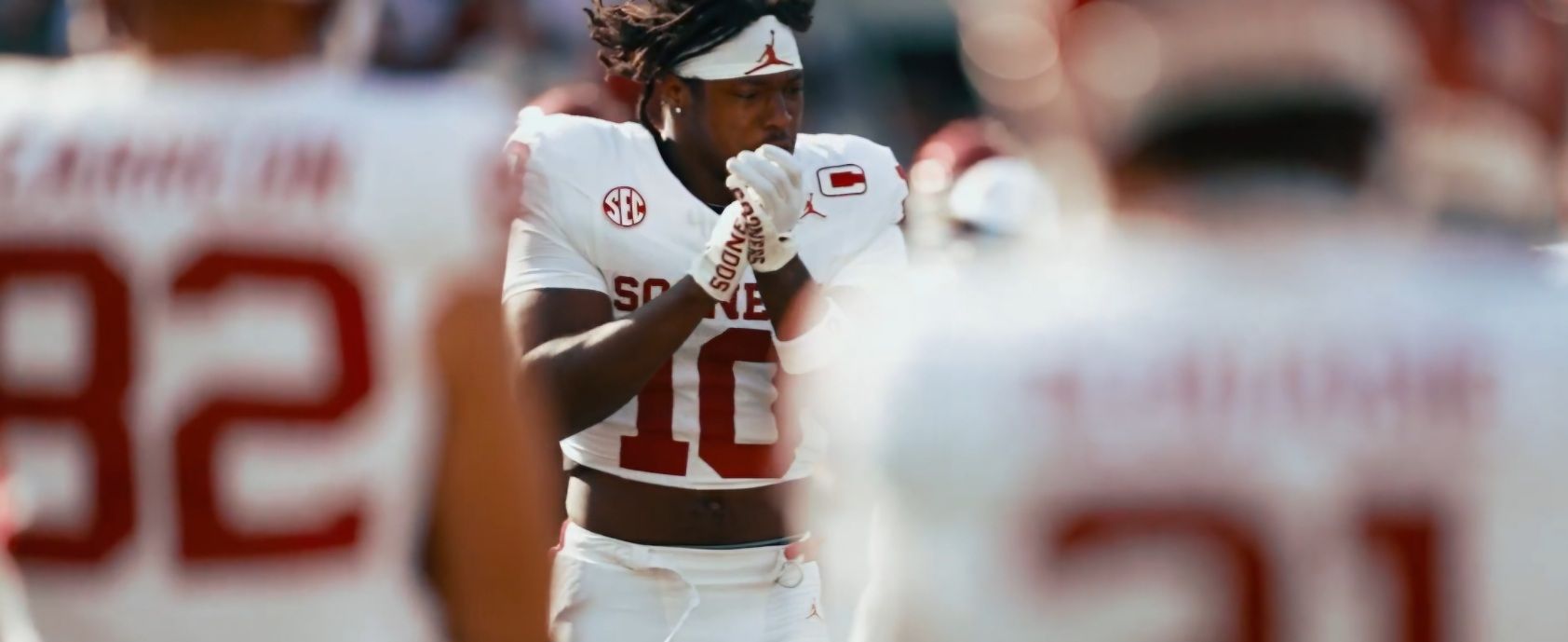
In modern college football, retention has become the new recruiting.
Stars leave early. Depth evaporates overnight. Leadership is often rented, not built. So when a player with legitimate NFL leverage looks at his options and chooses to come back anyway, that decision deserves more than a headline. It deserves context.
Kip Lewis returning to Oklahoma for the 2026 season isn’t simply good news for the Sooners. It’s a declaration — about the program’s identity, about its defensive ceiling, and about its belief that championships are still won the hard way.
Because let’s be clear: Kip Lewis didn’t stay because he had to. He stayed because he wanted to.
Lewis was widely viewed as a legitimate NFL Draft candidate after the 2025 season, likely somewhere in the Day 2 conversation. He had the production, the tape, the athletic profile. Linebackers who rack up 76 tackles, 10.5 tackles for loss, four sacks, pass breakups, and forced fumbles — while serving as the emotional center of an SEC defense — don’t come back by accident.
They come back with purpose.
For Oklahoma, that purpose changes everything about the 2026 outlook.
Start with the obvious: Lewis is the best defensive player on the roster. Not the most talented prospect, not the highest recruit — the best. He’s the guy offenses identify before the snap. The one coordinators scheme around. The one teammates feed off. When he’s on the field, Oklahoma’s defense doesn’t just play faster — it plays sharper.
That matters in Brent Venables’ system.
Venables’ defense is built on trust, communication, and relentless execution. It demands linebackers who can diagnose, adjust, and finish. Lewis has become the embodiment of that philosophy. He isn’t just a tackle collector; he’s a problem solver. He fills gaps with authority, closes space in the open field, and brings a physical tone that carries from the first snap to the last.
When Oklahoma finished the 2025 season ranked eighth nationally in total defense, Lewis was the through-line. He was the stabilizer on a unit that had talent around him but relied on his consistency to function at its highest level.
And consistency is exactly what Oklahoma needs heading into 2026.
The Sooners are facing transition at linebacker, particularly with the departure of Owen Heinecke. That kind of loss can fracture a defense — unless there’s a clear alpha still standing in the middle. Lewis ensures that the linebacker room doesn’t reset; it reloads. Younger players now grow into defined roles rather than being thrust into leadership positions prematurely.
That’s not just good roster management. That’s championship insurance.
But Lewis’ return matters just as much off the stat sheet.
Every elite defense has a heartbeat. Someone who sets the emotional temperature. Someone whose effort is non-negotiable. For Oklahoma, that’s Lewis. Coaches trust him. Teammates follow him. When things get chaotic — a busted coverage, a long drive, a hostile road environment — Lewis becomes the anchor.
That leadership is priceless in the SEC, where momentum swings are violent and unforgiving.
There’s also a broader pattern forming that shouldn’t be ignored. Lewis’ decision aligns with the returns of quarterback John Mateer and wide receiver Isaiah Sategna. Oklahoma didn’t just keep one star — it kept pillars on both sides of the ball. That kind of continuity is rare in the transfer portal era, and it signals something deeper than individual choices.
It signals belief.
Belief in Venables. Belief in the roster. Belief that Oklahoma isn’t just surviving in the SEC — it’s positioning itself to contend.
And Lewis, perhaps more than anyone, understands what that takes.
This isn’t a linebacker chasing numbers. This is a linebacker chasing legacy. His decision to return gives him another year to refine his game, elevate his draft stock, and — most importantly — lead a defense that could be special. With safety Peyton Bowen patrolling the back end and a defensive line featuring David Stone and Jayden Jackson, Oklahoma has the bones of an elite unit.
Lewis is the connective tissue.
He ties the front to the back. He cleans up mistakes. He makes the call that puts everyone in the right spot. In Venables’ defense, that role isn’t glamorous — but it’s indispensable. Without it, even talented units unravel.
There’s also a cultural message embedded in this decision that fans shouldn’t overlook.
Oklahoma wants to be a program that keeps its best players long enough to finish what they started. That used to be the norm. Now it’s the exception. When a potential NFL pick comes back not out of necessity, but ambition, it reinforces a standard that can’t be manufactured through NIL deals alone.
That standard attracts the right kind of player.
Recruits notice who stays. So do current teammates. When Lewis chose another year in Norman, he didn’t just secure Oklahoma’s defensive future — he raised the bar for everyone around him. Leadership like that compounds.
Make no mistake: this decision raises expectations.
With Lewis back, Oklahoma can no longer hide behind “transition” language on defense. This unit should be fast, physical, and disciplined. It should close games. It should travel. It should win ugly when necessary. Those are all traits of defenses led by veteran linebackers who understand situational football.
Lewis gives Oklahoma all of that.
And maybe the most important part? He gives them belief when it matters most.
Because championship runs don’t start with hype. They start with choices. Choices to stay. Choices to lead. Choices to chase something unfinished.
Kip Lewis made his choice.
Now Oklahoma has to live up to it.
Follow us on Instagram & Facebook