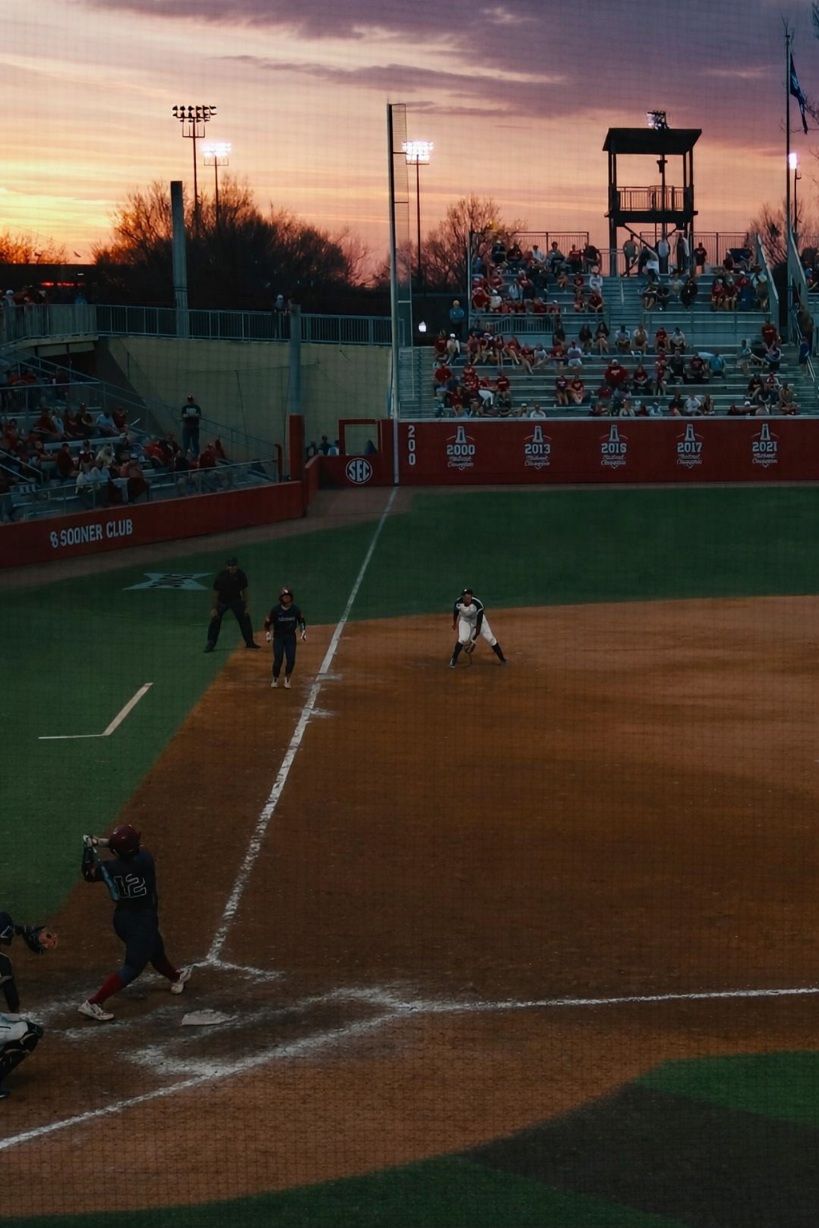
There are two types of dominance in college softball.
There’s the kind you explain away.
And then there’s the kind you can’t.
What Oklahoma did over the course of last weekend’s six-game homestand at Love’s Field falls squarely into the second category.
From Feb. 26 through March 1, Oklahoma didn’t just win six games. The Sooners rewrote the tone of their season. They hit .544 as a team. They scored 116 runs and allowed just 15. They hit 30 home runs and racked up 92 hits. Every single game ended in five innings via run rule.
And before anyone rushes to the nearest strength-of-schedule argument, let’s be clear: offensive production of this magnitude transcends the opponent.
Because numbers like these aren’t normal.
They’re not inflated.
They’re historical.
A Weekend That Looked Like a Video Game
The Sooners opened the homestand with a 32–0 dismantling of Alabama State. That wasn’t just a win — it was a program record for runs in a home opener.
Two days later, in a 29–6 rout of Alabama State, Oklahoma put up a 21-run third inning — the highest-scoring inning in program history and the second-highest single inning in NCAA softball history.
Twenty-one runs. In one inning.
You don’t accidentally do that. You don’t luck into that because the pitcher had a bad day. That kind of avalanche requires lineup-wide execution: plate discipline, power, baserunning awareness, two-strike approaches, and depth.
And Oklahoma displayed all of it.
Across the six games — against Alabama State, Sam Houston State, and Southeastern Louisiana — the Sooners never once flirted with danger. Every contest was over early. Every game followed the same script: relentless pressure from spots one through nine.
When you score 13.8 runs per game over a stretch, that’s not matchup-dependent. That’s system-dependent.
The Competition Argument — And Why It Fails
Yes, none of last weekend’s opponents were ranked. That matters in some contexts.
But here’s what also matters:
Oklahoma has already run-ruled three ranked teams this season — No. 17 Arizona (21–3), No. 14 Duke (11–1), and No. 23 Washington (15–2). In those three games, the Sooners outscored top-25 competition 47–6.
So the narrative that this offense only thrives against mid-majors doesn’t survive contact with reality.
When you are 4–1 against ranked opponents and you’ve beaten three of them by run rule, the evidence says your approach travels.
The difference last weekend wasn’t opponent quality. It was volume.
Depth That Breaks Scouting Reports
One of the quietest but most devastating truths about this team is that every Sooner with an official at-bat this season has recorded a home run.
Think about that.
There is no “bottom of the lineup.” There is no breather inning for opposing pitchers. There is no sequence where you can pitch around one hitter to get to a softer spot.
Freshman Lexi McDaniel hit .769 over the weekend, going 10-for-13 with four home runs and 12 RBIs. Kai Minor extended her hitting streak to 16 games and is sitting at a .545 season average. Gabbie Garcia launched two home runs in the finale against Southeastern Louisiana and drove in five in a single game earlier in the weekend. Kendall Wells delivered multiple multi-homer performances, including two bombs during that record-setting third inning.
That’s not one star carrying the load. That’s waves.
It’s the kind of lineup construction that makes defensive game-planning almost irrelevant. If you pitch around one threat, you walk into another. If you try to steal strikes early in the count, you’re jogging back to the dugout watching the ball leave the yard.
Thirty home runs in six games is not about the opponent’s circle. It’s about the hitter’s approach.
Take A Deeper Dive Into Oklahoma Softball
Exclusively on our subscription page.
– Five Homers, 49 Pitches, One Message
– Oklahoma Rewrites History In 29-6 Route of Alabama State
– Seventy-Five Homers And Counting
Outpacing History
The 2021 Oklahoma’s offense set the NCAA home run record and became the gold standard for modern collegiate power.
This 2026 group is outpacing it.
Through 21 games, the Sooners have blasted 86 home runs. They’re slugging .964 — nearly .200 points higher than the 2021 team’s final mark. They’re scoring at a clip that feels unsustainable — except they keep sustaining it.
At some point, you stop comparing them to the opponent and start comparing them to history.
When a team begins to outdistance its own national-title predecessors, that’s no longer about strength of schedule. That’s about generational talent paired with championship infrastructure.
Championship Habits, Not Exhibition Stats
Under head coach Patty Gasso, Oklahoma has never framed non-conference weekends as stat-padding exercises. The internal standard doesn’t change based on the logo in the opposite dugout.
That’s why the Sooners drew double-digit walks in blowouts. That’s why they left minimal runners on base. That’s why the at-bats in a 29–6 game look the same as they do against a top-15 opponent.
They are building habits.
Plate discipline travels. Power travels. Situational hitting travels.
And perhaps most importantly, confidence travels.
When you string together six straight run-rule wins and outscore opponents 116–15, you’re not just collecting wins. You’re reinforcing an identity: if you make one mistake, we make you pay three times.
That psychological advantage doesn’t show up in the box score, but it shows up when SEC play tightens and a pitcher tries to challenge a hitter with two outs and a runner on second.
The Sooners believe damage is inevitable.
And that belief matters.
The Statistical Floor
There’s also a broader reality in the postseason picture. Lopsided wins build statistical insulation. Batting average, slugging percentage, run differential — these aren’t vanity metrics. They help maintain a national profile that keeps Oklahoma in position for a top-eight seed and home-field advantage deep into May.
Even if you dismiss one or two lopsided scores, you can’t dismiss 116 runs in six games.
You can’t dismiss 30 home runs in a weekend.
You can’t dismiss a .465 team batting average.
Those are structural numbers. They raise the floor of what this team is offensively. And when the floor is this high, the ceiling becomes terrifying.
The Grand Scheme
So yes, in the grand scheme of things, Oklahoma is dominating both ranked and unranked opponents.
They are 19–2 overall. They have beaten elite teams decisively. They have humiliated mid-majors efficiently. They have erased program records and flirted with NCAA history before conference play even settles in.
The competition last weekend doesn’t matter.
Because if you are scoring 21 runs in an inning, if every hitter in your lineup owns home run power, if you are slugging nearly .200 points above one of the greatest offenses in NCAA history — that’s not schedule inflation.
That’s separation.
And separation is what championship teams create long before Oklahoma City in June.
The real warning sign for the rest of the country isn’t that the Sooners beat Alabama State 32–0.
It’s that they hit the same way against Arizona.
It’s that they’ve already proven the power shows up against ranked teams.
It’s that there are no weak spots to exploit.
When offensive numbers reach this magnitude, the opponent becomes secondary.
Because what you’re watching isn’t a hot weekend.
It’s a machine.
And right now, that machine is running at a historic pace.
Follow us on Instagram & Facebook