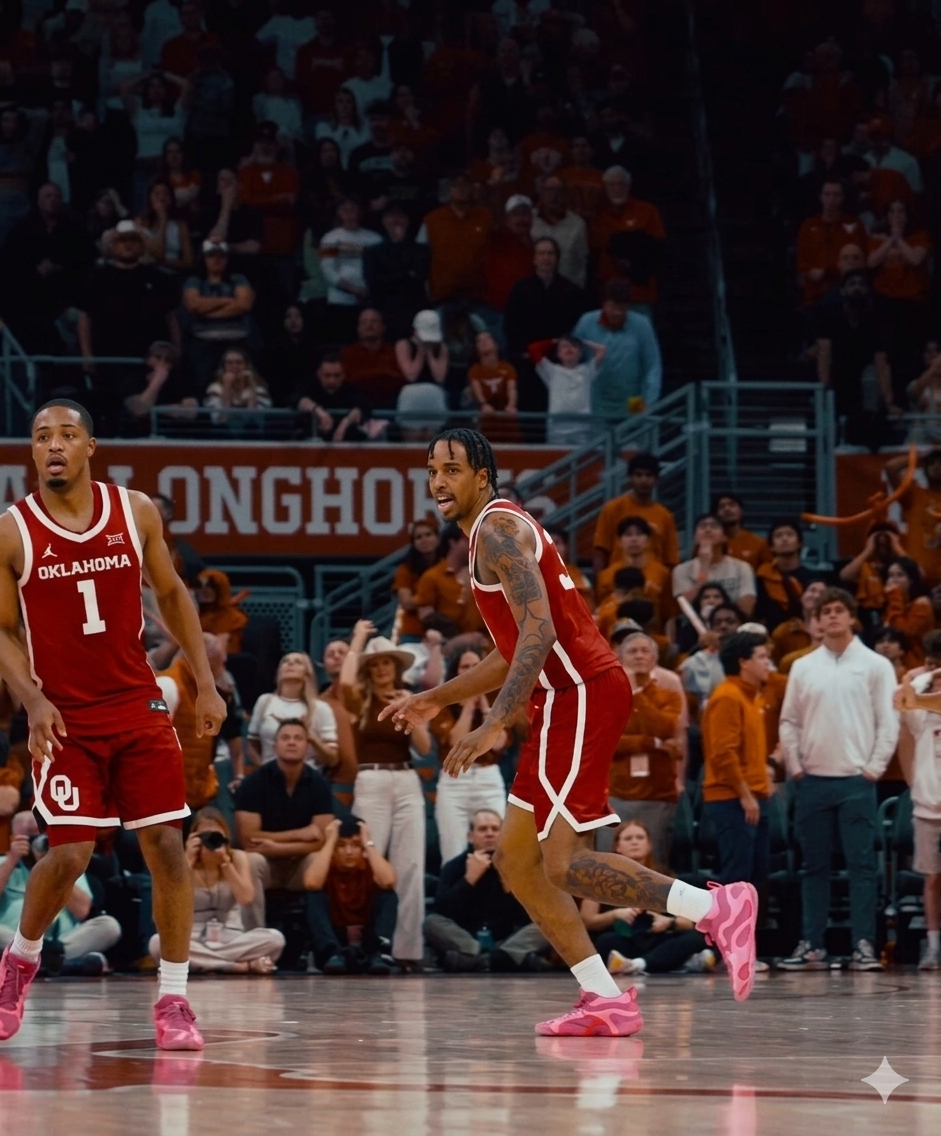
The box score will record it as an overtime win. The standings will simply mark it as another late-season victory. But for the players inside burnt orange territory on Saturday night, what unfolded at the Moody Center felt much bigger.
In a game that swung wildly between control and chaos, the Oklahoma Sooners men’s basketball survived a late collapse, regrouped in overtime, and escaped Austin with an 88–85 victory over the Texas Longhorns.
For a team fighting to strengthen its postseason résumé, the result mattered. But the way it happened — dramatic, nerve-rattling, and ultimately resilient — might matter even more as Oklahoma heads toward the SEC Tournament in Nashville.
The Sooners improved to 17–14 overall and closed the regular season on a four-game winning streak, the kind of late momentum that can reshape a season’s narrative.
And it nearly slipped away.
A Game Oklahoma Controlled — Until It Didn’t
For long stretches Saturday night, Oklahoma looked like the more composed team.
The Sooners’ backcourt dictated tempo, their defense generated turnovers, and their rebounding quietly neutralized one of Texas’ usual strengths.
Much of that stability came from veteran guard Nijel Pack.
Pack delivered the kind of performance Oklahoma has leaned on throughout the season, finishing with 23 points while serving as the offensive engine during the Sooners’ decisive second-half run.
With the game tied midway through the second half, Oklahoma erupted on a 14–2 surge that changed the entire feel of the night.
Pack scored nine points during that stretch, hitting timely jumpers and attacking gaps in Texas’ defense. When the run ended, Oklahoma suddenly held a 12-point lead with fewer than seven minutes remaining.
For a moment, it looked like the Sooners might cruise to a road win.
But rivalry games rarely follow scripts.
Texas’ Furious Finish
Texas guard Jordan Pope refused to let the game end quietly.
Pope, who finished with a game-high 30 points, led a furious Longhorn rally in the final minutes. Texas began to speed the game up, forcing Oklahoma into uncomfortable defensive possessions and capitalizing on late fouls.
Still, Oklahoma maintained a six-point lead with just 38 seconds remaining.
Then everything unraveled.
A defensive miscue led to a Texas three. Another possession ended with a foul beyond the arc. Suddenly the Longhorns had life.
With 3.8 seconds remaining, Pope stepped to the free-throw line after drawing a foul on a three-point attempt.
The building held its breath.
He sank all three.
Just like that, the game was tied 77–77.
For Oklahoma, the collapse felt devastating. A double-digit lead had evaporated in a matter of seconds. Momentum had swung completely toward the home team.
Overtime felt inevitable.
Resetting in Overtime
The mental challenge in overtime wasn’t tactical.
It was psychological.
Teams that lose control late in regulation often struggle to regroup in the extra period. For Oklahoma, the first possessions of overtime would determine whether the Sooners folded or fought.
They fought.
Guard Xzayvier Brown took command early in the extra session, attacking the paint and forcing Texas’ defense to collapse. Brown’s stat line — 21 points, four assists, and four steals — reflected his all-around impact.
But the most important play he made never showed up as a scoring highlight.
With just over a minute left in overtime and the game hanging in the balance, Oklahoma needed a spark.
It came from an unlikely source.
Mohamed Wague’s Crucial Second Chance
On a missed Oklahoma shot with 1:04 remaining, forward Mohamed Wague slipped inside the defense and tipped the ball back into the basket.
The play gave Oklahoma an 83–82 lead.
It also reset the emotional balance of the game.
Instead of chasing Texas in the closing moments, the Sooners had regained control.
Still, the final dagger was yet to come.
The Moment
In pressure games, there’s always a moment when someone unexpected changes the story.
For Oklahoma, that moment belonged to sophomore forward Derrion Reid.
With the Sooners clinging to a narrow lead and the clock ticking under 20 seconds, Brown drove into the paint, drawing multiple defenders.
The Texas defense collapsed.
In the corner stood Reid.
Brown kicked the ball out.
Reid didn’t hesitate.
The sophomore rose up and buried a three-pointer from the corner with 11 seconds remaining — a shot that pushed Oklahoma’s lead to four and silenced the arena.
For a player still early in his collegiate career, it was the biggest shot of the season.
Possibly the biggest of Oklahoma’s year.
Pack Seals It
After Reid’s shot, Texas scrambled for one last push.
But Oklahoma turned once again to its veteran presence.
Pack calmly stepped to the free-throw line in the closing seconds and knocked down two free throws, effectively icing the game and securing the 88–85 victory.
It was a fitting ending.
The Sooners had leaned on Pack all night, and he delivered in the final moment that mattered.
Winning the Hidden Battles
While the late drama grabbed headlines, several subtle factors helped Oklahoma win.
Rebounding Edge:
Despite Texas’ reputation as a strong rebounding team, Oklahoma won the battle on the glass 40–35. That margin included Wague’s critical overtime tip-in.
Defensive Disruption:
The Sooners forced 12 Texas turnovers, with Brown playing a major role through his four steals.
Backcourt Control:
The Pack-Brown duo combined for 44 points and dictated Oklahoma’s offensive rhythm throughout the night.
Those elements allowed Oklahoma to build its second-half lead — even if holding it proved more difficult.
Momentum at the Right Time
For Oklahoma, the victory did more than add another number to the win column.
It strengthened a late-season surge that suddenly has the Sooners playing their best basketball heading into postseason play.
The win marked Oklahoma’s fourth straight to close the regular season — a crucial stretch for a team attempting to navigate its way back onto the NCAA Tournament bubble.
Momentum can be fragile in March.
But right now, Oklahoma has it.
The Sooners will enter the conference tournament as the No. 11 seed and open play against South Carolina in Nashville. Meanwhile, Texas will enter as the No. 10 seed after finishing conference play at 9–9.
What happens next will determine whether Oklahoma’s season continues beyond conference tournament week.
But Saturday night proved something important.
Even when things unravel.
Even when a double-digit lead disappears.
Even in a hostile arena.
This Oklahoma team has found a way to keep playing.
And sometimes, in March, that’s enough.
Follow us on Instagram & Facebook