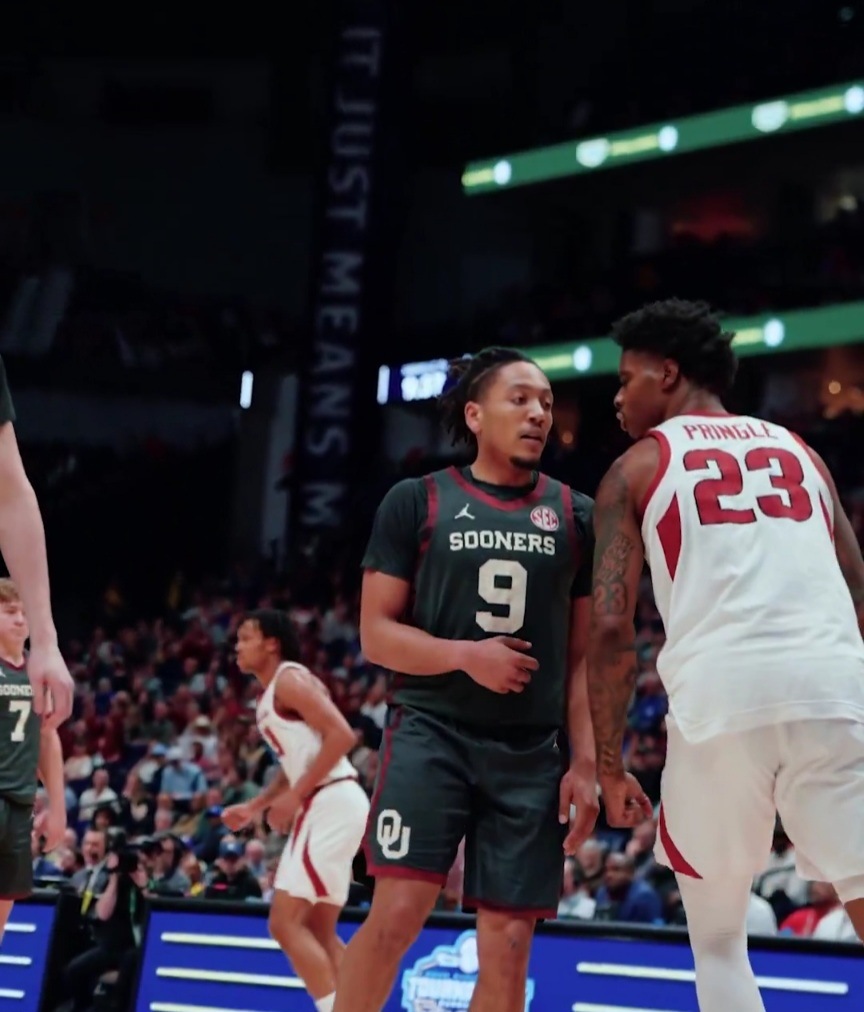
By the time the final seconds ticked away inside Bridgestone Arena and the last three-point attempt clanged harmlessly off the rim, the reality of the moment settled over Oklahoma Sooners men’s basketball.
It wasn’t just that the Sooners had lost a thriller to Arkansas in the quarterfinals of the 2026 SEC Men’s Basketball Tournament.
It was the uncomfortable feeling that the shot represented more than the end of a game.
It might have been the end of Oklahoma’s season as an NCAA Tournament hopeful.
And the frustrating truth for the Sooners is this: their late-season surge deserved a better ending. But the math of college basketball selection rarely rewards teams for getting hot only after digging themselves into a deep hole.
That’s why, as the college basketball world waits for Selection Sunday, Oklahoma appears destined to land just outside the field of 68.
A March Run Worth Applauding
First, let’s acknowledge what Oklahoma accomplished in Nashville.
Entering the SEC Tournament as the No. 11 seed, the Sooners looked nothing like a team that had stumbled through the middle of the season. They looked confident, organized, and—most importantly—dangerous.
The opening-round win over South Carolina was impressive not simply because Oklahoma won, but because of how they did it. The Sooners shot 60 percent from the field away from home, a level of offensive execution that rarely shows up in postseason play.
Then came the statement game.
Against Texas A&M, Oklahoma didn’t just win—they dominated. From the opening minutes, the Sooners controlled the pace, dictated the physicality, and ran away with an 83–63 victory that provided the type of Quadrant 1 win the NCAA Tournament selection committee values.
For a brief moment, it felt like Oklahoma had turned the corner at exactly the right time.
But March is unforgiving.
The quarterfinal matchup with Arkansas was a reminder of how thin the margin can be in postseason basketball. The Sooners battled for forty minutes before ultimately falling 82–79. When the final three-point attempt missed at the buzzer, the run that had reignited their tournament hopes came to an abrupt halt.
And with it, the uncertainty began.
The Problem With the Résumé
If the selection committee judged teams only on the final month of the season, Oklahoma would be dancing.
But the committee doesn’t do that.
It evaluates the entire body of work.
And that’s where Oklahoma’s case begins to unravel.
The Sooners finished the season 19–15 overall and just 7–11 in SEC play during the regular season. That alone places them in a historically difficult position for an at-large bid. Sub-.500 conference records rarely produce comfortable selections unless the team has elite metrics or a collection of high-end wins.
Oklahoma has some quality victories—wins over teams like Auburn, Texas, and Texas A&M certainly stand out—but the larger picture remains problematic.
The biggest issue is the nine-game losing streak that defined the middle of the season.
For nearly a month, Oklahoma went from a team trending toward the NCAA Tournament to one fighting simply to stay relevant. Loss after loss piled up, and by the time the skid ended, the Sooners’ résumé had taken a hit that would be nearly impossible to repair.
Even the late surge—winning eight of the final eleven games—could only do so much damage control.
That stretch proved that Oklahoma was capable of playing like a tournament team.
But it didn’t erase the losses that came before it.
Metrics Don’t Tell a Comfortable Story
Modern selection decisions are heavily influenced by advanced metrics, and Oklahoma sits squarely in the most uncomfortable territory possible.
The Sooners’ NET ranking around the mid-40s places them directly on the bubble. Historically, teams in that range need either a winning conference record or a strong collection of Quadrant 1 victories to feel safe.
Oklahoma has neither.
Their combined record against Quadrant 1 and Quadrant 2 opponents sits well below .500, and while they do have ten wins across those categories, they also have fourteen losses.
That ratio matters.
It tells the committee that Oklahoma was capable of beating good teams—but also that it struggled to do so consistently.
Then there’s the Strength of Record metric, which evaluates how difficult it would be for an average top-25 team to achieve the same results against the same schedule. Oklahoma’s ranking there sits outside the comfort zone of most at-large selections.
In other words, the numbers reinforce the same conclusion the eye test suggests.
The Sooners were good.
Just not good enough often enough.
Porter Moser’s Program Is Close
If there is a silver lining in all of this, it’s what Oklahoma’s late surge revealed about the trajectory of the program under head coach Porter Moser.
For much of the season, the Sooners looked like a team searching for an identity. Offensive droughts and defensive lapses created long stretches of inconsistent basketball.
But something changed late.
The ball movement improved. The defense tightened. Confidence returned.
By the time the SEC Tournament began, Oklahoma looked like a team no one wanted to play.
And that’s ultimately what makes the situation so frustrating.
The Sooners didn’t fade in March.
They surged.
They just needed that surge to start a few weeks earlier.
The Bubble Is Brutal
The final problem facing Oklahoma is something completely outside its control: the chaos of championship week.
Every year, “bid stealers” emerge in conference tournaments across the country. When a lower-seeded team wins its league’s automatic bid, it takes a spot away from the at-large pool.
That shrinking bubble hurts teams like Oklahoma the most.
Even if the Sooners’ résumé might normally place them on the edge of the tournament field, a few unexpected conference champions elsewhere could push them out entirely.
That’s why most bracket projections currently list Oklahoma as the first team out.
It’s not because the Sooners don’t belong in the conversation.
It’s because someone always has to be the last team left standing outside the door.
The Verdict
So was Oklahoma’s SEC Tournament run enough to earn an NCAA Tournament bid?
Probably not.
And that’s the harsh truth.
The Sooners played their best basketball when it mattered most. They proved they could beat quality opponents and compete with ranked teams on a neutral floor.
But college basketball seasons aren’t judged in two-week bursts.
They’re judged over four months.
Oklahoma’s March surge was impressive. It showed resilience, growth, and the potential of a team that refused to quit.
Unfortunately, the nine-game collapse in January still carries more weight.
When the bracket is revealed on Selection Sunday, the Sooners will likely be watching with the uneasy feeling that they were just one win—or perhaps one fewer loss—away from hearing their name called.
That’s the cruelty of the bubble.
And for Oklahoma, it may be the difference between dancing in March and wondering what might have been.
Follow us on Instagram & Facebook