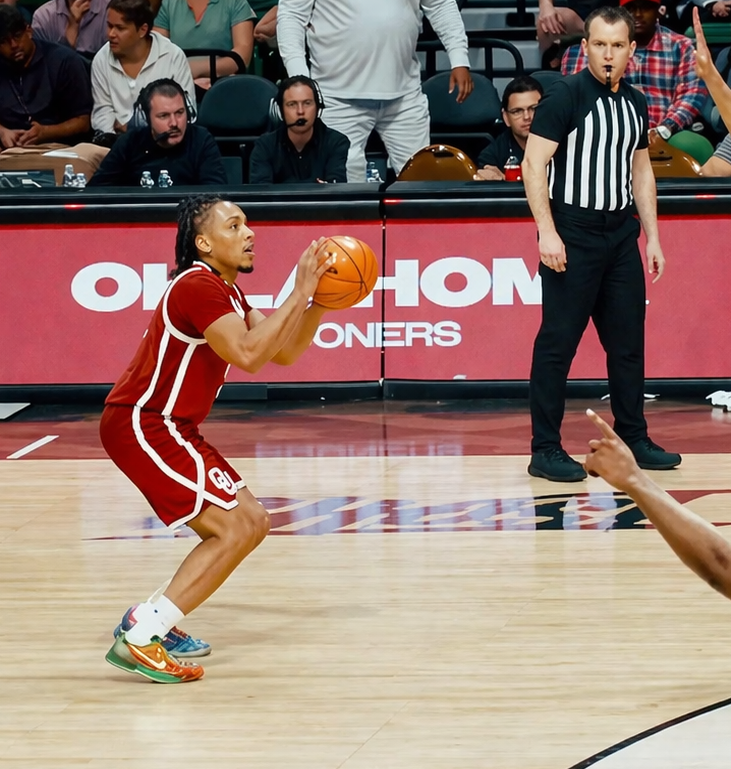
Oklahoma’s 90–86 overtime victory over Colorado in the College Basketball Crown quarterfinals wasn’t just another postseason result. It was a statement. Not about talent—because we’ve seen flashes of that all season—but about something far more elusive and far more important this time of year:
Mental toughness.
And if you’ve watched this Oklahoma team closely over the past few months, you understand why that matters.
Because for much of the season, the Sooners weren’t losing due to a lack of ability. They were losing because they couldn’t sustain belief, composure, or execution when things went sideways. Leads slipped. Cold stretches lingered. Close games tilted the wrong way.
That’s what makes Wednesday night in Las Vegas feel different.
That’s what makes it feel like Oklahoma is still clicking after a late-season push that nearly landed them in the NCAA Tournament.
This Wasn’t Supposed to Be a Win
Let’s start with the obvious: Oklahoma had no business winning this game if you judged it purely on how it began.
The Sooners missed 10 of their first 11 shots. They were out of rhythm, out of sync, and quickly staring at a double-digit deficit. Late in the first half, they trailed 41–31, and nothing about their offensive flow suggested a quick turnaround was coming.
Earlier in the season, that script would have written itself.
Oklahoma would have pressed. Shots would have gotten worse. The deficit would have ballooned. The game would have slipped away before halftime.
But this time, something changed.
Instead of unraveling, the Sooners responded. Back-to-back three-pointers in the closing moments of the half cut the deficit to four, completely shifting the emotional temperature of the game. It wasn’t just a scoring run—it was a reset.
Mentally tough teams don’t panic when things go wrong. They recalibrate.
Oklahoma did exactly that.
The Collapse That Didn’t Break Them
If the first half tested Oklahoma’s composure, the final two minutes of regulation tested its resolve.
After fighting all the way back and building a 74–67 lead with under two minutes remaining, the Sooners were in control. They had done the hard part. They had seized momentum. All that remained was closing the door.
Instead, Colorado’s Barrington Hargress ripped it wide open.
Seven unanswered points. A game-tying layup with 1.6 seconds left. Overtime.
That’s the kind of sequence that has haunted Oklahoma this season. It’s the exact scenario that, in January, would have led to a deflated overtime performance and another mark in the loss column.
Because when you lose control late, it’s rarely just about execution. It’s about psychology. Doubt creeps in. Shoulders tighten. The moment gets heavier.
So here’s the question that defined this game—and may ultimately define Oklahoma’s postseason:
What happens next?
This time, the answer was everything.
Nijel Pack and the Anatomy of a Closer
Every team that makes a meaningful postseason run has one. A player who doesn’t just want the moment, but who thrives in it.
For Oklahoma, that player is Nijel Pack.
And in overtime, he didn’t just show up—he took over.
Pack scored six of his 20 points in the extra period, drilling two massive three-pointers that flipped the game back in Oklahoma’s favor. What makes that performance even more telling is context: he hadn’t shot particularly well from deep earlier in the game.
That didn’t matter.
Because closers don’t operate on memory. They operate on belief.
Pack’s willingness to take—and make—those shots after everything that had just unfolded is the clearest sign yet that Oklahoma has found its emotional anchor. A player who stabilizes chaos. A player who turns pressure into opportunity.
That’s not just a luxury in March.
It’s a requirement.
The Discipline That Wins in March
While Pack delivered the highlight moments, Oklahoma’s win was just as much about something less glamorous but equally critical: discipline.
The Sooners went 28-of-32 from the free-throw line, an 87.5 percent performance in a high-pressure environment. Tae Davis was a perfect 7-for-7. Xzayvier Brown calmly knocked down the game-clinching free throws with two seconds left in overtime.
That’s not luck. That’s focus.
Free throws are the ultimate test of mental stability. There’s no defense. No chaos. Just you, the ball, and the moment.
And Oklahoma didn’t flinch.
In a game that swung wildly with momentum shifts, the Sooners controlled the one area that often decides postseason outcomes: the “free” points. That level of execution speaks to a team that understands the details—and trusts itself to deliver them under pressure.
Strength in Numbers
Another sign that Oklahoma is rounding into form is its balance.
While Colorado leaned heavily on Hargress, who poured in 31 points, the Sooners attacked in waves. Four players scored at least 16 points—Pack, Davis, Brown, and Kuol Atak.
That kind of distribution matters.
It means Oklahoma isn’t searching for answers when one option is taken away. It means the offense can adapt in real time. It means different players can step into the spotlight depending on the moment.
Most importantly, it reflects a team that has found its identity.
Earlier in the season, Oklahoma often looked unsure of where its offense should come from in critical stretches. Now, the ball moves with purpose. The roles feel defined. The confidence is shared.
That’s what “clicking” actually looks like.
The Bigger Picture: Timing Matters
Here’s the part that should catch the attention of anyone watching this team closely:
This wasn’t an isolated performance.
Oklahoma is now 7–3 in its last ten games. During that stretch, the Sooners have improved their shooting efficiency, tightened their defense, and—most importantly—won different types of games.
They’ve won comfortably. They’ve won grinding battles. And now, they’ve won a game where everything went wrong—and still found a way.
That last category is the one that matters most in March.
Because postseason basketball isn’t about perfection. It’s about survival.
And teams that survive are the ones that can absorb punches without losing structure, confidence, or clarity.
Oklahoma just passed that test.
More Than Just a Consolation Run
There’s a temptation to view the College Basketball Crown as a secondary stage—a place for teams that fell short of the NCAA Tournament.
But that mindset misses the point.
For Oklahoma, this tournament has become something far more valuable: a proving ground.
A place where a team that spent much of the season searching for itself is now discovering exactly who it is.
A place where mental toughness is no longer theoretical—it’s being demonstrated, possession by possession, under real pressure.
And if you’re projecting forward—whether to the rest of this tournament or even into next season—that matters.
Because the version of Oklahoma we saw Wednesday night is not the same team that stumbled through January.
This one is tougher. Sharper. More connected.
This one believes.
The Verdict
Oklahoma’s overtime win over Colorado didn’t just keep its season alive.
It revealed something.
It showed a team that can recover from a disastrous start, withstand a crushing late-game collapse, and still execute with precision when everything is on the line.
That’s mental toughness.
And more importantly, it’s the clearest indication yet that the Sooners are finally clicking—not just in how they play, but in how they respond.
At this time of year, that’s everything.
And it’s why Oklahoma suddenly looks like the most dangerous team left in the bracket.
Follow us on Instagram & Facebook