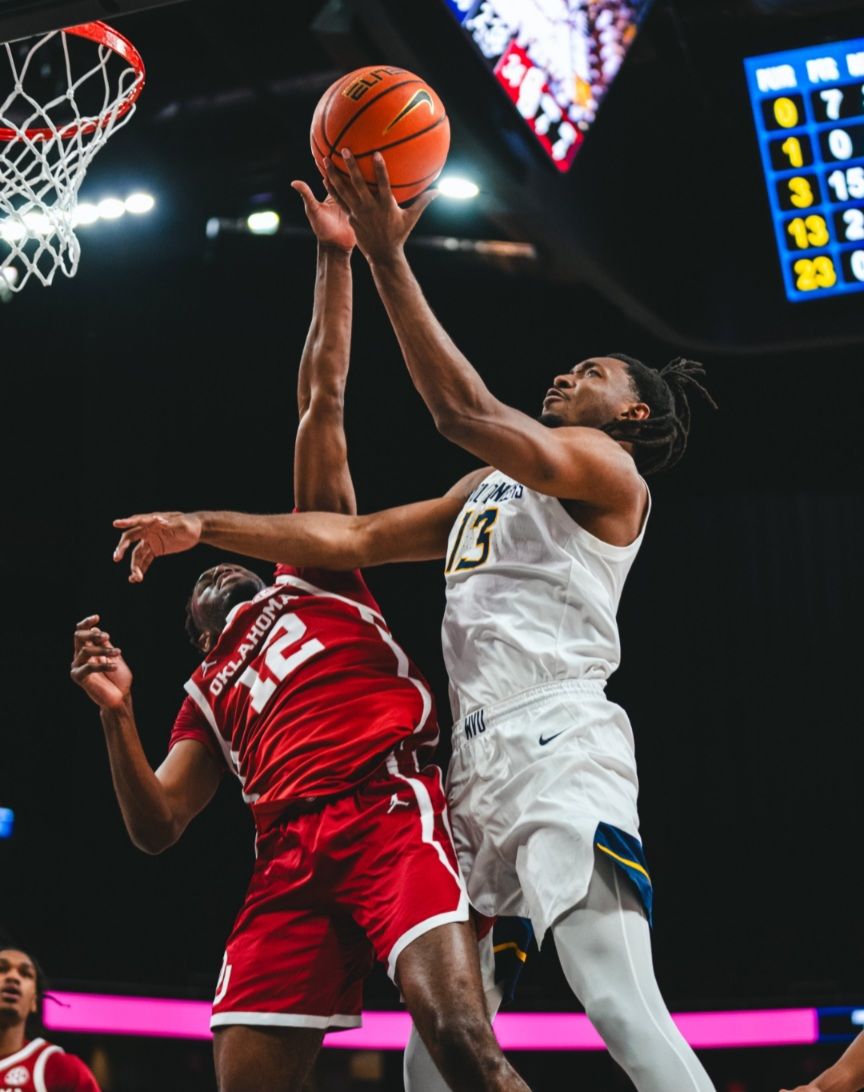
There are box scores that tell you who won.
And then there are games like Oklahoma’s 89–82 loss to West Virginia in overtime—where the numbers don’t just record a result, they expose a truth.
This wasn’t just a championship game in the College Basketball Crown. It was a psychological case study. A pressure test. A revealing, unflinching look at what happens when one team resets under stress… and the other quietly comes apart.
Because the defining narrative of this game wasn’t talent. It wasn’t even execution.
It was resilience versus collapse.
The Moment Everything Changed
Overtime began the way Oklahoma envisioned it.
A quick 6–0 burst. Momentum reclaimed. A double-digit lead earlier in the second half already suggested they were the more stable team. Now, in the extra period, they had control again—82–76 with just over four minutes remaining.
Then came the moment that split the game in two.
West Virginia head coach Ross Hodge called timeout.
Not a panic timeout. A surgical one.
What followed wasn’t a response. It was a transformation.
West Virginia closed the game on a 13–0 run.
Oklahoma didn’t score again.
“Death by Zero” Isn’t Bad Luck—It’s Collapse
Let’s be clear: teams go cold. Shots don’t fall. That’s basketball.
But this? This was something else.
Oklahoma went scoreless for the final 3:19 of overtime—in a five-minute period.
That’s not variance. That’s a breakdown.
At this level, with experienced guards and structured offense, you don’t simply fail to score for that long unless something deeper is happening. Possessions tighten. Decision-making slows. Players stop attacking and start hoping.
The Sooners didn’t just miss shots—they stopped generating them.
Late possessions devolved into stagnant isolations. The ball stuck. Movement disappeared. Confidence drained possession by possession until the offense resembled something closer to survival than execution.
That’s what collapse looks like. Quiet. Gradual. Then suddenly, total.
West Virginia’s Secret: The Reset Button
What makes West Virginia’s performance so striking isn’t just that they took advantage—it’s how they did it.
They reset.
Over and over again.
Start with Honor Huff, who delivered a performance that belongs in any postseason conversation—38 points, complete control, and perhaps most tellingly, 12-for-12 from the free throw line.
In pressure environments, free throws are truth serum. They strip away chaos and reveal composure.
Huff didn’t just score—he stabilized. Every trip to the line was a reminder: West Virginia was not rattled.
They were recalibrating.
The Possession That Defines a Team
But resilience isn’t defined by your best player doing what he always does.
It’s defined by what happens when things go wrong.
Enter Jasper Floyd.
He started the game 0-for-8 from the field. For most players, that’s a night-ending stat line. Confidence erodes. Hesitation creeps in. You become a non-factor.
Floyd did the opposite.
In the defining stretch of overtime, during that 13–0 run, he hit two massive three-pointers—shots that didn’t just erase Oklahoma’s lead, but psychologically flipped the game.
That’s not just shot-making.
That’s a next-play mentality in its purest form.
West Virginia didn’t carry failure with them. They discarded it. Possession to possession. Mistake to mistake. Shot to shot.
That’s what elite teams do.
The Tactical Reset That Oklahoma Never Solved
The timeout wasn’t just emotional—it was strategic.
Out of the break, West Virginia shifted into a 1–3–1 zone, a subtle but devastating wrinkle. It disrupted Oklahoma’s rhythm immediately. Passing angles vanished. Driving lanes closed. The Sooners, already tightening under pressure, now had to process something new.
They couldn’t.
This is where resilience becomes tangible. It’s not just about toughness—it’s about adaptability.
West Virginia adapted in real time.
Oklahoma froze.
Possession after possession, the Sooners looked like a team trying to remember rather than react. By the time they adjusted—if they ever did—the game was gone.
Discipline vs. Desperation
Even the smallest moments told the same story.
Tae Davis delivered one of the biggest plays of the night, forcing overtime with a clutch layup. But late-game basketball doesn’t reward isolated heroics—it punishes lapses.
A critical turnover in regulation.
A foul on a three-point shooter—Huff—in the final minute.
Those aren’t just mistakes. They’re pressure leaks.
And against a team like West Virginia—disciplined, composed, and relentlessly present—those leaks become breaking points.
The Stakes Made It Real
This wasn’t just another postseason game.
The College Basketball Crown has created something real—something with weight. With $300,000 in NIL money on the line, this environment doesn’t feel like a consolation bracket.
It feels like a proving ground.
And pressure doesn’t create character. It reveals it.
West Virginia looked like a team built for this stage—emotionally steady, tactically flexible, and unshaken by momentum swings.
Oklahoma looked like a team still learning how to win when everything tightens.
What This Game Actually Told Us
In the end, the scoreboard reads West Virginia 89, Oklahoma 82.
But that’s not the story.
The story is this:
- One team went more than three minutes without scoring when the game demanded execution.
- The other closed on a 13–0 run when everything was on the line.
- One team tightened.
- The other reset.
That’s the difference.
Not between good and bad.
Between composed and overwhelmed.
Between a team that believes the next possession is its own… and one that starts to wonder if it’s slipping away.
West Virginia never wondered.
Oklahoma couldn’t stop wondering.
And in a game defined by pressure, that was everything.
Follow us on Instagram & Facebook