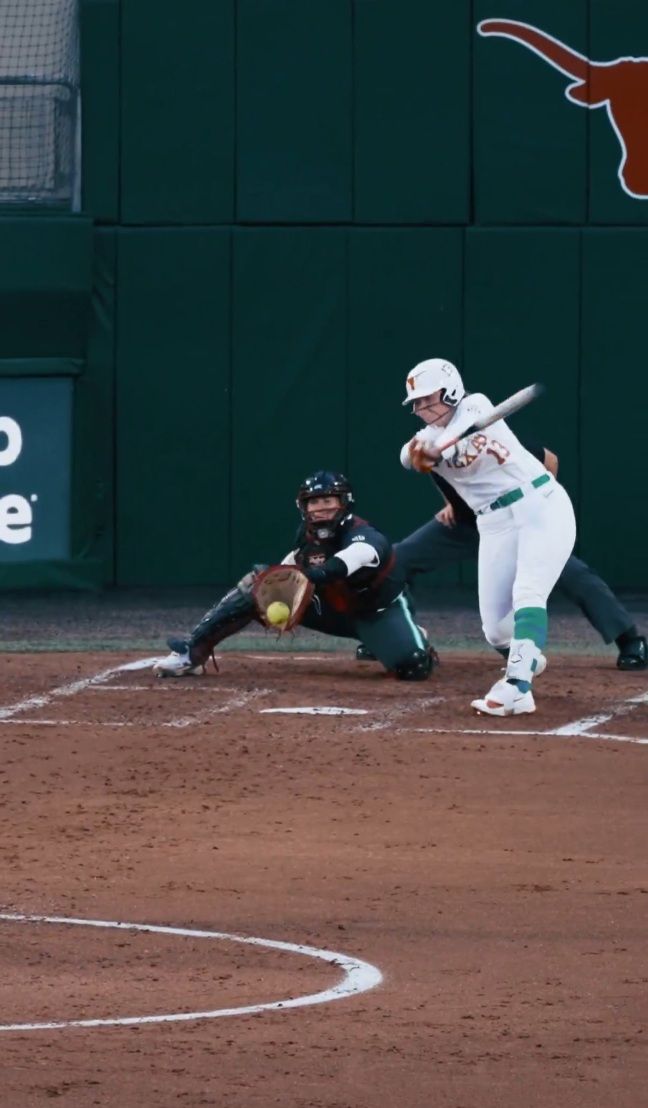
When the margin is one run, the difference isn’t talent—it’s precision.
And on a night where every pitch, every swing, and every defensive decision carried weight, Oklahoma once again proved why it remains the standard in college softball, outlasting Texas 4-3 in a series-clinching win that was defined as much by numbers as it was by nerve.
This wasn’t just a victory in Austin.
It was a data-backed statement.
Here’s how the game—and the series—unfolded inside the numbers.
31 — A Record, A Moment, A Shift
Some numbers carry weight.
Others change history.
Freshman phenom Kendall Wells delivered both with one swing in the fifth inning.
Her three-run home run didn’t just flip a 2-1 deficit into a 4-2 lead—it gave her 31 home runs on the season, breaking the NCAA freshman single-season record previously shared by Lauren Chamberlain, Jocelyn Alo, and Hawaii’s Kelly Majam.
But here’s the deeper layer to that number:
- It came on a 2-2 count
- After fouling off multiple pitches
- In the most pivotal moment of the game
That’s not just power.
That’s control within chaos.
And in a game where offense was difficult to string together, Wells didn’t wait for another opportunity. She ended the inning—and effectively tilted the game—with one swing.
4–3 — Oklahoma’s Comfort Zone
For most teams, one-run games are coin flips.
For Oklahoma, they’re becoming a pattern.
With the win, the Sooners improved to 6-0 in one-run games this season, a statistic that speaks volumes about their late-game execution.
Saturday night reinforced that trend:
- Timely hitting instead of volume offense
- Clean defensive execution in key moments
- Pitching that bends, but rarely breaks
It’s a formula built for postseason softball—where margins shrink and composure becomes the deciding factor.
13 — Comebacks That Define Identity
Early adversity didn’t derail Oklahoma.
It activated it.
Texas struck first in the opening inning and later reclaimed the lead in the fourth, forcing Oklahoma into comeback mode twice.
The response?
Measured. Immediate. Effective.
With Saturday’s win, Oklahoma now has 13 comeback victories this season—a number that reflects more than resilience.
It reflects belief.
Because this team doesn’t chase games. It stays within them long enough for the moment to arrive.
And when it does, it capitalizes.
8–8 — When Hits Don’t Tell the Story
On paper, the box score looks even.
Both teams finished with eight hits.
But the outcome reveals the difference between accumulation and execution.
Texas:
- Eight hits
- Three runs
- Multiple stranded runners
Oklahoma:
- Eight hits
- Four runs
- Two home runs accounting for all scoring
The contrast is stark.
Texas built innings.
Oklahoma finished them.
That’s the defining offensive philosophy of this program—one that prioritizes impact over volume.
0 — Extra-Base Hits Allowed
Perhaps the most underrated number of the night?
Zero.
That’s how many extra-base hits Oklahoma allowed against one of the most potent offenses in the country.
The Longhorns produced traffic—eight hits worth—but none of them changed the geometry of the field.
No doubles in the gap.
No balls off the wall.
No momentum-shifting swings.
Instead, Oklahoma’s pitching staff forced Texas into a ground-ball, small-ball approach—one that requires multiple events to score.
And against a defense this disciplined, that’s a losing equation.
Take A Deeper Dive Into Oklahoma Softball
– The Moment That Changed The Math | Kendall Wells and the New Freshman Standard
– Wells Delivers History, Sooners Clinch Series with 4-3 Win Over Texas
– Ice In Her Veins | Audrey Lowry Didn’t Just Beat Texas – She Redefined What Dominance Looks Like
Exclusively on our subscription page.
6.0 — Guachino’s Controlled Chaos
Freshman right-hander Miali Guachino improved to 12-0 with six innings of work that perfectly encapsulated Oklahoma’s pitching identity.
Her line:
- 6.0 innings
- 8 hits allowed
- 2 walks
- 6 strikeouts
It wasn’t dominance in the traditional sense.
It was management.
Guachino navigated traffic in nearly every inning but avoided the catastrophic frame. She struck out key hitters—like Katie Stewart and Reese Atwood—in critical spots, preventing Texas from stacking momentum.
Most importantly, she retired the final four batters she faced, handing the game to the bullpen with control intact.
30–1 — The Sophomore Backbone
Behind every championship-caliber team is reliability in the circle.
For Oklahoma, it comes in pairs.
Guachino and Audrey Lowry are now a combined 30-1 on the season—a staggering number that highlights both consistency and trust.
Lowry’s role Saturday was different.
After a complete-game shutout the night before, she entered in the seventh inning not as a starter—but as a closer.
The result?
- A strikeout after falling behind 3-0 in the count
- A single allowed
- A game-ending 5-4-3 double play
That sequence defines Oklahoma’s pitching philosophy:
Attack. Adjust. Finish.
4 — Double Plays, Maximum Damage Control
Defense doesn’t always dominate headlines.
But in this series, it quietly dictated outcomes.
Oklahoma has now turned four double plays through two games—each one eliminating potential scoring opportunities and shifting momentum.
Saturday’s biggest?
The final play.
With the tying run on base and the winning run at the plate, Oklahoma executed a clean 5-4-3 double play to end the game.
No chaos. No hesitation.
Just execution.
148 — The Power Identity Holds
Even in a close game, Oklahoma’s identity doesn’t change.
It just becomes more selective.
With two home runs Saturday—one from Gabbie Garcia and the record-breaker from Wells—the Sooners pushed their season total to 148 home runs.
That number isn’t just impressive.
It’s defining.
Because even in a game where they didn’t dominate offensively, Oklahoma still leaned on the long ball to produce all four runs.
15 of 16 — Sustained Rivalry Control
This isn’t just a hot stretch.
It’s sustained dominance.
With the win, Oklahoma has now taken 15 of the last 16 series against Texas—a staggering figure in one of college softball’s most competitive rivalries.
And this one carried extra weight:
- Road environment
- Top-five opponent
- SEC implications
Yet the result felt familiar.
Final Takeaway: Numbers That Travel
The most telling part of Saturday night isn’t any single stat.
It’s how they all connect.
- Record-breaking power
- Efficient pitching
- Situational defense
- Late-game execution
That combination travels.
It works in hostile environments. It holds up in one-run games. And it mirrors exactly what’s required in postseason softball.
Because when the margins shrink, Oklahoma doesn’t need to be perfect.
It just needs to be precise.
And once again, the numbers prove—it is.
Follow us on Instagram & Facebook