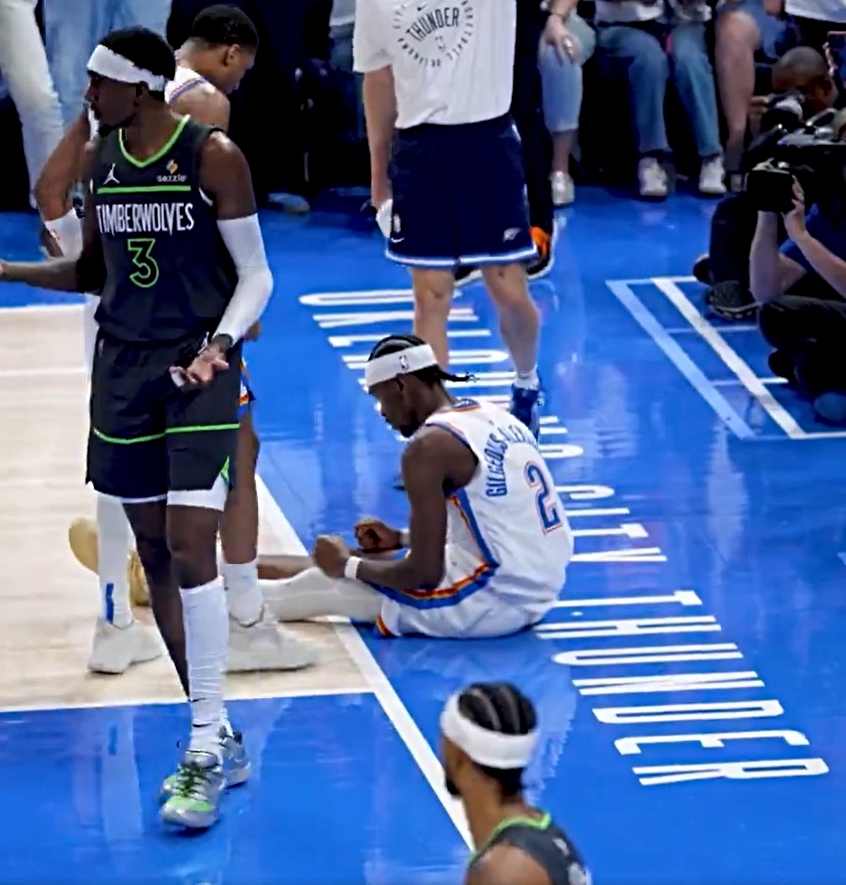
If you’re still looking for a defining characteristic of the Oklahoma City Thunder, stop. It’s not their age, their speed, or even their depth. It’s Shai Gilgeous-Alexander’s resolve. That unwavering, stoic presence — the unshakeable calm that settles over this team in the middle of chaos — isn’t just admirable. It’s contagious. And on Tuesday night, it was the difference.
In Game 1 of the Western Conference Finals, the Thunder didn’t start fast, didn’t dominate wire-to-wire, and didn’t even look especially sharp through most of the first half. But they won, handily, 114–88. And if you want to know why, just follow the arc of their superstar.
Shai shot just 2-of-13 in the first half. Oklahoma City trailed at the break, 48–44, and looked the worse of the two teams — especially considering Minnesota had been off for a week while OKC was still recovering from a grueling seven-game series with Denver.
But that second half? That was something else entirely. Gilgeous-Alexander poured in 20 of his 31 points after halftime on a ruthlessly efficient 8-of-14 from the field. He attacked the rim, pulled up from the elbow, finished through contact, and calmly sank 11-of-14 free throws. He was decisive. He was sharp. And, as always, he was in control.
“I didn’t particularly change my mindset, honestly,” Shai said afterward. “I just tried to continue to be aggressive, trust my work.”
That quote tells you everything you need to know about how this Thunder team plays and why they’re here. There’s no panic, no dramatic adjustments, no knee-jerk reactions. It’s composure, rooted in preparation — and the belief that the right decisions, made consistently, will win out.
The Comeback That Wasn’t Loud — Until It Was
Let’s be clear: this wasn’t an overwhelming blowout from the jump. Minnesota played well early. Julius Randle was lights out in the first half, scoring 20 points and drilling five of his first six three-point attempts. Jaden McDaniels gave the Timberwolves an early spark. Anthony Edwards, while quieter than usual, made his presence felt.
And yet, the Thunder hung around. They didn’t play well. They missed open threes. They turned the ball over. But they stayed close.
That’s where Shai matters most. His presence in the lineup — even when his shot isn’t falling — keeps the floor spaced, keeps defenses honest, and keeps teammates confident. There’s never a sense of panic, because they know their guy is still out there. And as long as he is, they believe a run is coming.
It came in the third quarter.
Oklahoma City went on a 10-0 run midway through the third to flip a 60–56 deficit into a 66–60 lead. Kenrich Williams, who had played just 27 total minutes in the playoffs prior to Game 1, hit a jumper and a three in quick succession. Chet Holmgren’s spinning dunk ignited the crowd. Then came Shai’s three-point play, a prayer of a floater tossed in while falling to the floor, giving OKC a 91–77 lead.
That wasn’t a spark. That was a statement.
Defense Wins… Everything
What’s maybe most overlooked in this Thunder surge is their defense — a suffocating, high-IQ unit that turned the Western Conference’s hottest offense into rubble.
Anthony Edwards, who had been averaging 26.5 points per game in the playoffs, was held to just 18 points on 5-of-13 shooting. He was visibly frustrated postgame, calling out OKC’s paint-packing scheme.
“They bank on us not making shots, I guess,” Edwards said. “Because every time I go to the rim it’s like four people… They put like five, four bodies in the paint, make you kick it out.”
That’s exactly what they do. And it works. Because when you rotate as quickly, communicate as clearly, and recover as consistently as this Thunder team does, you don’t need to be bigger or stronger. You just need to be smarter.
Mark Daigneault once again played with lineup flexibility — mixing in small-ball looks with the two-bigs combo of Holmgren and Isaiah Hartenstein. Off the bench, Cason Wallace showed growth as a playmaker (seven assists), Alex Caruso continued to harass opposing ball-handlers, and Kenrich Williams gave the team a spark it didn’t even know it needed.
The Timberwolves shot just 40.8% from the floor and 10-of-32 from three. Outside of Randle, they couldn’t find a rhythm. By the time Edwards returned from the bench in the fourth quarter, the game was already slipping away.
A Superstar Who Plays Both Ends
That’s where the real value of Shai’s performance comes into focus. It wasn’t just the 31 points, nine assists, five rebounds, or three steals. It was the timing.
He didn’t force it early. He let the game come to him. Then, when it mattered most, he took over.
That’s MVP-level stuff. Not just stats, but impact. Not just flash, but feel. And when you zoom out, what you see is a team that feeds off that energy — steady, calm, and efficient.
The Thunder aren’t a “young team” anymore. Not really. That narrative has worn out its usefulness. They’re a playoff-tested, battle-hardened squad with a legitimate superstar, a top-tier defense, and the depth to withstand just about anything.
They’re not here by accident. And they’re not going away.
Next Up: Game 2
Minnesota will make adjustments. They’re too good not to. Expect Anthony Edwards to get more off-ball looks. Expect more minutes from the Wolves’ bench. Expect Game 2 to be tighter.
But also expect the Thunder to be ready.
That’s the thing about Shai Gilgeous-Alexander and this team. You can punch them early, push them late, and throw them off for stretches. But you can’t knock them out. Not when their best player is the steadiest heartbeat in basketball.
Follow us on X: @SportsHeartland & Instagram