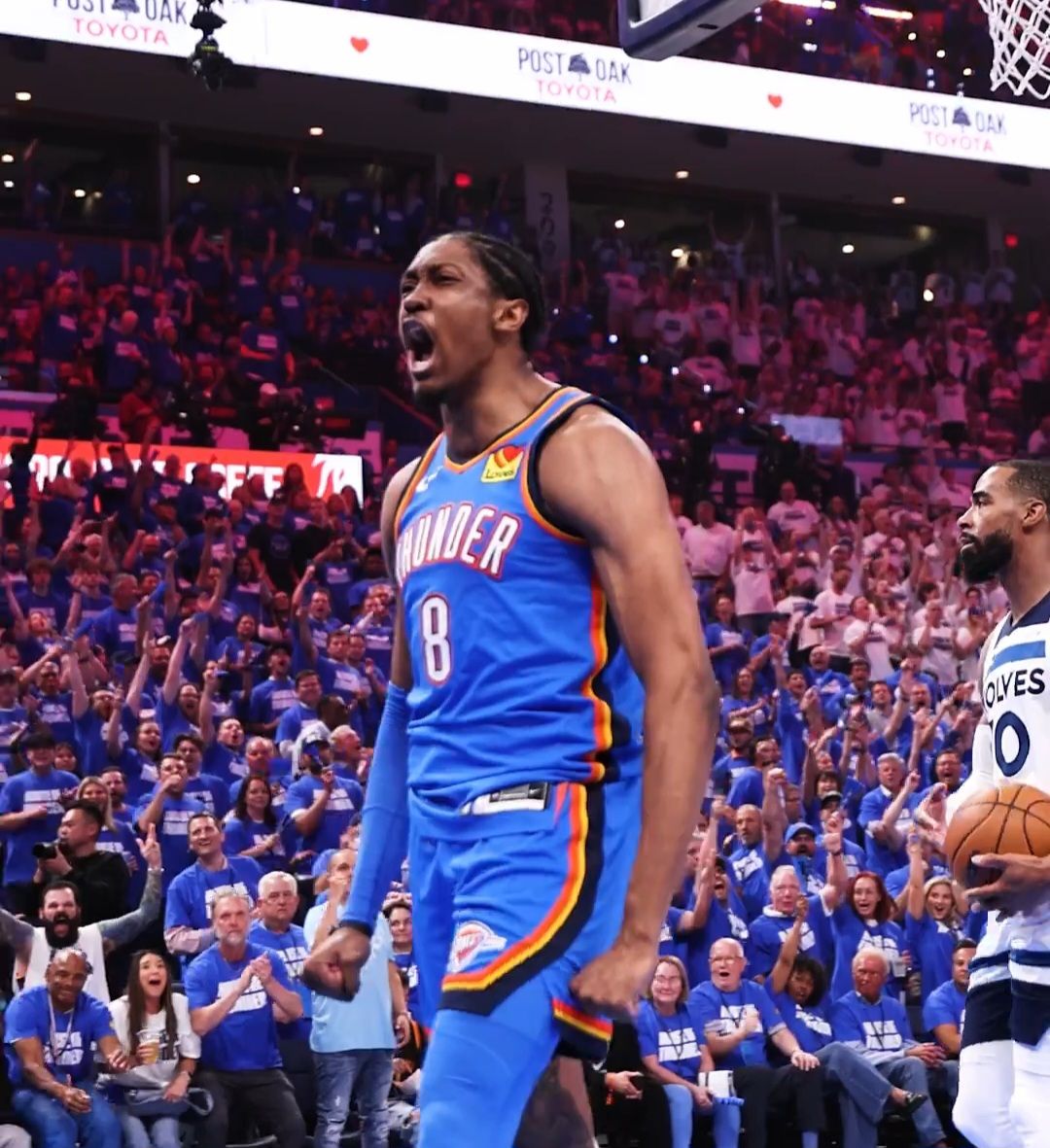
The Oklahoma City Thunder didn’t just clinch a spot in the NBA Finals on Wednesday night — they made a statement that echoed far beyond Paycom Center. Their emphatic 124–94 dismantling of the Minnesota Timberwolves in Game 5 of the Western Conference Finals wasn’t just a win; it was a seismic shift in the balance of power across the league. This was less a basketball game and more a declaration: the Thunder are no longer a team of the future. Their time is now.
For years, Oklahoma City was a team in waiting — young, promising, patient. But the waiting game is over. The 2024–25 Thunder have arrived with a vengeance, and the rest of the NBA should be paying attention. In a league long dominated by superteams and legacy franchises, the Thunder have carved out a different path — one built on grit, culture, and homegrown talent. And in doing so, they’ve become one of the most dangerous forces in basketball.
Let’s begin with the cornerstone of it all: Shai Gilgeous-Alexander. The newly crowned league MVP played like a man possessed in Game 5, putting up 34 points with surgical efficiency. But it wasn’t just about the numbers — it was about the command. Every possession seemed to orbit around him. His poise in the halfcourt, his precision in transition, and his tenacity on defense all screamed of a player who understands both the stakes and his role as the face of a franchise. Gilgeous-Alexander isn’t waiting for greatness anymore. He is greatness.
But what makes this Thunder team so lethal is that it doesn’t rely on just one star. Chet Holmgren, the lanky, cerebral youngster-turned-anchor, played perhaps his most complete game of the playoffs. His 22 points came with quiet confidence, his presence on defense disrupted Minnesota’s rhythm, and his ability to stretch the floor at seven feet tall opened the court in ways few bigs can manage. Holmgren’s potential was never in question — but his polish and poise on this stage are years beyond his experience.
Then there’s Jalen Williams — the unsung hero in a lineup of rising stars. His game doesn’t always scream for attention, but his impact is undeniable. Williams’ efficiency, decision-making, and defensive intensity have made him a vital two-way threat who elevates everyone around him. And finally, there’s Alex Caruso. Every team with championship aspirations needs a glue guy — someone who holds everything together on both ends. For Oklahoma City, that guy is Caruso. Four steals, endless hustle, and a defensive mindset that sets the tone: he’s the connective tissue between raw talent and seasoned execution.
What’s most staggering, however, isn’t just who did it — it’s how. The Thunder didn’t simply outscore the Timberwolves. They outworked them, out-defended them, and out-executed them. Holding Minnesota to just nine points in the first quarter — their lowest output in any period all season — was the kind of early gut punch from which the Wolves never recovered. Oklahoma City forced 21 turnovers and built an insurmountable lead before halftime, turning the rest of the night into a victory lap.
This kind of performance wasn’t a fluke. It was a culmination. Just three years ago, the Thunder were at the bottom of the league, in the throes of a rebuild that many expected would take the better part of a decade. But under the patient, visionary leadership of general manager Sam Presti and head coach Mark Daigneault, Oklahoma City has engineered one of the most remarkable turnarounds in recent NBA history.
They didn’t chase superstars. They didn’t mortgage the future for short-term gain. Instead, they collected assets, drafted with precision, and cultivated a culture of accountability and growth. The result? A team with the second-youngest average age ever to reach the NBA Finals — and yet one that plays with the maturity and composure of seasoned champions.
And the numbers back it up. Oklahoma City’s postseason has been nothing short of dominant. They’ve logged four 30-point wins so far — a feat matched only by the likes of the 1987 Lakers and 2008 Celtics, two of the most iconic title-winning teams of the modern era. This isn’t a group that’s squeaking by. They’re steamrolling, and they’re doing it together.
But what may be most terrifying for the rest of the league is this: the Thunder aren’t satisfied. Listen to their postgame interviews and you won’t hear many mentions of celebration or vindication. Instead, you’ll hear determination. Focus. Purpose. Shai said it best after Game 5: “We’re not done yet.” That’s not just a soundbite. It’s the ethos of this team.
There’s still work to be done. The Thunder now await the winner of the Eastern Conference Finals — either the Indiana Pacers or the New York Knicks. Both are formidable in their own ways, but neither has the combination of athleticism, defensive integrity, and offensive fluidity that Oklahoma City is bringing to the Finals.
And they’re doing all of this with the humility and hunger of a group that knows its legacy is still being written. That’s perhaps the most compelling part of this Thunder narrative: they haven’t just arrived — they’re still ascending.
This isn’t just a feel-good story of a small-market team defying the odds. It’s a model for how to build in the modern NBA. Through vision, patience, and an unrelenting commitment to culture, the Oklahoma City Thunder have become a force to be reckoned with — not just this year, but for years to come.
So go ahead and mark it down. This isn’t a fluke. This isn’t a flash in the pan. This is a new era. The Oklahoma City Thunder are here.
And they’re just getting started.
Follow us on Instagram