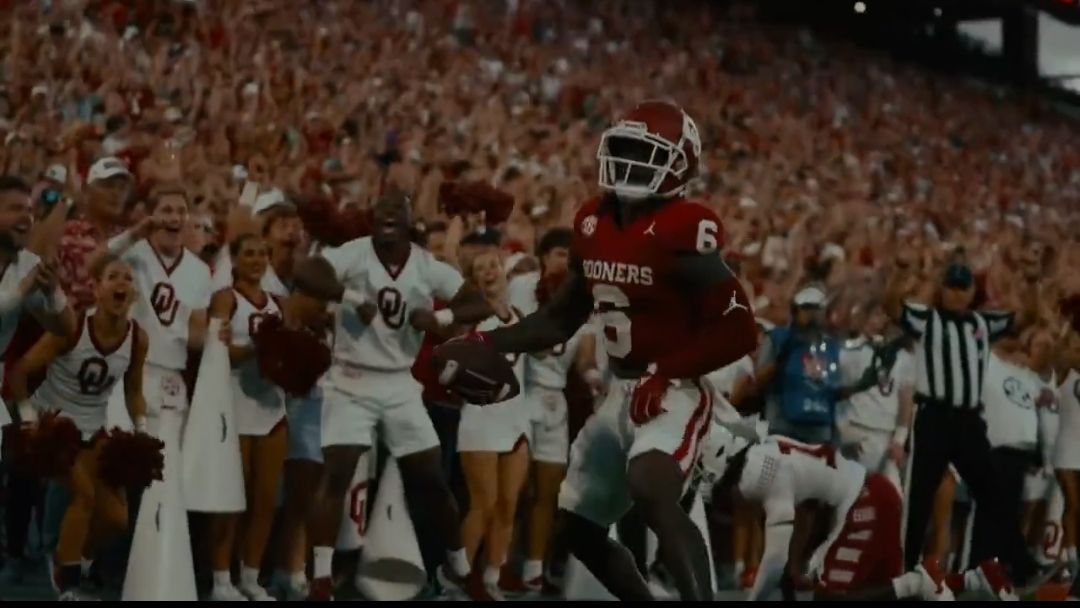
Oklahoma’s 2024 season was a portrait of offensive dysfunction. The passing attack—once the crown jewel of Sooner football—ranked 121st out of 134 FBS teams, averaging a meager 175.8 yards per game. Injuries, inconsistency, and a lack of explosive playmaking all contributed to a year where tight end Bauer Sharp, not a wide receiver, led the team in receiving yards. With an offense that lacked both identity and rhythm, Oklahoma fell into mediocrity.
But with a new quarterback in John Mateer, a fresh system under offensive coordinator Ben Arbuckle, and a trio of key wideouts in Zion Kearney, Isaiah Sategna, and Deion Burks, there’s reason to believe the Sooners’ passing game could be poised for a dramatic rebound in 2025.
Zion Kearney: From Role Player to Reliable Option
Zion Kearney’s freshman season wasn’t supposed to be meaningful. Entering a crowded wide receiver room as a true freshman, the consensus 4-star recruit from Fresno, Texas, was expected to take a developmental role behind veterans like Nic Anderson, Jalil Farooq, and Andrel Anthony.
But the 2024 season had other plans.
Injuries decimated the Sooners’ depth at receiver, and Kearney was thrust into action early. His stat line—8 catches, 128 yards, and a touchdown—won’t turn heads nationally, but it’s the how and when that makes his production significant. He made his first catch against Tulane, led the team in receiving yards against Texas in the Red River Rivalry, and started in the Armed Forces Bowl, where he scored his first career touchdown.
Kearney’s biggest leap, however, has come in the offseason. Arbuckle praised the sophomore’s transformation, especially his growth in confidence. “He’s 6-2, 215 pounds, and he can move and he can catch and he can run,” Arbuckle said. The implication is clear: Kearney’s physical tools aren’t in question—it’s his mindset and comfort level in the offense that will determine his trajectory. If he continues trending upward, Kearney could evolve into a reliable chain-mover and red zone threat for Mateer.
Isaiah Sategna: Veteran Steady Hand and Downfield Threat
While Kearney represents raw upside, Isaiah Sategna offers experience, maturity, and versatility.
The Arkansas transfer arrived in Norman with three years of SEC play under his belt. In 2024, he hauled in 37 passes for 491 yards and a touchdown, numbers that immediately position him among the most productive receivers on Oklahoma’s roster. Perhaps more importantly, he has experience in high-pressure environments and a proven ability to contribute on special teams.
“He’s mentally tough. He’s really smart, he’s played a lot of football,” Arbuckle said, underscoring the trust already placed in Sategna by the coaching staff. That reliability is essential for an Oklahoma offense undergoing transition—not just schematically, but philosophically. Arbuckle needs receivers who will execute his system without hesitation or learning curve issues. Sategna checks that box.
More than just a safety valve, Sategna believes this system will unlock his biggest strength: explosiveness. “John likes to push the ball downfield, and that’s my specialty,” he said. Given Mateer’s deep-ball capability and Arbuckle’s reputation for vertical passing schemes, Sategna could emerge as the most dangerous deep threat in Norman.
If healthy, Sategna projects as a high-volume slot or Z-receiver who can stretch defenses vertically, convert third downs, and help accelerate the learning curve for younger receivers around him.
Deion Burks: The Forgotten Star With Breakout Potential
Among the trio, Deion Burks is the most tantalizing and simultaneously the biggest unknown.
A Purdue transfer who flashed brilliance during Oklahoma’s 2024 spring camp, Burks entered the season looking like a potential breakout star. Then came injury in Week 4 against Tennessee, and outside of one late-season appearance, his impact vanished. His stat line—245 receiving yards, despite missing seven games—only hints at what could have been.
Now healthy and back for his final collegiate season, Burks might be the wild card that transforms Oklahoma’s aerial attack from serviceable to spectacular. At one hundred percent, Burks is a legitimate home-run threat with game-breaking speed. SEC Network analyst Cole Cubelic didn’t mince words: “Dude can freaking go, and if he’s healthy, he’s a problem.”
Burks offers something no other receiver on the roster can fully replicate: dynamic acceleration in space. Arbuckle’s offense thrives on isolating defenders and scheming open space. If he and Mateer can establish chemistry, Burks could easily become the X-factor who swings games in Oklahoma’s favor—especially against the physical defenses of the SEC.
Three Roles, One Goal: Rebuild the Passing Attack
Each of these three receivers brings something different to the table:
- Kearney is a physical, ascending talent with the size and confidence to become a mismatch against smaller corners.
- Sategna is the savvy veteran, consistent and reliable, with the ability to stretch the field and lead by example.
- Burks is the burner, the weapon who can flip the field with one play and completely change defensive game plans.
Individually, they represent pieces of a puzzle. Together, they offer Oklahoma something it lacked all of last season: a balanced, dynamic, and dependable receiving corps.
Why It Matters in 2025
The stakes for Oklahoma couldn’t be higher. Brent Venables enters a make-or-break season. Arbuckle, in his first year in Norman, is tasked with overhauling one of the worst passing games in the Power Four. And new quarterback John Mateer will be judged immediately by how effectively he can command the offense.
That’s why these three receivers are so crucial. They form the core of a rebuilt offensive identity—one that must be competent, explosive, and SEC-ready from Week 1. Oklahoma doesn’t need a Biletnikoff winner at receiver this year. But it does need Kearney to grow into a consistent No. 2 option. It needs Sategna to be the glue and guide in a young room. And it needs Burks to finally be the star many believe he can be.
If those things happen, Oklahoma’s offense could look completely different in 2025—and the nightmare of 2024 might start to feel like a distant memory.
Follow us on Instagram