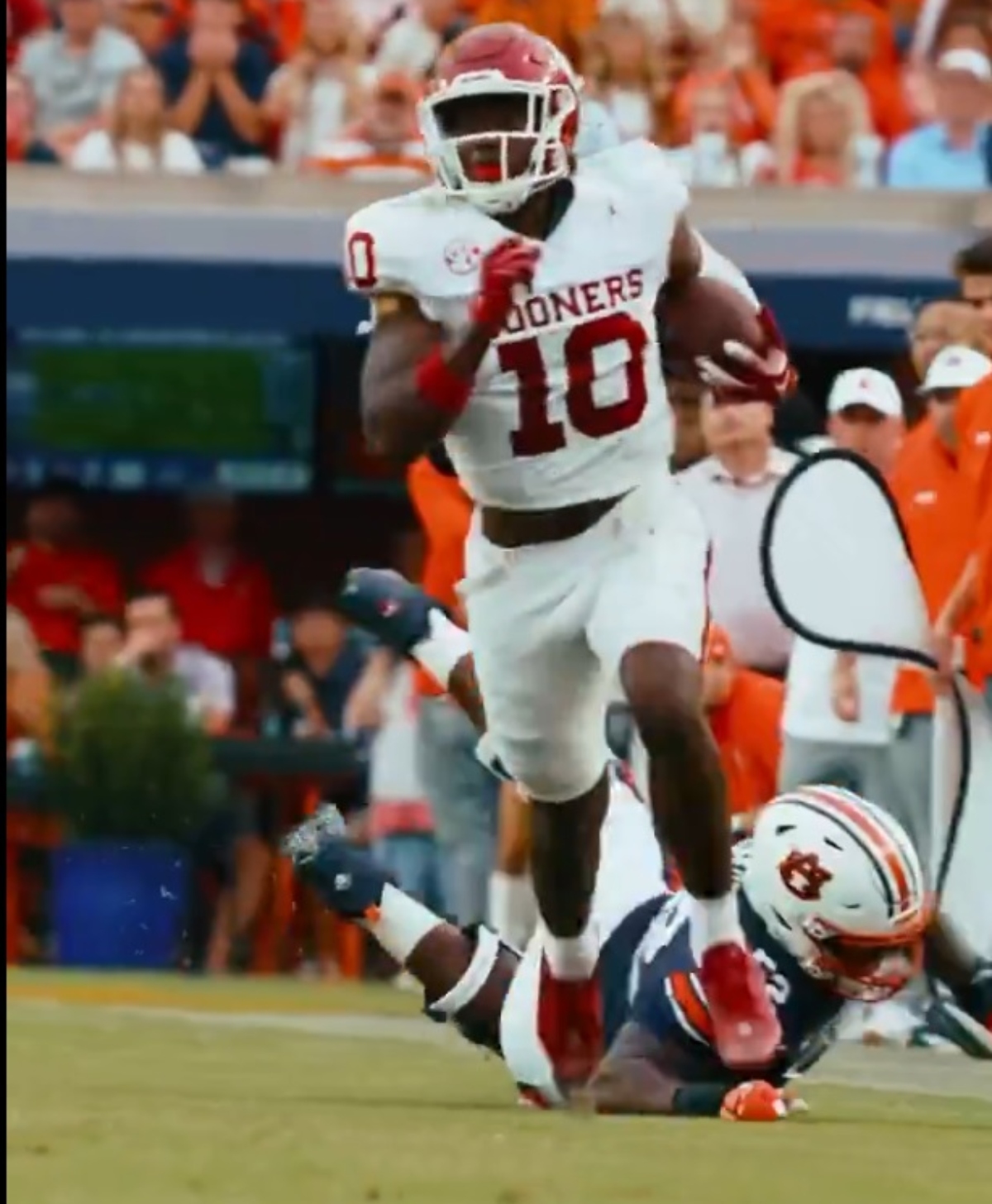
For the first time since Brent Venables took over in Norman, Oklahoma football has decided to move away from its week-to-week captain rotation. Team 131 will instead march into the 2025 season with a fixed group of seven permanent captains — two on offense and five on defense — a bold shift that reflects not just a change in philosophy, but also a calculated attempt to establish continuity and accountability within a program still finding its footing in the SEC.
The move feels symbolic. After a frustrating 6–7 campaign in 2024, Venables appears to be prioritizing stability over variety, continuity over constant change. By anointing a core of leaders to carry the program through the ups and downs of an SEC gauntlet, Venables is betting that this team’s voice will be stronger, clearer, and more unified than in years past.
A Quarterback at the Helm
The headline name among the captains is undoubtedly John Mateer, the Washington State transfer who arrives with enormous expectations. In Pullman, Mateer put up video-game numbers: 44 total touchdowns, over 3,100 passing yards, and 826 more on the ground. But the real story isn’t the stat sheet — it’s how quickly he’s won over his new locker room.
Teammates have described him as “sneaky athletic,” “ultra-competitive,” and, perhaps most importantly, “a natural leader.” Running back Jaydn Ott, himself a transfer, called Mateer one of the first players who stood out when he arrived in Norman. Leadership, after all, is about more than production. Mateer gifted every teammate new headphones, but his credibility comes from sweat equity — attacking workouts, setting the tone in practice, and showing the kind of edge that makes others follow.
That the only newcomer in the group is the starting quarterback is not just fitting, it’s telling. Oklahoma is a program in transition, and while Mateer may not have the crimson pedigree of some of his fellow captains, his presence is a vote of confidence in his ability to steer the Sooners through unfamiliar waters.
The Steady Hand of the Offensive Line
Mateer’s lone offensive counterpart is Troy Everett, a redshirt junior offensive lineman who transferred from Appalachian State. Everett has already embraced the role of tone-setter for a group that must be dramatically better in 2025. Last season, inconsistency along the line derailed offensive rhythm far too often, leaving quarterbacks vulnerable and drives stalling before they could get started.
Everett’s transition from guard to center has been pivotal — both literally, in terms of anchoring the line, and symbolically, as he’s taken on the role of communicator and leader in the trenches. Offensive linemen rarely get the glory, but when your teammates describe you as the one calling for accountability, that says plenty about how Everett is viewed within the building.
A Defensive Line That Demands Respect
If there was any doubt about which unit will define Oklahoma’s 2025 identity, the captain list erased it. Three defensive linemen — Damonic Williams, Gracen Halton, and R. Mason Thomas — were named captains.
Williams, in just his second year after transferring from TCU, has already become the anchor in the middle. Halton, a senior, led the group with five sacks a season ago. And Thomas, the edge rusher who earned preseason All-SEC honors, is already viewed as one of the conference’s most disruptive pass-rushers.
When your offensive linemen are openly telling reporters that they practice daily against “four guys who could be first-round picks,” you know the respect is genuine. This defensive line doesn’t just want to be good; it wants to be the best in America. The fact that three members of the unit were voted captains proves that the leadership isn’t top-heavy — it’s widespread.
The presence of so many defensive linemen also underscores the larger point: Oklahoma football is rediscovering its defensive backbone. For years, the Sooners were mocked as an offensive juggernaut with a paper-thin defense. Venables, a defensive-minded coach, has been working to change that narrative since day one. Seven captains with five coming from the defensive side of the ball? That’s not an accident.
Linebacker Reliability
Kip Lewis rounds out the front-seven representation. A redshirt junior linebacker, Lewis was a full-time starter in 2024 and even earned SEC Player of the Week honors after a standout performance against Auburn. He plays fast, covers sideline to sideline, and, most importantly, has shown a knack for delivering in big moments.
Linebackers have historically been the “quarterbacks of the defense,” and Lewis’ inclusion fits that mold. His leadership bridges the trenches and the secondary, a role that often goes unnoticed but is crucial for communication on the field.
The Veteran Safety
Finally, there’s Robert Spears-Jennings, the senior safety who has been a fixture in Norman since his freshman year. Spears-Jennings had 66 tackles in 2024 and brings invaluable experience to a secondary that has seen its share of growing pains.
With Billy Bowman gone, Spears-Jennings is now the unquestioned leader of the defensive backfield. His presence as captain isn’t just about his production — it’s about stability. He has lived through the growing pains of the Venables era and now has the chance to help guide a young but talented defensive backfield toward consistency.
Why Permanent Captains Matter
Venables’ decision to abandon the rotating captain system is significant. For three years, Oklahoma leaned on a model that allowed a wide swath of players to share leadership duties. The idea was inclusivity — that leadership should be spread, not concentrated.
But inclusivity can sometimes create inconsistency. When no single player is the steady voice week after week, the message risks getting diluted. In shifting to permanent captains, Venables is saying, “These are our guys. This is our voice. Follow them.”
For a program transitioning fully into SEC life, that matters. The Sooners will face Alabama, LSU, and Tennessee in 2025 — programs steeped in tradition, talent, and consistency. Those teams have clear voices at the top. Oklahoma, now, is embracing the same model.
The Verdict
So what does this say about Team 131? To me, it says Oklahoma is serious about establishing its identity — not as the finesse-heavy Big 12 contender of old, but as a balanced, SEC-ready program that takes defense seriously and values grit in the trenches.
With Mateer setting the tone on offense, Everett demanding accountability up front, and a wave of defensive leaders ensuring that Venables’ culture resonates through every practice and every Saturday, the Sooners have created a leadership structure that mirrors the kind of team they want to be: tough, disciplined, and unified.
Will that translate into wins? That’s the ultimate question. But for the first time in the Venables era, Oklahoma has a captain group that feels like a reflection of the program’s desired identity. And if that identity sticks, the Sooners won’t just be surviving the SEC in 2025 — they’ll be competing to thrive in it.
Matt Hofeld is a college football analyst and contributor covering the SEC. Follow him for more Oklahoma and conference-wide analysis throughout the 2025 season.
Follow us on Instagram