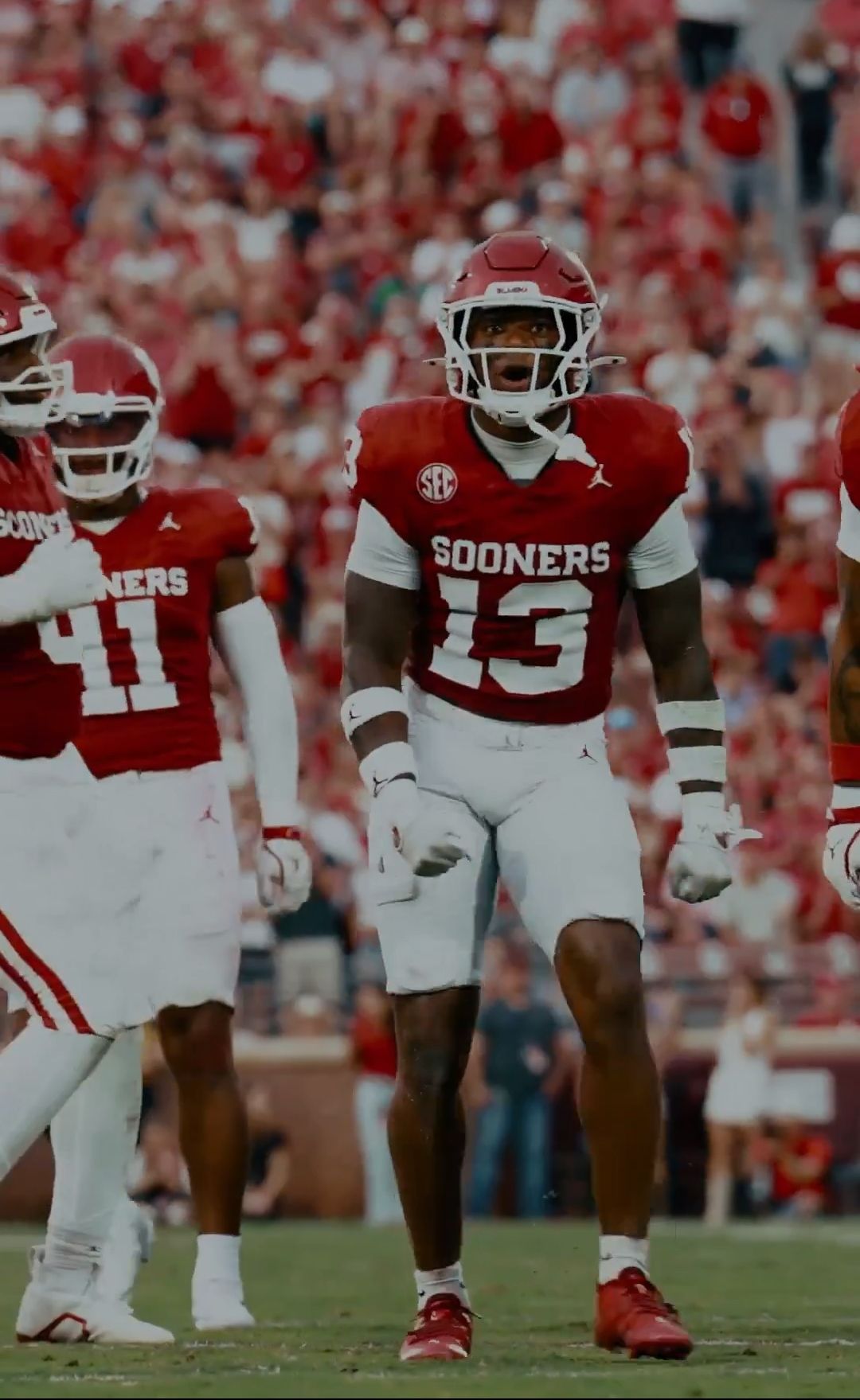
For years, Oklahoma’s defense has carried a reputation that lagged far behind its powerhouse offense. Among the most maligned units has been the safety position, long viewed as a weak link in the Sooners’ chain. Since 2012, only two Oklahoma safeties have been drafted into the NFL, a stunning figure for a program of this stature. But Saturday night’s 35-3 victory over Illinois State may have offered the clearest evidence yet that the tide has turned. With Peyton Bowen and Reggie Powers leading the way in the secondary, and Brent Venables back to calling plays, the Sooners’ defense looked not just competent, but versatile and disciplined — a welcome sight as they prepare for a pivotal showdown with Michigan.
Bowen and Powers Shine
Sophomore Peyton Bowen looked like the player OU fans hoped they were getting when he signed as a five-star recruit. A nagging injury slowed him last season, but against Illinois State, Bowen showed no hesitation, no tentativeness, and no missed assignments. He allowed just one catch for three yards, made a key defensive stop, and — perhaps most importantly — didn’t miss a single tackle. That kind of efficiency has been missing from Oklahoma’s safety play for far too long.
Right alongside him, second-year defensive back Reggie Powers III looked equally sharp. On two targets, he allowed zero yards, added two defensive stops, and, like Bowen, finished the game without a missed tackle. Their ability to rotate seamlessly between strong safety and the “Cheetah” role gave Venables and his defensive staff an element of unpredictability that Illinois State’s offense simply couldn’t solve.
The numbers back it up: according to Pro Football Focus, Powers lined up at 10 different alignments throughout the contest, while Bowen appeared in seven. That kind of versatility doesn’t just keep quarterbacks guessing; it allows Oklahoma to adapt to different looks without subbing, a critical advantage against hurry-up offenses they’ll soon face in SEC play.
“Just seeing those two guys move around and not miss a beat — that’s what you want,” Venables said after the game. “It opens up the whole playbook.”
Depth That Matters
For years, Oklahoma’s problem in the secondary wasn’t just a lack of top-end talent — it was depth. One injury could completely destabilize the defense. But Saturday showed a different reality. Behind Bowen and Powers, captain Robert Spears-Jennings gave steady leadership. True freshman Michael Boganowski and fellow youngsters Jaydan Hardy and Omarion Robinson all saw the field and held their own.
That level of rotation was no accident. Venables made it clear after the game that his staff’s priority is to build a unit where “the standard doesn’t drop” when backups check in. Against Illinois State, 29 different defenders logged snaps, and the defense didn’t flinch.
A Venables Defense Again
There was a noticeable difference in the energy and communication on the field with Venables back as the defensive play-caller. After Zac Alley’s departure to West Virginia, the head coach decided to reclaim those duties — and it paid immediate dividends.
Oklahoma gave up just 151 total yards, including only 34 through the air. The Redbirds managed a respectable 4.5 yards per carry on the ground, but that was largely a result of a few chunk runs from Wright Wenkers, who finished with 50 yards on seven carries. In truth, the Sooners controlled the line of scrimmage and dictated the pace.
The only points Illinois State scored came after John Mateer’s interception gave the Redbirds the ball inside the Sooners’ 25-yard line. Even then, OU’s defense forced a quick three-and-out, holding them to a field goal.
Illinois State head coach Brock Spack didn’t mince words: “We lost that game in the passing game on both sides of the ball.” His frustration was a direct credit to Oklahoma’s secondary, which smothered receivers and allowed virtually no separation.
Standouts Beyond the Safeties
While Bowen and Powers drew the headlines, the rest of Oklahoma’s defense showed promising signs as well. True freshman cornerback Courtland Guillory justified the buzz he generated in fall camp, playing physical man-to-man coverage and breaking up multiple passing lanes. “He looked like he belonged out there,” Venables said. “That’s not something you always see from a freshman in his first game.”
On the defensive line, Taylor Wein made his presence felt with a sack and the hit that knocked Illinois State quarterback Tommy Rittenhouse out of the game. Todd Bates’ and Miguel Chavis’ group set the tone early, generating pressure even without blitz help. Edge rusher R Mason Thomas led the team in snaps and looked explosive throughout.
The Bigger Picture
No one is going to confuse Illinois State with Michigan or Georgia. The Sooners know that. But for a defense that has been maligned for years — and specifically a safety group that has rarely inspired confidence — Saturday night mattered.
It wasn’t just about shutting down an FCS opponent; it was about how Oklahoma did it. Tackling was crisp. Coverages were disciplined. Players were interchangeable without confusion. And Venables’ fingerprints were all over the play-calling, with a mix of basic alignments and disguised coverages that kept Illinois State guessing all night.
The Sooners were content to play things fairly vanilla, and still, the Redbirds converted just 1 of 11 third downs and averaged only 3.3 yards per play. That is a winning formula, no matter the opponent.
What Comes Next
The real test comes Saturday against Michigan. The Wolverines will bring a physical running game, NFL-caliber offensive linemen, and far more dangerous wideouts than Illinois State could muster. Oklahoma’s safeties won’t just need to be solid; they’ll need to be difference-makers.
But the signs are there. For the first time in a long time, Oklahoma has a safety room that looks deep, versatile, and — perhaps most importantly — reliable. If Bowen and Powers continue to grow into their roles, and if Spears-Jennings and the younger rotation players hold steady, the Sooners might finally have solved a problem that has haunted them for more than a decade.
For a program trying to shed the reputation of being “great on offense, shaky on defense,” that’s not just progress. That’s transformative!
Follow us on Instagram