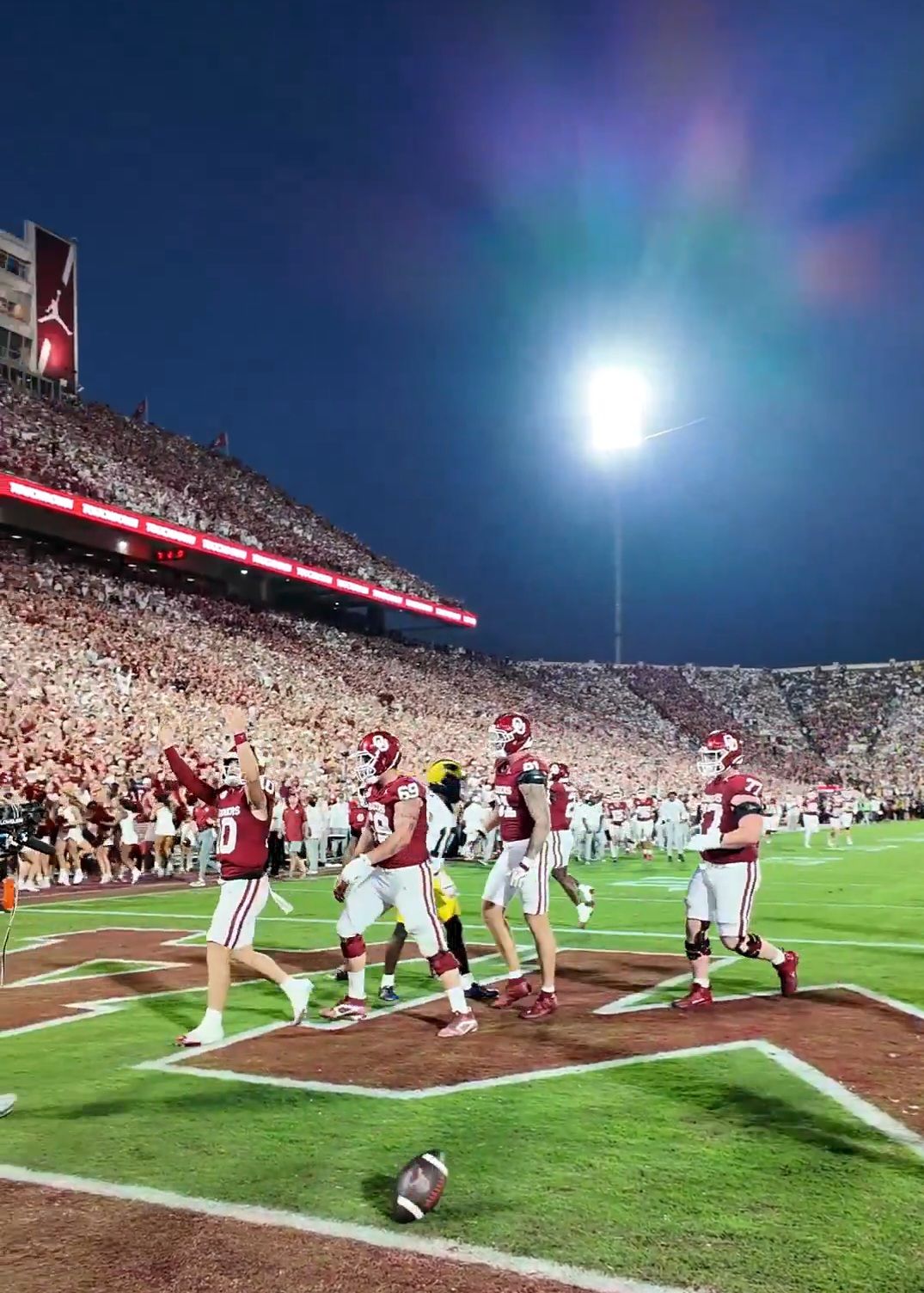
For the better part of a decade, Oklahoma football has been chasing balance. The Sooners could always score, but too often they lacked the defensive toughness needed to win the games that mattered most. On Saturday night in Norman, that narrative flipped. In a 24–13 victory over No. 15 Michigan, Brent Venables’ team showcased a defense that suffocated one of college football’s most physical programs, while transfer quarterback John Mateer provided the spark Oklahoma’s offense has been missing.
This wasn’t a game defined by Oklahoma’s flash. It was defined by grit, defense, and the kind of quarterback play that gives a fan base hope for more than just relevance. John Mateer, the Washington State transfer who stepped into his first marquee test as a Sooner, didn’t flinch. He threw for 270 yards, ran for 74, and accounted for three touchdowns. He wasn’t perfect—an interception and a few missed throws kept Michigan within striking distance—but he was relentless. Mateer kept drives alive with his legs, absorbed pressure without folding, and made the kinds of off-schedule plays that have been missing in Norman. As ESPN’s broadcast noted, “Mateer seemed impossible to sack.”
More importantly, Venables’ defense looked like something pulled from his Clemson glory days. Oklahoma held Michigan to just 288 total yards, limiting the Wolverines to five first downs in the second half. Freshman quarterback Bryce Underwood, the crown jewel of Michigan’s future, looked rattled and overwhelmed. He completed just 9 of 24 passes for 142 yards and went 0-for-8 when blitzed. The Sooners didn’t just beat Michigan; they suffocated them, forcing the Wolverines to retreat into a shell offensively.
That’s the kind of football Venables was hired to deliver. His first two seasons were marred by uneven defensive play and questions about whether the program had lost its edge in the post-Lincoln Riley era. Saturday’s win answered those doubts, at least for one night. Oklahoma’s defense wasn’t just opportunistic—it was punishing. Kendal Daniels’ thunderous hit on Justice Haynes during a screen pass was a snapshot of the night: fast, physical, and intimidating. This absolutely was the type of defensive performance Oklahoma envisioned when it hired Venables four years ago.
The timing of the performance matters, too. This wasn’t Illinois State, Oklahoma’s Week 1 victim. This was Michigan, a program that has made the College Football Playoff a standard and prides itself on physicality. The Sooners didn’t back down. They matched the Wolverines’ punch in the trenches and ultimately wore them down with a late fourth-quarter drive that chewed nearly eight minutes of clock. That 16-play, 78-yard march, capped by a short Tate Sandell field goal, might not show up in highlight reels, but it was championship-caliber football. It was also something Oklahoma couldn’t have pulled off a year ago.
Of course, this isn’t to say Oklahoma has suddenly solved every issue. The run game outside of Mateer remains a work in progress. The Sooners finished with modest production from their backs, and against tougher defensive fronts, that lack of balance could become a problem. Mateer’s gunslinger mentality also means he’ll put the ball in harm’s way from time to time, as seen in his lone interception. And for all their defensive dominance, Oklahoma benefited from Michigan’s inexperience at quarterback and struggles at wide receiver. Bryce Underwood may be special one day, but he wasn’t ready for a night like this.
Still, context matters. Oklahoma came into this season with playoff sleeper whispers, but those were mostly brushed off as wishful thinking. Saturday’s performance gave those whispers real volume. The Sooners now have a top-15 win to bolster their résumé, and more importantly, they look like a team built for the SEC battles looming on the horizon. They can win ugly, they can win with defense, and they can win with a quarterback who isn’t afraid of the spotlight.
Mateer, in particular, feels like the missing piece. His late-game poise, especially on that grinding fourth-quarter drive, gave Oklahoma fans something they haven’t felt in a while: confidence that their quarterback could close out a big game. Mateer kept picking up first downs with his legs, but was far from one-dimensional. He made a lot of great throws in key situations. That dual-threat ability kept the Wolverines on their heels and may keep future opponents awake at night. If he continues to progress, the Heisman chatter mentioned in some postgame takes won’t be far-fetched.
For Venables, this win buys more than breathing room. It buys belief. After back-to-back years of transition, roster retooling, and questions about whether Oklahoma still belonged among the sport’s elite, the Sooners just earned a signature victory over one of the bluest of blue bloods. They’ll move up in the polls, but more importantly, they’ll move up in national perception. No longer just a team in rebuild mode, Oklahoma now looks like a contender.
The Sooners were the faster, stronger, and more physical team on Saturday night. They were fueled by a defense that finally looked the part and a quarterback who played with fearlessness. The fans in Norman left the stadium believing their program is back on track, and for once, the evidence supports that belief. Oklahoma may not yet be the finished product Venables envisions, but after dismantling Michigan, the Sooners don’t just look improved—they look dangerous.
Saturday wasn’t just about a win over Michigan. It was about Oklahoma rediscovering itself. Venables called the defense, Mateer delivered the spark, and the Schooner rolled. For a program hungry for relevance on the national stage, this was more than a victory—it was a statement.
Matt Hofeld is a college football analyst and contributor covering the SEC. Follow him for more Oklahoma and conference-wide analysis throughout the 2025 season.
Follow us on Instagram