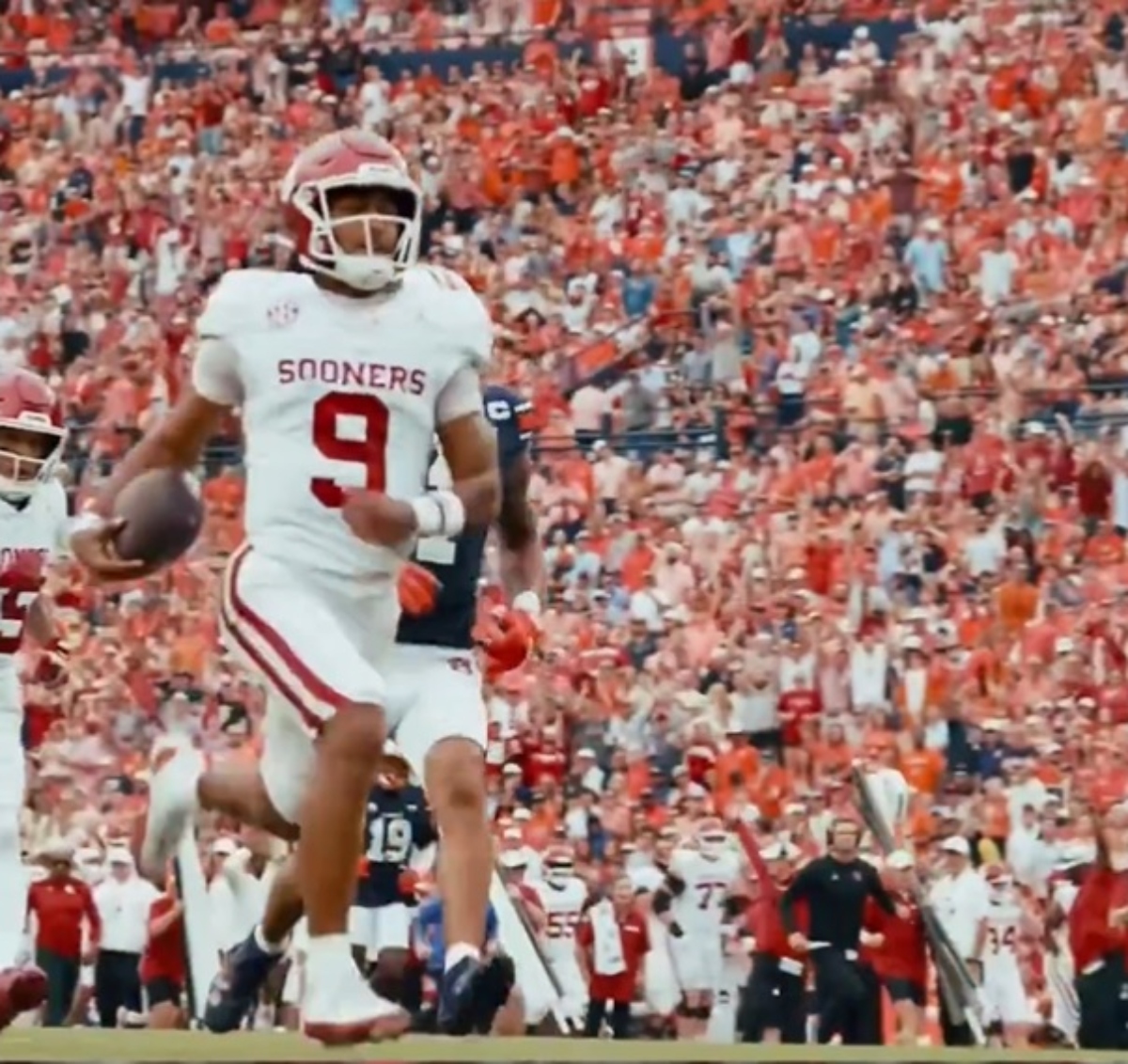
When John Mateer went down and was scheduled for surgery, the coaching staff made the expected move: Michael Hawkins Jr. becomes the starter. But this isn’t 2024’s version of Hawkins, thrust into action with minimal preparation and limited coaching support. Now, as a sophomore, Hawkins has more experience, more seasoning, and a better institutional framework behind him.
In 2024, Hawkins appeared in seven games, started four, and posted 783 passing yards, 204 rushing yards, with three passing and one rushing TD. He completed about 63% of his passes but also had moments of turnover trouble, particularly when he had to carry more of the offense on his back. Those ups and downs are fair for a freshman, especially in a transition season for Oklahoma.
But the difference now is that this time he’s not being thrown in unprepared. Head coach Brent Venables has made it clear that Hawkins has matured. “He’s just grown and matured … This is a developmental game. Mike’s no different,” Venables said. He emphasized that Hawkins has worked on the basics, picked up the offense well, and developed a deeper understanding of both offense and defense.
The presence of strong supporting pieces is also a huge upgrade. In 2025, the Oklahoma offense under Mateer has been elite—massive passing totals, great chemistry with receivers like Isaiah Sategna, Deion Burks, Keontez Lewis, tight end Jaren Kanak, and a better backfield with the rise of Tory Blaylock. That means Hawkins doesn’t have to carry the load in the way he did during parts of 2024.
What Hawkins Must Prove (and Can Leverage)
1. Avoid the “placeholder” stigma
One of the biggest challenges Hawkins faces is perception. Fans, pundits, and even internal critics will see him as a temporary stopgap until Mateer returns. To shift that narrative, Hawkins must consistently manage games, make few mistakes, and show steadiness. One turnover or ill-timed misread could invite criticism faster than we expect.
2. Maintain tempo, protect the ball
Oklahoma’s offensive identity under Ben Arbuckle includes tempo, play-action, and schemed throws. Hawkins has to execute that style at pace, trusting pre-snap reads, quick throws, and letting the run game help him. But even if the run game falters, he must avoid sacrificing ball security. A key metric this season will be Hawkins’ interception and fumble ratio per attempt—if he can keep those in check, the offense can sustain drives.
3. Get comfortable with pressure, not overwhelmed by it
As soon as Hawkins takes the first snap against Kent State, pressure will mount: that games that follow will be against tougher defenses, expectations will creep upward, and comparisons to Mateer’s statistical explosion will swirl. But Hawkins already benefits from having eight games under his belt. Venables noted this won’t be a fresh-faced freshman moment. The “first-time jitters” are likely gone. That experience matters.
4. Leverage weapons & depth
Hawkins is blessed in a way few backups are: his targets are proven, deep, and experienced. Sategna and Burks can stretch the field. Kanak is a safety valve in the seams or in tight windows. The running backs now include a freshmen with juice. Moreover, the offensive line is being built (and recruited) to dominate gaps. If Hawkins can manage the line communication, keep cadence and protection clean, the weapons around him give the staff flexibility to scheme around his limitations.
Risks That Could Derail the Transition
Even with all those positives, Hawkins faces steep traps:
- Turnovers and momentum swings: A pick-six, fumble, or sudden three-and-out could flip a game. Because the spread in many SEC games is tight, one swing can decide whether he “covers” or is retrospectively judged harshly.
- Running game inconsistency: If the run game fails to convert—or if the O-line gets pushed backward—then Hawkins will be forced to hold the ball, scramble, or force throws into tight coverage, which invites pressure or sacks.
- Opponent adjustments: Defenses will scheme against Hawkins differently than they did for Mateer—more pressure, less cushion, disguised looks. Hawkins must show adaptability, quick recognition of blitzes, and poise under shifting looks.
- Expectations burden: Because Oklahoma is 4–0 and was riding Mateer’s Heisman noise, any stumble with Hawkins will be magnified. The optics of a close loss or weak performance could invite unfair criticism. He’ll have to thrive under scrutiny.
Why I’m Optimistic (and Why the Sooners Should Be, Too)
Despite the risks, I believe Hawkins is capable of more than many expect—possibly enough to carry Oklahoma through Mateer’s absence without a collapse.
First, the staff has invested in his development. Venables’ praise of Hawkins’ growth, maturity, and grasp of the offense is not lip service—this is a player they trust. Offensive coordinator Ben Arbuckle provides tailored guidance and structure. That kind of coaching support is a huge boost.
Second, the supporting cast is elite. Few backups get to step into a system midseason with receivers and weapons that already demand defensive attention. Hawkins can benefit from coverage breakdowns, mismatches, and open routes if the defense overcompensates for Mateer-style throws.
Third, experience—something too often undervalued in projections. Hawkins has seen the speed of SEC games, he has lived under pressure, and he’s played meaningful snaps already. That familiarity will make his transition smoother than last year’s scramble. As Venables put it, “some of those first-time jitters are in the past.”
Finally, when teams face adversity with confidence, that’s when culture and identity show. Oklahoma isn’t built around one guy. Their defense, recruiting strength, line depth, and institutional beliefs are real. If Hawkins meets expectations even at 80–90%, OU is still in fine shape.
What Fans Should Watch (Game to Game)
- Turnover margin — A must-win indicator. Hawkins must minimize errors and the defense must make a takeaway.
- Third-down and red-zone execution — Can Hawkins sustain chains? Can he deliver under compression?
- Pressures and sacks allowed — If the O-line holds up, that gives Hawkins breathing room. If not, he’ll be exposed.
- Big throws under duress — Hawkins must show he can make throws when windows shrink or blitzes come.
- Growth week to week, not just flash plays — If Hawkins improves each week in decision-making, reads, anticipation, that consistency is what turns confidence into credibility.
Final Verdict: A High-Stakes Opportunity
Michael Hawkins Jr. has been handed one of the toughest challenges a young quarterback can face: following in the footsteps of a breakthrough star, in a loaded offense, in the middle of the season. But he enters this moment with advantages that he didn’t have in 2024: experience, better supporting cast, committed coaching, and a team identity built around consistency rather than flair.
He won’t be perfect. He may make mistakes. But if he plays within himself, leans on his weapons, avoids turnovers, and commands the offense with poise, Oklahoma will survive—and maybe even thrive—without its expected starter.
And if Hawkins proves that kind of resilience? This becomes more than just an interim chapter. It becomes a statement that Oklahoma’s offense is sustainable, that the quarterback depth matters, and that this program is deeper than the sums of its parts.
The Hawkins’ era, in part, begins now—and what he does in the coming weeks may define not just this season, but the future curve of this program’s offense.
Matt Hofeld is a college football analyst and contributor covering the SEC. Follow him for more Oklahoma and conference-wide analysis throughout the 2025 season.
Follow us on Instagram