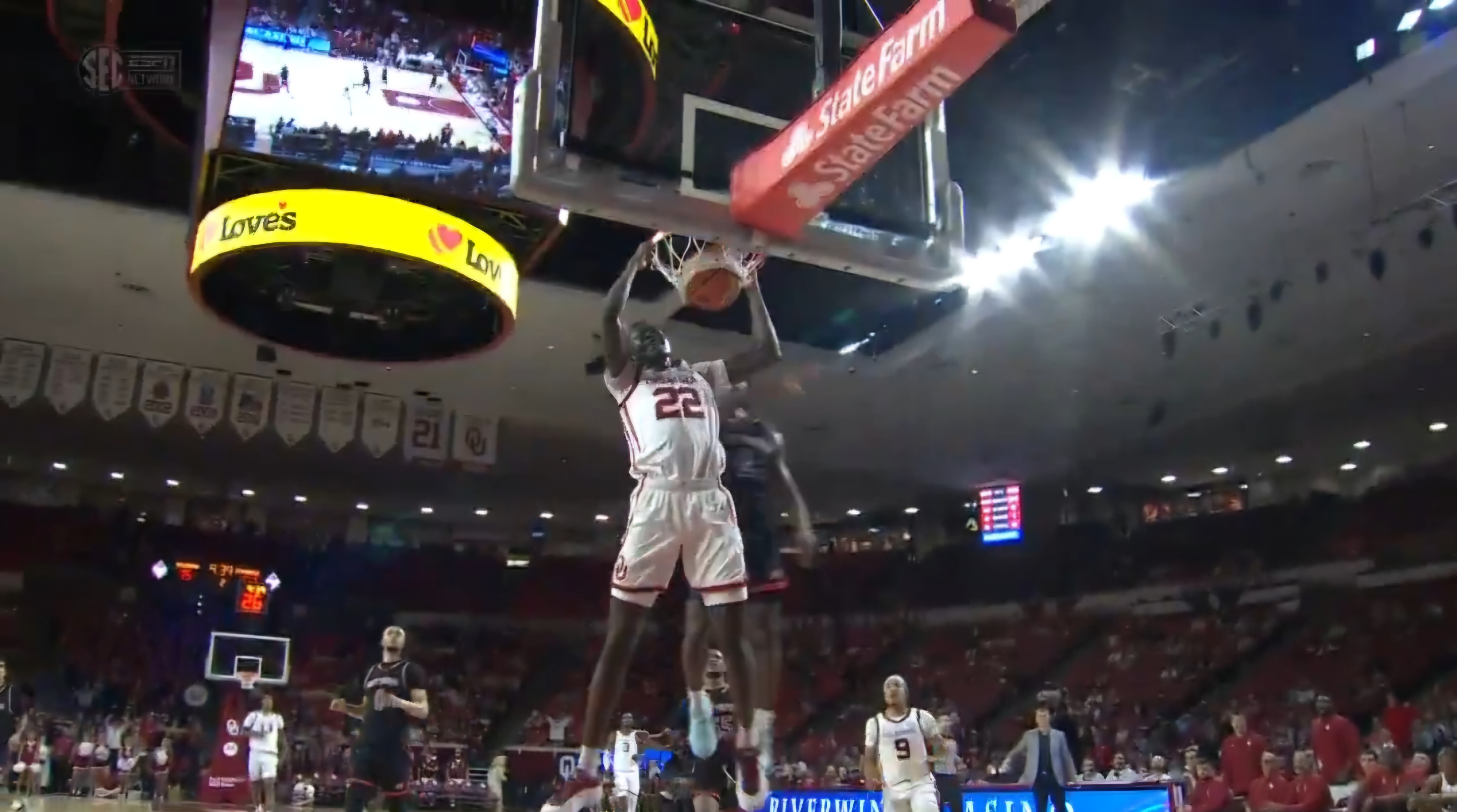
If there was a single takeaway from Oklahoma’s season-opening 102–66 rout of St. Francis on Monday evening, it’s this:
The Sooners may have lost all five starters from a tournament team — but they have not lost their identity. And in Kuol Atak, they may have found their next foundational piece.
The redshirt freshman waited a full year to see the floor. He sat, practiced, lifted, studied, and stayed ready. Then, in the first real minutes of his college career, he walked into the Lloyd Noble Center like he’d been waiting to explode.
By the time the night was over, Atak led the Sooners with 18 points on 7-for-11 shooting, swatting a shot and flashing a skill set that felt part stretch-four, part slashing wing, and part mismatch nightmare.
He didn’t just contribute — he changed the feel of the game.
And on a roster defined by turnover and opportunity, that matters.
This offseason was supposed to be one of skepticism in Norman.
Five starters gone.
Only two players returning who logged points last season.
A portal-rebuilt roster entering the SEC jungle for the first time.
On paper? It’s a recipe for growing pains.
On the court Monday? It was a statement.
Oklahoma wasn’t just talented — it was deep, fast, aggressive, and unrelenting. The Sooners shot 55.7% from the field, buried threes, ran waves of length-and-motor bodies at St. Francis, and played defense with the edge of a team already tired of hearing who they used to be.
They outscored the Red Flash by 35 in the final 20 minutes, turning a one-point halftime margin into a highlight reel of blocked shots, transition buckets, and physical rebounding dominance.
57–22.
20–0 run to blow it open.
Ten team blocks.
Rust? Sure — for a half.
Resolve? That part looked permanent.
The first games of a young college career can go one of two ways:
You dip your toe in the water and blend in.
Or you cannonball into the deep end and force everyone to notice.
Atak chose the latter.
He didn’t force shots. He didn’t hunt the moment. He simply seized it — whether slipping behind the defense for a finish, popping out to space the floor, or putting it on the deck with fluidity that belies his 6-9/192 with seemingly endless length.
More importantly, he played like someone who spent a year preparing, not waiting.
That’s not luck. That’s work.
Porter Moser saw that same mindset across his new roster, especially in Atak and the transfers who debuted alongside him:
“These guys have come in working, not entitled, wanting the right things,” Moser said. “Hey, I’m going to get better here at Oklahoma and also we’re going to be a part of a team that tries to win big.”
Atak isn’t a portal splash. He’s a developmental success — and in today’s college basketball economy, that’s gold.
You need stars, sure. But you also need glue, patience, culture, and dudes who buy in when nobody’s watching.
Atak bought in for a full year.
Monday night was the return on investment.
The headlines will (and should) praise Oklahoma’s portal haul.
Nijel Pack — steady and efficient with 16 points.
Xzayvier Brown — electric, explosive, also 16 points.
Tae Davis — physical, versatile, another 14-point game.
Mohamed Wague (second year transfer from Alabama) — double-double anchor with 16 and 10 boards.
All four proved they belong.
All four fit into Moser’s tempo-plus-toughness blueprint.
But the story that matters long-term?
Atak wasn’t a transfer — and he stole the show anyway.
Titles aren’t built on portal cycles alone. They’re built on continuity and development. Someone has to rise from within.
For Oklahoma, that player might be Atak.
He doesn’t have to be a 20-point scorer every night. He just has to be the versatile, energetic, matchup-problem spark he showed Monday — because teams that make noise in March don’t rely on one or two guys.
They bring weapons off the bench that change the math.
Atak changes the math.
The Sooners are not chasing last year’s version of themselves. They’re reinventing — and doing it faster than most expected.
We learned four things Monday:
- Depth is no longer theoretical.
Multiple lineups worked. The energy didn’t drop. - Defense travels.
Ten blocks, swarming close-outs, a massive second-half rebounding swing. - Experience blends with youth.
Without trying to be leaders, the transfers led. Without hesitation, Atak followed — and sometimes led himself. - There’s ceiling left to hit.
The first half showed nerves and sloppy possessions. The second half showed what happens when things click.
That’s not a warning shot — it’s a foundation.
St. Francis isn’t Gonzaga, nor the SEC gauntlet. The Sooners know that. Monday wasn’t about the opponent — it was about the mirror.
And in that reflection, Oklahoma saw a team with:
- length
- depth
- balance
- rim protection
- unselfish scoring
- next-man-up maturity
And yes, something even more valuable:
A breakout freshman who chose Oklahoma, stayed at Oklahoma, and may now be what lifts Oklahoma to its next chapter.
Moser summed up the defensive turnaround — and metaphorically, the team’s growth curve — perfectly:
“We guarded the dribbler better. We had better team defense. We got back in transition. We just settled down and did so many more things aggressively, but within what we were doing.”
Settled down.
Got aggressive.
Played together.
Trusted the work.
That applies to the second half. It applies to Atak’s rise. And it applies to the season ahead.
One game does not define a team.
But sometimes, it reveals one.
Oklahoma isn’t rebuilding — it’s reloading.
The roster turnover isn’t a weakness — it’s a clean slate.
And the most exciting piece of the puzzle isn’t a veteran at all — it’s a redshirt freshman who waited his turn and then announced his arrival.
Kuol Atak didn’t just debut.
He introduced himself.
If Monday night was the first chapter, Oklahoma fans will want to keep reading.
And if SEC opponents were watching?
They saw the same thing everyone else did:
The Sooners didn’t lose their identity. They’re building a new one — and it might be scarier than before.
Follow us on Instagram & Facebook