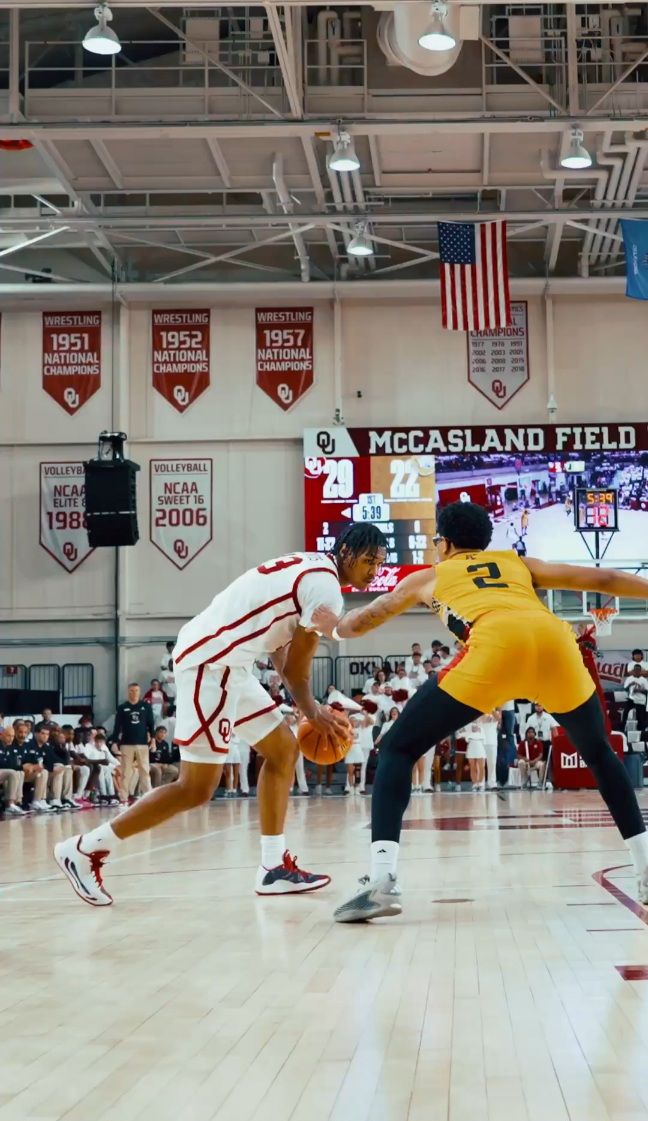
After the sting of a tough road loss to Gonzaga Bulldogs, the Oklahoma Sooners responded in the right way. With a 95-69 victory over Arkansas–Pine Bluff Golden Lions at McCasland Field House on Tuesday night, the Sooners not only got back in the win column (2-1) — they also showcased one of the most encouraging aspects of their team this young season: depth.
In a game where seven different Sooners scored at least two field goals, and nine different players registered points, what stood out was how the supporting cast raised its hand. That kind of balanced contribution isn’t always highlighted in a blow-out win, but perhaps it should be — because it may be the difference between a promising team and a deep one.
It’s easy to focus on the obvious: Xzayvier Brown led all scorers with 19 points, going 7-of-13 from the field and hitting all five of his free throws. But even that stat hides how much else was happening. He chipped in four rebounds, four steals and three assists — a full-court effort with flare.
Just behind him, the uptempo two-guard of the season so far, Nijel Pack, poured in 15 points while making 5-of-7 from three-point range. Pack has now scored in double figures in each of his first three games at Oklahoma, immediately becoming a go-to option off the catch and shoot. Asked about Pack’s shot-making, head coach Porter Moser said, “Nijel is just an elite shot maker, really good.”
And then there was sophomore forward Dayton Forsythe — 15 points of his own in a game in which he diversified his scoring: more than just the “catch and fire” guard role many expected from him. Then you reach Tae Davis: 13 points, but more tellingly 15 rebounds, including 11 offensive boards, giving him his fifth career double-double. That kind of work on the glass matters now, especially given how the frontcourt faltered last week.
Derrion Reid chipped in 12 points on 5-of-8 shooting, rounding out a quartet of players who scored double figures. But the story is bigger than that — eight of the ten Sooner players who saw the floor scored at least five points. The bench mattered. The rotation mattered. For a team still forging its identity, that matters too.
This isn’t to dismiss the reasonable concerns that surfaced in the Gonzaga loss — specifically, Oklahoma’s struggles in the paint, on the glass, and defending physical bigs. But in Tuesday’s win those issues became a smaller part of the story.
Arkansas-Pine Bluff shot 40% from the field and just 28% from three. The Sooners, meanwhile, improved in the second half to 56.7% from the field and 42.9% from long range. That uptick after halftime is key — it signals a team capable of adjusting.
Pack’s 5-of-7 on threes helped open the floor. Brown’s full-court activity created movement. Davis’s offensive rebounds gave second-chance opportunities. What you saw was a team less reliant on one or two scorers and more reliant on movement, spacing, and every player knowing what his turn might look like.
And for Oklahoma — given the turnover this offseason and the roster full of transfers and first-year contributors — that kind of balanced output could be the fastest path to stability.
Wins like this can be misleading. Against a mid-major opponent where Oklahoma held the edge in most facets, it’s easy to write the result off as inevitable. But within the win lies an important clue about what this Sooners team might become.
First, the bench depth: when you have nine or ten players comfortable scoring, it means opponents can’t key on just one or two guys. It means fatigue isn’t as much of a threat. It means the injury substitution risk diminishes.
Second, the guard-centric scoring coupled with forward rebounding signals two things: the guards can shoot and move, the forwards are willing to dirty the work. That mix is essential in modern college basketball — you need the spacing, and you need the physicality. The Gonzaga game showed Oklahoma still needs more physicality inside. The UAPB game showed the spacing and guard work are already good. Now it’s a matter of combining them.
Third, the mental bounce-back factor: after being exposed inside by Gonzaga, facing doubt, this win showed a team that could reset. In the student-only “Boom Squad” white-tee crowd at McCasland, Oklahoma looked like it enjoyed playing together. Confidence is often intangible, but it was visible.
If one player exemplified this “depth and balance” narrative, it was Brown. He led the team in points, but what stood out just as much were the steals, rebounds, and assists. He didn’t just score — he impacted all phases of the game.
7-of-13 shooting is efficient. Adding four steals shows defensive awareness. Four rebounds from a guard? That’s a bonus. Brown attacked, defended, and made plays. In a season where Oklahoma is re-building its identity, he may be the archetype of what the Sooners want their two-guard to be: versatile, impactful beyond his points, willing to take responsibility.
And because Brown’s performance came within a team context rather than at the expense of others, it supports the deeper thesis: Oklahoma isn’t relying on one breakout star tonight, they’re building through supporting roles stepping up.
Of course, no game is without caveats. Arkansas-Pine Bluff is not Gonzaga. The Sooners still have to show they can sustain intensity, uphold defensive standards, and handle SEC-level physicality over time. Their frontcourt still needs to prove itself when paint dominance becomes the key to winning. The rebound battle, for example, remains a priority area.
Echoing that, Coach Moser stressed earlier in the week: “I need more rebounding out of some of our longer guys … we talk about being longer, more athletic, but we’ve got to play that way on the glass.”
So while depth was on display Tuesday, Oklahoma still has a blueprint of what to improve. The beauty of this win is that it gives them space to grow — to integrate freshmen and transfers, to experiment with lineups, to figure out how best to combine their scoring weapons with their length and athleticism.
Looking ahead to their next test (against Nebraska Cornhuskers this Saturday in Sioux Falls), the Sooners will want to see that Tuesday’s balanced output isn’t just for cupcakes. They’ll want it to carry into tougher matchups.
In a season of transition, the Sooners are doing something far more important than wins and losses: they’re finding themselves.
Tuesday’s 95–69 victory wasn’t simply about padding a schedule or making the student section roar. It was about showing that Oklahoma’s roster depth is real, its guards are dynamic, and its forwards are willing to dive into the details.
If the season’s identity is going to be built on versatility, movement, and team-first play rather than one-and-done stars, Tuesday gave one of the best previews of that. Xzayvier Brown’s emergence as a catalyst, combined with contributions all across the roster, signals that this team may not just be climbing — they may be constructing.
Of course, the big tests are ahead. But for now, Oklahoma didn’t just win a game — it reinforced the idea that the days of “can we score?” might be over, and the days of “who contributes?” might be beginning.
Depth may not show up in every stat sheet. But on this Tuesday night, it showed up.
Follow us on Instagram & Facebook