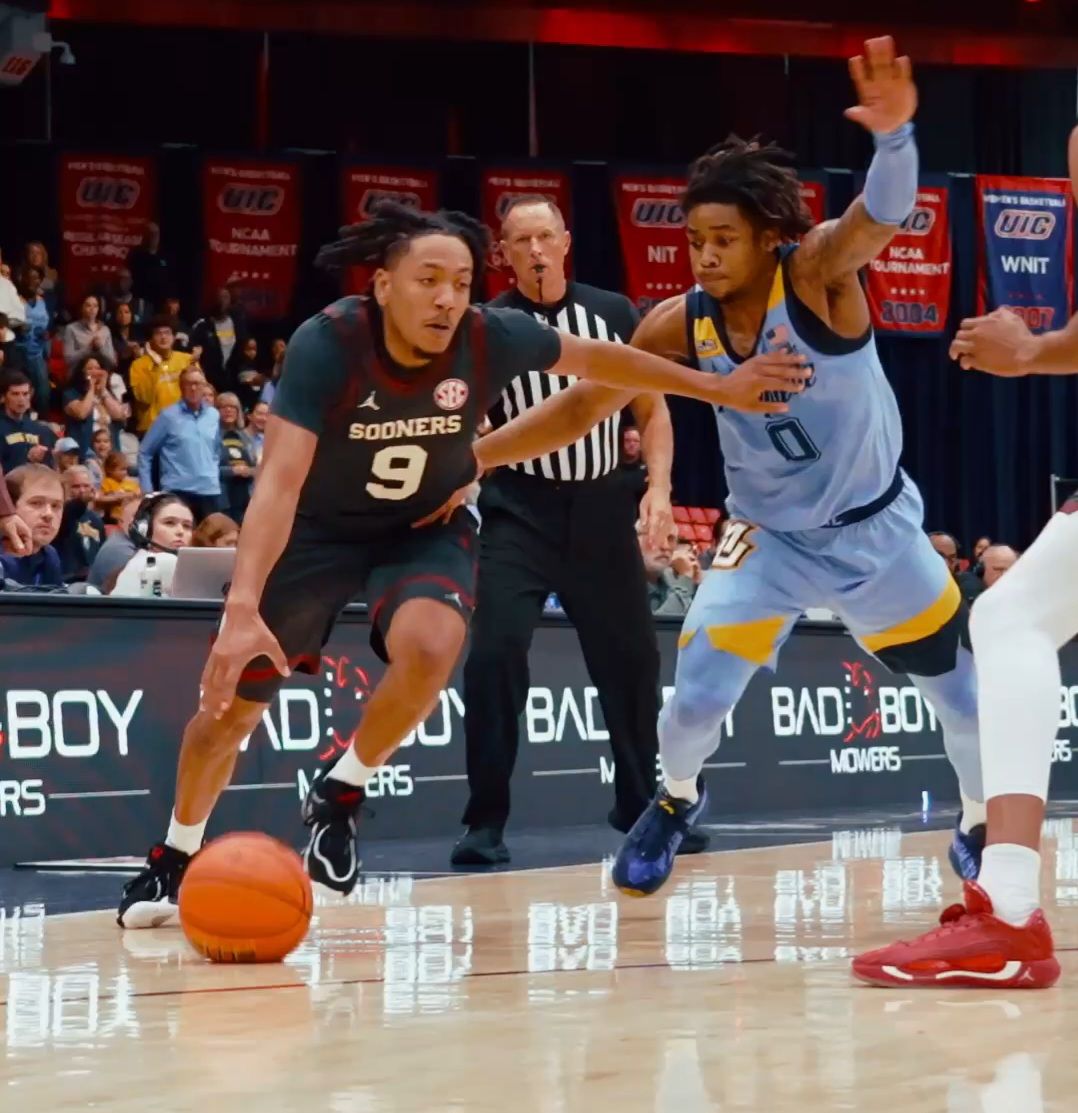
If you’re looking for the moment that “won” the game for Oklahoma against Marquette, the obvious answer is Derrion Reid’s corner three with 35.5 seconds left. The shot broke a tie, tilted the scoreboard, and ultimately decided a 75–74 game that felt like a heavyweight bout.
But that shot wasn’t the story.
It was the consequence of the real story.
Oklahoma didn’t win Friday afternoon at the United Center because it hit one miracle jumper. Oklahoma won because, for once, it trusted its offense, stuck to its defensive assignments, and resisted the temptation to panic when everything tilted sideways.
And that matters more than any single highlight.
This team has talent — that much has been clear for weeks. But against Nebraska and Gonzaga, Oklahoma melted when the game tightened. Against Marquette, for the first time this season, the Sooners didn’t flinch.
They held their line.
The matchup never settled into a rhythm, and neither team let the other get comfortable.
Marquette jumped ahead early. Oklahoma countered. Marquette surged again. Oklahoma answered again. Every run demanded a response, and every response came with a new problem.
When Marquette pushed the lead to double digits in the second half, the old script loomed. This was exactly where Oklahoma had collapsed in prior games — when the opponent landed a punch and the Sooners failed to answer.
But instead of unraveling, Oklahoma went quiet.
Not in effort.
In chaos.
And that changed everything.
There was one unmistakable difference in this game from Oklahoma’s previous losses:
The Sooners didn’t rush.
They didn’t jack contested early-clock threes to “get back in it.”
They didn’t fire hail-mary passes into traffic.
They didn’t hunt a hero.
They hunted advantages.
Nijel Pack’s five threes weren’t desperation shots. They came in rhythm, off movement, after multiple actions forced the defense to bend. Tae Davis didn’t force isolations — he operated as a hub, catching at the elbows, pivoting, delivering passes, and attacking closeouts when available.
When Oklahoma ripped off its 20–5 run that flipped the game in the second half, it wasn’t because someone caught fire.
It was because the ball finally stopped sticking.
Every possession had a purpose.
Every shot had a reason.
That’s called offensive maturity — and it’s something Oklahoma has been searching for.
When Reid rose up from the left corner, it didn’t feel like a moment about bravery.
It felt like a moment about trust.
That is not always the same thing.
Oklahoma trusted Reid because he had already earned it earlier — with rebounding, with weakside defense, and with probably the most under-discussed part of his game: restraint. He didn’t press when his rhythm wasn’t there. He waited. He stayed within structure.
So when that pass came — and nothing else on the floor was clean — the shot didn’t feel forced. It felt inevitable.
There’s a difference.
It’s the difference between desperation and confidence.
Everyone will talk about Pack’s 24 points — and they should.
But the granular detail that buried Marquette late was defense.
For a five-minute stretch in the second half, Oklahoma essentially turned the lights off.
Marquette missed 12 of 14 shots during the window when Oklahoma took control. Not because the Golden Eagles suddenly forgot how to shoot — but because Oklahoma finally defended in space instead of chasing it.
Closeouts were controlled.
Switches were communicated.
Hands were active without fouling.
The paint was protected without overcommitting.
This season has featured too many games where Oklahoma defended reactively. On Friday, they defended anticipatorily.
And that’s an entirely different thing.
The reaction defense scrambles.
The anticipation defense dictates.
On this night, Oklahoma dictated.
Tae Davis: The Stabilizer
Davis didn’t need to be the leading scorer to exert total control of the game.
Nineteen points. Eleven rebounds. Five assists.
But the impact was deeper than numbers.
Every time the pace threatened to run away from Oklahoma, the ball gravitated toward Davis. He didn’t force tempo — he absorbed it.
He posted when a guard rushed him.
He dished when doubles came.
He chased rebounds like they had memory.
That’s what veterans do.
And while Oklahoma still has finishing issues and occasional mental lapses, Davis gave the Sooners something they hadn’t yet possessed:
A calm core.
Pack’s Growth Is More Important Than His Points
There was nothing surprising about Pack scoring in the mid-20s.
What mattered was something else entirely: how he scored.
He hit the early ones in rhythm.
He hit the late ones under pressure.
But the biggest development was that he passed when the shot wasn’t there.
This wasn’t a gunner’s night.
This was a leader’s night.
When Oklahoma trailed, he didn’t try to vaporize deficits with pull-ups. He moved defenders. He drew two and kicked to three. He manipulated defenders instead of daring them.
That’s what great guards do when they learn pace.
And Oklahoma may have just discovered it has one.
This wasn’t an “early December neutral-court win.”
This was a proof-of-concept.
Oklahoma proved it can:
- Execute late-game offense
- Defend through extended stretches
- Protect a lead without stalling
- Handle adversity without unraveling
None of those were certainties before Friday.
Now?
They’re possibilities.
And for a team that just weeks ago looked terminally fragile, possibility is everything.
The Road Ahead Is Still Brutal — But Now It’s WORTH Walking
Wake Forest is next.
Arizona State looms.
Oklahoma State is waiting.
And each one presents the same question, in a slightly different uniform:
Can Oklahoma play like this again?
Not shoot like this.
Not score like this.
Play like this.
If you’re a Sooner fan, this is the version of the team you’ve been waiting to see — the one that doesn’t blink, doesn’t panic, and doesn’t disappear when pressure begins to accumulate.
That version finally showed up.
Now the season can actually begin.
Bad teams survive with lucky shots.
Good teams survive with systems.
Great teams survive with swagger backed by structure.
Oklahoma didn’t win Friday because the buzzer was kind.
They won because they finally acted like a team that deserved to survive a tight game.
And that changes everything.
Follow us on Instagram & Facebook