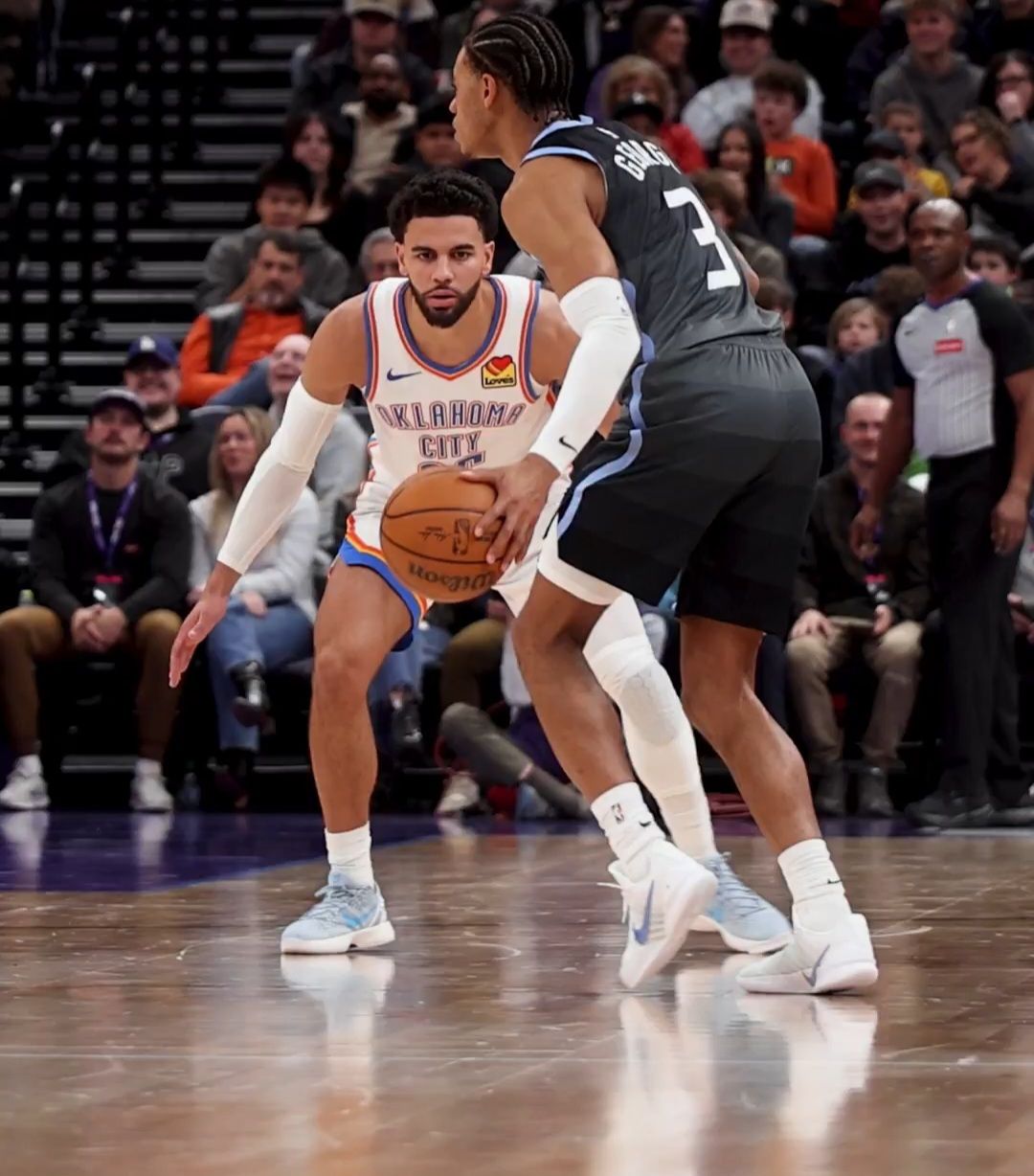
When Shai Gilgeous-Alexander was ruled out Sunday night in Salt Lake City, the expected questions wrote themselves.
Where would the offense come from?
Who would stabilize the tempo?
How would Oklahoma City compensate for the absence of an MVP?
By the end of a 131–101 demolition of the Utah Jazz, the only remaining question was simpler:
How is anyone supposed to stop a team that doesn’t rely on one player to function?
Oklahoma City’s win over Utah was not a survival effort. It was a statement. With seven players on the injury report — including Gilgeous-Alexander, Lu Dort, Isaiah Hartenstein, Alex Caruso, and Isaiah Joe — the Thunder tied a franchise record with their 15th straight win and improved to 23–1 on the seaso.
And they did it by overwhelming the Jazz from the opening possession.
It was 13–1 before Utah recorded a field goal.
It was 43–16 by the end of the first quarter.
It was over long before halftime.
Oklahoma City did not adjust to being short-handed.
They accelerated.
Power Vacuum? What Power Vacuum?
When a team loses its MVP, the expectation is control through committee — slow the game, simplify the offense, grind possessions.
The Thunder chose chaos.
Oklahoma City set a franchise record with 11 three-pointers in the first quarter alone, shooting nearly 65 percent from deep in the opening 12 minutes. They assisted on 15 baskets and committed just one turnover in the period.
It wasn’t just hot shooting.
It was organized aggression.
The ball didn’t stick — it moved. Defenders had no chance to reset. Utah’s rotations collapsed under volume and pace. And by the time the Jazz had managed to create rhythm, Oklahoma City had already turned the gym into a shooting gallery.
The message was immediate:
If you plan to survive against this team by outlasting them, you won’t.
They’ll bury you first.
Without Gilgeous-Alexander, the Thunder’s offense naturally ran through Chet Holmgren and Jalen Williams.
It didn’t hesitate to do so.
The two draft classmates combined for 50 points in just under 48 total minutes on the floor — Holmgren playing 23 minutes, Williams 25. Neither saw the court in the fourth quarter.
That’s not dominance with drama.
That’s dominance with margins.
Holmgren was clinical. He went 12-of-15 inside the arc, finishing with 25 points, nine rebounds, and two blocks. Utah tried contests, late help, and soft coverage. None of it mattered. Holmgren’s touch around the rim neutralized all of it.
Williams, recently returned from wrist surgery, looked freer than he has all season. He posted 25 points on 11-of-19 shooting, added eight assists, and dictated possessions when Utah tried to press.
Without the ball in Shai’s hands, the offense was not reduced.
It was redistributed.
Holmgren controlled space.
Williams controlled pace.
Together, they controlled the night.
Depth gets talked about.
It rarely gets demonstrated.
Oklahoma City demonstrated it.
Six Thunder players scored in double figures. Every active player recorded a point for the second straight game. A lineup missing four rotation guards and two starters looked… deeper than its opponent.
Cason Wallace was everywhere — five steals, four assists, and a game-high +32.
Branden Carlson delivered 11 first-quarter points in his home state.
Aaron Wiggins hit five threes.
Ousmane Dieng dropped 12 on efficient shooting.
Kenrich Williams filled the gaps with rebounds, playmaking, and toughness.
This wasn’t bench production.
This was roster symmetry.
There were no dead zones on the floor. No weak links to exploit. No segment of the rotation to target.
That’s not roster construction.
That’s infrastructure.
The Jazz didn’t roll over.
Kyle Filipowski produced a 21-point, 10-rebound effort.
Taylor Hendricks and Walter Clayton Jr. added 20 each.
And Clayton continues to grow.
“He’s been a score-first guard for most of his life,” Utah head coach Will Hardy said. “So it’s hard when you’re a young guard, and you come in, you’re trying to walk this line of, ‘I gotta get the other guys involved.’”
Clayton was decisive and productive — 20 points, nine assists — but the Jazz couldn’t string stops together. Turnovers snowballed. Oklahoma City scored 27 points off mistakes and turned broken possessions into open threes and uncontested layups.
Hardy was candid about playing time after the game.
“Minutes are earned,” he said. “Standards are clear. There’s a baseline level of execution that needs to happen. Sometimes minutes are the only thing that makes it glaring enough that you have to change some of the things you’re doing.”
Utah did not lack effort.
They lacked answers.
This Is No Longer a Team That Depends on Health
That may be the scariest part.
Oklahoma City does not need perfect conditions to dominate.
They do not need a complete roster.
They do not need star nights across the board.
They do not need favorable matchups.
They need structure.
They need movement.
They need pressure.
They need spacing and trust.
And they bring all of it with them — regardless of who’s in uniform.
Teams built around one superstar bend when he’s absent.
Oklahoma City doesn’t.
It simply reroutes.
The Thunder didn’t just win in Utah.
They exported their system.
And that may be the sharpest edge in the NBA right now.
Because when a team wins comfortably without its MVP — and does it with flow instead of force — it’s no longer about who plays.
It’s about what follows you onto the court.
For Oklahoma City?
It’s a machine.
And it doesn’t shut off when one piece is removed.
Follow us on Instagram & Facebook