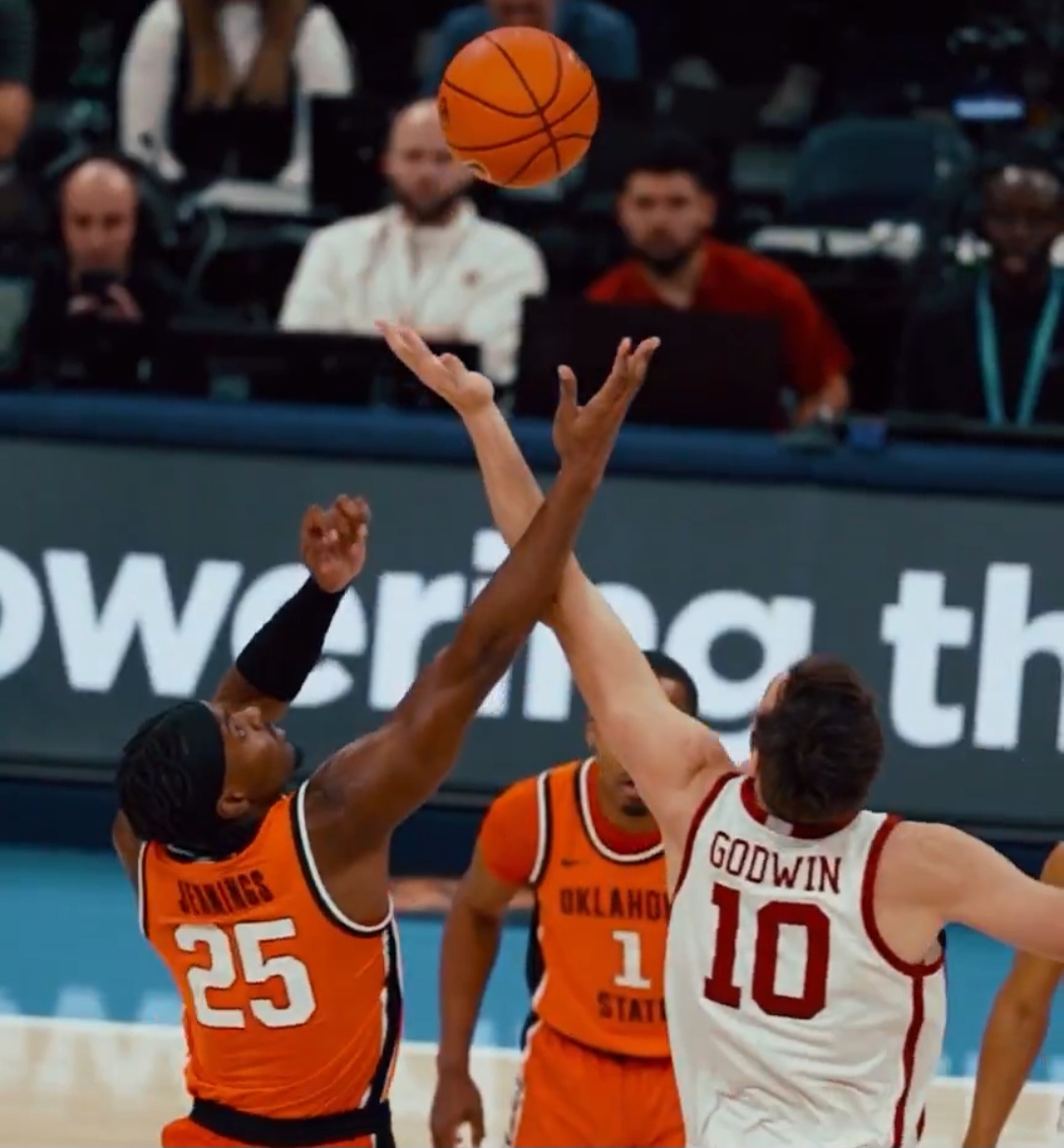
There are rivalry games, and then there is Bedlam.
On Saturday afternoon in downtown Oklahoma City, the Oklahoma Sooners and Oklahoma State Cowboys will meet for the 251st time in men’s basketball — a number that speaks to longevity, bitterness, familiarity, and pride. But this year’s matchup carries something extra: real momentum on one side, real urgency on the other.
Oklahoma State enters the Paycom Center 9–0, one of only eight unbeaten teams left in the country. Oklahoma arrives at 6–3, fresh off a sobering neutral-site loss to Arizona State that halted a three-game winning streak and raised legitimate questions about consistency.
The stakes may not be conference standings — not anymore — but make no mistake: this Bedlam matters.
For Oklahoma State, it’s a chance to prove its fast, fearless style can withstand the heat of a rivalry environment.
For Oklahoma, it’s a chance to show last weekend’s unraveling was a blip, not a warning sign.
And for both? It’s a chance to control the narrative heading into the final stretch of nonconference play.
A Clash of Styles, by Design
The most fascinating element of Saturday’s matchup is how starkly different these two teams want to play.
Oklahoma State plays fast — relentlessly so. Under second-year head coach Steve Lutz, the Cowboys rank seventh nationally in adjusted tempo, averaging 74.6 possessions per 40 minutes. They run after makes. They run after misses. They run because they believe pressure breaks teams before skill ever has to.
Oklahoma, by contrast, prefers structure. The Sooners rank 223rd nationally in tempo at 67.8 possessions per 40 minutes, a gap that feels even wider when watching both teams on film. Porter Moser’s offense values spacing, timing, and patience — not speed for speed’s sake.
Moser acknowledged the challenge this week after getting an up-close look at the Cowboys in Phoenix.
“Our guys got to see them firsthand, the pace they play (with). There’s a lot of respect there for what they do.”
That respect is warranted. Oklahoma State averages 91.3 points per game, ranking 14th nationally, and shoots 50% from the field. The Cowboys don’t just play fast — they score efficiently while doing it.
The question Saturday will be simple but decisive:
Can Oklahoma slow the game without losing control of it?
Oklahoma State: Unbeaten, Unafraid, and Unrelenting
At 9–0, Oklahoma State has passed every test put in front of it so far. Seven of those wins have come at home, two on neutral floors — including last weekend’s 84–78 victory over Grand Canyon in Phoenix, played hours before Oklahoma’s loss to Arizona State.
The Cowboys are deep, confident, and still learning who they are.
That’s not a contradiction. It’s a strength.
Lutz’s roster features 12 newcomers, a mix that could have produced inconsistency early. Instead, it’s created competition. Fresh legs, rotating roles, and constant pressure have become OSU’s calling card.
Vyctorius Miller leads the Cowboys at 15.9 points per game, while Parsa Fallah adds 14.6 points and ranks sixth nationally in field-goal percentage (.685). Jaylen Curry orchestrates the offense, averaging 5.1 assists, and Oklahoma State’s ball movement shows in its 16.9 assists per game.
What makes OSU dangerous, though, isn’t any single stat.
It’s belief.
The Cowboys play like a team that expects chaos — and welcomes it.
Oklahoma: High Ceiling, Narrow Margin
For Oklahoma, Saturday represents an inflection point.
The Sooners have shown they can be dangerous. They average 84.7 points per game, have scored 95 or more in four of nine contests, and recently earned quality wins over Marquette and Wake Forest.
But they’ve also struggled in neutral-site games against power-conference opponents, now sitting at 2–3 in those contests after losses to Gonzaga, Nebraska, and Arizona State.
The most concerning part of last weekend’s loss wasn’t the shooting — it was the loss of control. Oklahoma committed 23 fouls, allowed 33 free-throw attempts, and never recovered from an early avalanche.
That context matters heading into Bedlam.
Because Oklahoma’s path to winning this game isn’t about matching pace. It’s about dictating terms.
Nijel Pack leads the Sooners with 17.2 points per game and has scored at least 13 in eight of nine contests. Tae Davis has emerged as the heartbeat of the team, averaging 13.3 points and 6.8 rebounds while shooting 53.3%, and ranking near the top of the SEC in offensive rebounding.
When Oklahoma is at its best, Davis and Mohamed Wague control the paint, the ball moves side-to-side, and Pack picks his moments instead of forcing them.
When Oklahoma struggles, everything speeds up — and discipline evaporates.
Saturday will test which version shows up.
History Favors OU — But History Doesn’t Play Defense
Oklahoma holds a 144–106 all-time advantage in the series and has won three straight Bedlam matchups, including an 80–65 victory at Paycom Center last season. The Sooners are also 15–6 all-time in the building and have won six of their last seven games there.
But rosters change. Styles change. And momentum certainly changes.
Only two current Sooners — Dayton Forsythe and Mohamed Wague — played in last year’s Bedlam game. Oklahoma State’s roster is almost entirely new.
Saturday won’t be decided by banners or streaks.
It will be decided by who handles discomfort better.
What Will Decide Bedlam
1. Pace Control
If Oklahoma State dictates tempo, the Cowboys will score in bunches. If Oklahoma can force half-court possessions, the game tilts dramatically.
2. Foul Discipline
Arizona State exposed what happens when Oklahoma reaches instead of slides. Against a team that lives in transition, fouls become fuel.
3. Interior Presence
Davis and Wague must be more than contributors — they must be anchors. OSU’s speed means nothing if the paint is controlled.
4. Emotional Poise
Bedlam always brings noise. Saturday brings a packed NBA arena and a doubleheader atmosphere. The team that stays composed will create separation.
Final Word
This game is bigger than a rivalry win.
For Oklahoma State, it’s a chance to validate a perfect record against its biggest rival.
For Oklahoma, it’s a chance to reclaim its footing before nonconference margins disappear entirely.
Bedlam has always been about pride.
This one is also about direction.
Tipoff is noon.
The answers won’t take long.
Follow us on Instagram & Facebook