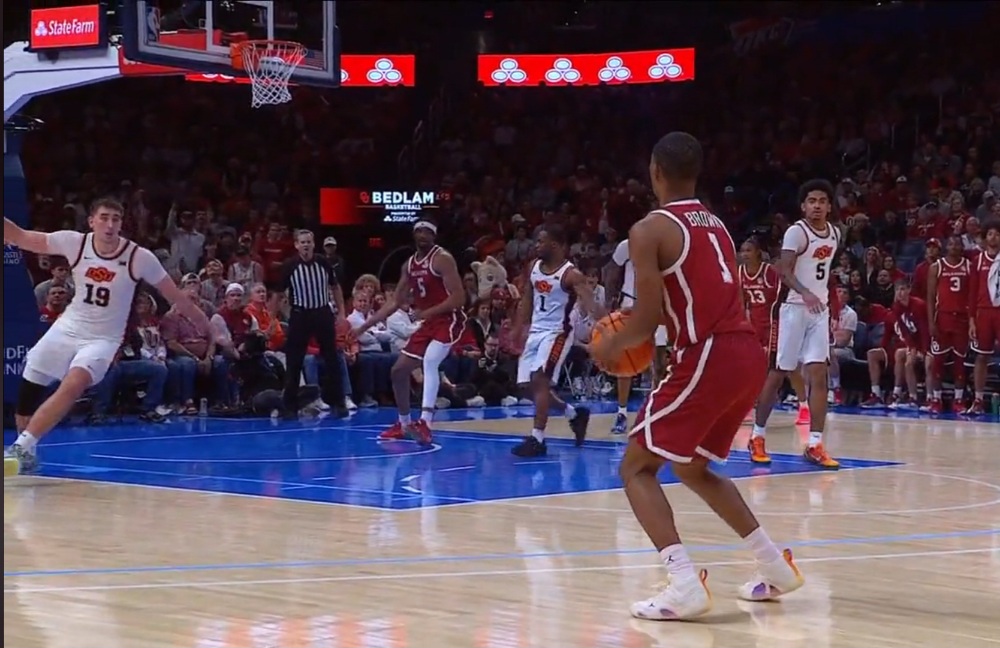
Bedlam never unfolds quietly.
It swings. It surges. It tests nerve.
On Saturday afternoon at Paycom Center, Oklahoma didn’t beat Oklahoma State by dominating the rivalry from start to finish. The Sooners beat the Cowboys by answering every punch that mattered — and by refusing to let one bad stretch turn into a collapse.
That’s how you survive Bedlam.
Oklahoma’s 85–76 win over Oklahoma State wasn’t clean. It wasn’t comfortable. And for long stretches, it felt dangerously familiar — like the kinds of games that had slipped away earlier this season.
This time, though, Oklahoma finished.
And that’s the difference.
Every rivalry game has runs. Bedlam magnifies them.
Oklahoma State made theirs — multiple times. The Cowboys erased a halftime deficit, surged ahead early in the second half, and cut a nine-point lead down to three with under two minutes left.
What separated this Oklahoma team from earlier versions wasn’t shooting alone.
It was response.
When OSU jumped ahead 51–50 early in the second half after Oklahoma State outscored OU 16–9, the building tilted. The noise spiked. The Sooners wobbled.
Mohamed Wague’s split pair at the line with 10:28 remaining gave Oklahoma a 54–53 lead — and the Sooners never trailed again.
That moment didn’t show up on highlight reels.
But it stabilized everything.
Xzayvier Brown Was the Game’s Steadiest Force
Xzayvier Brown’s stat line — 21 points on 6-of-9 shooting — was impressive. His timing was more important.
Brown scored when Oklahoma needed the game to slow down.
His layup with 4:54 left stretched the lead to 72–63, briefly creating separation. When Oklahoma State countered with a 13–7 run, Brown didn’t disappear. He stayed aggressive without forcing shots, playing within structure while still attacking seams.
That balance matters.
In rivalry games, guards often confuse urgency with recklessness. Brown never did. He took what the defense gave him, finished efficiently, and didn’t hunt the moment.
He let it come to him.
If Brown was the stabilizer, Nijel Pack was the release.
Every time Oklahoma State flirted with momentum, Pack hit something that quieted it.
Pack finished with 18 points, including 4-of-9 from three, and those shots weren’t decorative — they were corrective. Each one arrived just as Oklahoma State threatened to speed the game up beyond Oklahoma’s comfort level.
Pack acknowledged the importance of defensive growth after the game, tying Saturday back to a painful lesson earlier this season.
“That loss for us was huge,” Pack said. “For us to give up 100 points (Nebraska), we learned from that. Today, we locked in on the defensive end. Defensively we played much better, and held them under their average, which was great for us.”
That growth showed.
Pack didn’t force offense when OSU made its runs. He didn’t try to erase deficits with one possession. Instead, he trusted spacing, trusted teammates, and punished defensive lapses.
That’s leadership, not volume.
Defense Was Imperfect — But Timely
This wasn’t Oklahoma’s best defensive performance of the season.
But it was its most situationally sound.
After missing their first six shots to open the second half, Oklahoma State went cold again late. When the Cowboys pulled within 79–76 with 1:37 remaining, the margin felt razor-thin.
Then came the stop.
Then came the set.
Then came the dunk.
Out of a timeout, Porter Moser dialed up a look that freed Tae Davis for an uncontested dunk — a possession that felt heavier than two points. It reset the tone. Oklahoma never allowed Oklahoma State to score again.
Moser credited his team’s ability to absorb pressure.
“I thought OSU made a great run and got their crowd into it,” Moser said. “Every time we responded when we took a punch.”
That sentence captures the entire game.
Oklahoma didn’t win this game solely with stars.
Moser leaned into energy late, extending minutes for Jeff Nwankwo, Dayton Forsythe, and Kuol Atak. None filled the stat sheet. All contributed to stability.
Nwankwo defended.
Forsythe spaced.
Atak rebounded and chased shooters.
Against a team that thrives on pace and chaos, those roles mattered.
Bedlam isn’t about five players beating five players. It’s about five players surviving waves — and Oklahoma’s rotation absorbed just enough impact to keep its footing.
Oklahoma State’s Absence Inside Changed the Game — But Didn’t Decide It
Oklahoma State played most of the game without starting center Parsa Fallah, who exited after 10 first-half minutes and spent the second half on the bench with a brace around his lower back.
That absence mattered.
But it didn’t hand Oklahoma the game.
The Cowboys still shot in spurts. They still pressured the rim. They still had four players score at least 16 points. They still cut the lead to three late.
Oklahoma still had to finish.
And it did.
What This Win Actually Means
This wasn’t Oklahoma’s prettiest win.
It wasn’t its most dominant.
It wasn’t its most complete.
It might be its most important.
Earlier this season, Oklahoma lost games like this — games where both teams traded runs, where momentum swung violently, where one lapse could undo 35 minutes of work.
Against Oklahoma State, that lapse never arrived.
The Sooners bent.
They absorbed.
They answered.
Five wins in the last six games now sit on the resume, including victories over Marquette, Wake Forest, and now previously undefeated Oklahoma State — all achieved in different ways.
That versatility matters.
Bedlam doesn’t reward perfection.
It rewards resolve.
Oklahoma didn’t win Saturday because it controlled every moment. It won because it controlled the response when control slipped away.
That’s growth.
That’s maturity.
And with conference play approaching, that’s the kind of win that travels.
The Sooners didn’t just survive Bedlam.
They learned how to finish it.