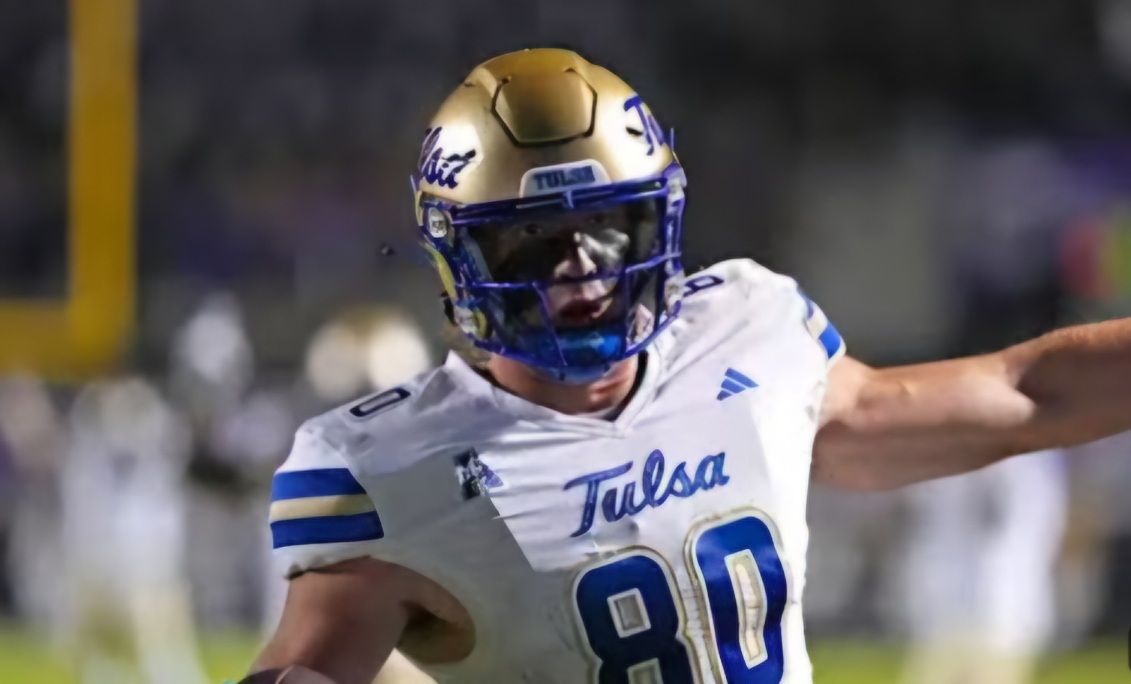
If Oklahoma is serious about becoming a program that controls games in the SEC instead of merely surviving them, then its next transfer portal move at tight end can’t be flashy. It has to be functional. Intentional. And frankly, a little boring.
That’s why Brody Foley makes so much sense.
Not because he’s the loudest name in the portal. Not because he’s trending on social media. But because his football journey — and what he became at Tulsa in 2025 — aligns almost perfectly with what Oklahoma has been missing since it left the Big 12’s comfort zone.
This isn’t about chasing production. It’s about correcting structure.
From Afterthought to Asset
Brody Foley’s college career didn’t follow the modern fast-track narrative. He wasn’t a Day 1 contributor at Indiana. He didn’t arrive as a ready-made mismatch weapon. For three seasons with the Hoosiers, Foley lived in the margins — contributing primarily on special teams, learning the position, and waiting for an opportunity that never quite arrived.
For a lot of players, that’s where the story ends.
Instead, Foley transferred to Tulsa — and everything changed.
Given real snaps, real responsibility, and real trust, Foley emerged in 2025 as one of the most productive tight ends in the country. He caught 37 passes for 528 yards, averaged 14.3 yards per reception, scored seven receiving touchdowns, and even added two rushing scores. That stat line didn’t just lead Tulsa’s tight ends — it placed Foley in rare historical company for the program, marking a level of production the position hadn’t seen in roughly two decades.
More importantly, it showed translation. His game scaled up when the opportunity did.
That matters for Oklahoma.
Oklahoma’s need at tight end isn’t about replacing a player. It’s about replacing a function.
Since entering the SEC ecosystem, the Sooners have repeatedly run into the same problem against physical defenses: once the outside lanes close and timing breaks down, the offense doesn’t have a reliable internal stabilizer. There hasn’t been a consistent presence who can win over the middle, stay on the field regardless of down and distance, and keep the offense from feeling fragile when momentum turns.
In the SEC, perimeter speed alone doesn’t sustain drives.
Defenses are built to erase it.
That’s where tight ends become offensive connectors — players who bridge concepts, convert chaos into manageable situations, and give quarterbacks forgiveness throws when protection leaks. Oklahoma hasn’t had that consistently. And when the offense stalled late in games last season, it wasn’t because the playbook lacked answers. It was because the personnel did.
Foley’s Production Isn’t Accidental — It’s Informative
There’s a tendency to discount Group of Five production as inflated or misleading. Foley’s numbers don’t fit that narrative.
A tight end averaging more than 14 yards per catch isn’t living on checkdowns. A tight end scoring seven receiving touchdowns isn’t an afterthought in the red zone. That efficiency speaks to route discipline, spatial awareness, and trust — the very traits that tend to survive the jump from G5 to Power Five football.
Just as important: Foley wasn’t force-fed targets. He maximized limited opportunities. That suggests a player who understands role value — a crucial trait for portal success.
Oklahoma doesn’t need a tight end who demands eight touches a game. It needs one who turns three touches into first downs and one busted coverage into seven points.
The SEC Geometry Problem — and How Tight Ends Fix It
The SEC is built to suffocate offenses that live outside the numbers. Corners are longer. Safeties are faster. Linebackers are disciplined enough to sit on RPO looks without vacating zones.
A capable tight end changes that geometry.
Suddenly linebackers can’t cheat downhill. Safeties hesitate before robbing routes. Play-action becomes legitimate instead of decorative. And defensive coordinators are forced to declare their intentions earlier — which is where explosive plays are born.
Alabama understands this. Georgia understands this. Ole Miss understands this.
Oklahoma is still learning it.
Adding a tight end like Foley wouldn’t revolutionize the offense. It would unlock it.
Why the Portal Is the Only Sensible Path
This isn’t a developmental cycle problem. It’s a timing problem.
Oklahoma doesn’t need a high-ceiling freshman who might contribute in two years. It needs someone who can line up in September, block SEC edge defenders without protection, recognize coverage rotations on the fly, and hold up physically for an entire season.
That profile almost never comes straight from high school.
The portal provides maturity. Experience. Survivability. Foley has already taken hits. Already adjusted to role changes. Already proven he can produce when responsibility increases.
That’s efficiency — not desperation.
A Quarterback’s Best Insurance Policy
Whether John Mateer remains Oklahoma’s quarterback in 2026 or moves on, the offense needs better answers against pressure.
Tight ends provide:
- Larger catch windows
- Safer throwing lanes
- Reliable third-down options
- Red-zone calm
In Oklahoma’s CFP loss, the offense unraveled not because it lacked talent, but because once Alabama seized the mental edge, there was no stabilizing presence over the middle to reset the game.
That’s a personnel gap — not a schematic one.
Culture Matters More Than Hype
Portal additions don’t just change depth charts. They change locker rooms.
Tight ends like Foley tend to arrive with humility. They block without glory. They accept dirty work. They lead quietly. In a program navigating turnover and identity evolution, those traits matter.
Oklahoma doesn’t need another personality. It needs ballast.
Foley fits that mold.
This isn’t about chasing the biggest portal name.
It’s about making the smartest one.
Brody Foley represents the kind of addition that serious programs make when they understand what actually wins in the SEC: leverage, balance, and control. He won’t dominate headlines in March. But by October, he could be the reason Oklahoma sustains drives, finishes in the red zone, and plays offense from a position of authority instead of urgency.
Oklahoma doesn’t just need a tight end.
It needs this kind of tight end.
And that’s why Brody Foley belongs squarely on the Sooners’ portal board.
Follow us on Instagram & Facebook