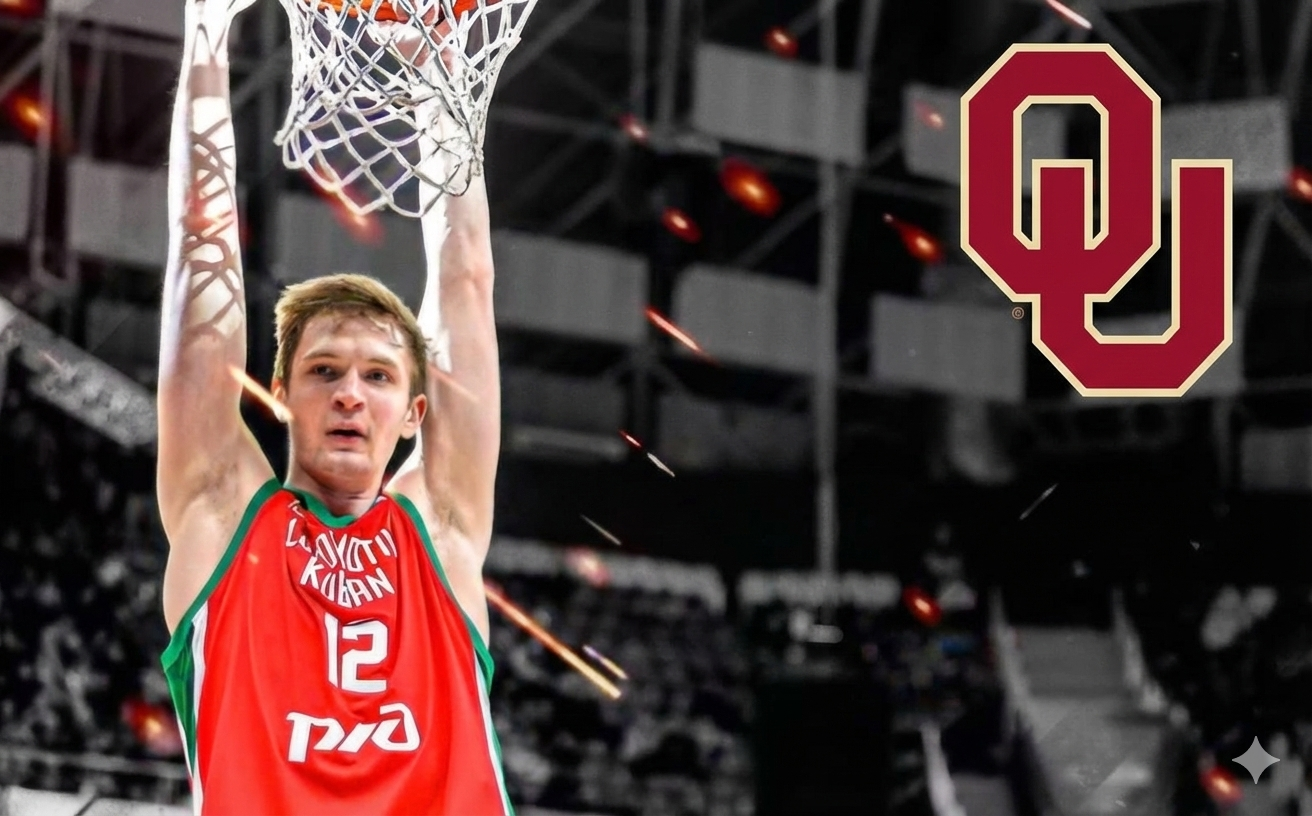
The timing matters as much as the player.
When Oklahoma learned this week that Kirill Elatontsev had been cleared by the NCAA and would be eligible to join the rotation, it didn’t feel like a headline designed to win a December news cycle. It felt like something more deliberate — a move that fits exactly where Porter Moser’s program is right now, not where fans might wish it already were.
Elatontsev doesn’t arrive with a mixtape built for social media or the buzz of a one-and-done prospect. He arrives with professional minutes, defensive instincts forged against grown men, and a resume that reads more like a midseason reinforcement than a developmental project. That distinction matters, especially for a team about to step into the SEC grind.
This isn’t about chasing ceiling. It’s about stabilizing the floor.
Over the past two weeks, Oklahoma basketball has quietly found traction. Wins over Oklahoma State and Kansas City weren’t just about the final margin; they revealed something more encouraging: structure. The Sooners are playing with purpose early, valuing possessions, defending without gambling, and letting their guards dictate tempo instead of reacting to it.
Xzayvier Brown and Nijel Pack have become reliable tone-setters. Derrion Reid’s efficiency has turned him into a problem for opposing forwards. Mohamed Wague has anchored the defense more consistently, even when his offensive production fluctuates.
And yet, there’s still a gap — one that shows up not in blowouts, but in the margins against physical teams.
Oklahoma’s frontcourt depth has been functional, not formidable. Wague has been solid. Kai Rogers is trending upward. Kuol Atak brings length and energy. But none of them, individually or collectively, change how opponents plan for Oklahoma in the paint.
Elatontsev changes that conversation.
Why Elatontsev Fits This Team — Right Now
Elatontsev’s appeal isn’t built on projection. It’s built on evidence.
At 6-foot-11 and 23 years old, he doesn’t look like a typical college big because he isn’t one. He’s already played in a high-level professional league with Lokomotiv Kuban, logging meaningful minutes against experienced post players. His numbers — roughly seven points, four rebounds, and over a block per game — won’t overwhelm anyone scanning a stat sheet. But that misses the point entirely.
What matters is how those numbers were earned.
He finished efficiently. He defended vertically. He rebounded in traffic. He stayed on the floor. He was trusted.
That’s the part Oklahoma needs.
This Sooners team doesn’t need a center who demands touches. It needs one who protects possessions, deters drives, and allows guards to pressure the ball knowing there’s real size behind them. Elatontsev’s professional background suggests he understands those responsibilities instinctively.
He doesn’t need to be featured. He needs to be reliable.
There’s a temptation in December to evaluate teams through the lens of what they’ve done so far. But the SEC doesn’t care about December résumés. It tests depth, physicality, and composure in February.
That’s where Elatontsev’s value sharpens.
SEC basketball is relentless inside. Every night brings another frontcourt that wants to play through contact, force rotations, and wear opponents down. Oklahoma can compete on the perimeter with anyone in the league. Whether it can survive the paint is the open question.
Elatontsev doesn’t guarantee answers. But he gives Moser options.
He allows Oklahoma to absorb foul trouble without panic. He provides another body capable of defending true centers. He creates lineup flexibility that didn’t exist a week ago. And perhaps most importantly, he raises the internal standard in practice.
Players who’ve spent years in professional systems tend to do that without saying a word.
This Isn’t About Flash — It’s About Program Trajectory
One of the quiet criticisms of Moser’s early tenure has been roster balance. Oklahoma has often leaned guard-heavy, relying on skill and pace to compensate for physical mismatches. Sometimes that worked. Sometimes it didn’t.
The addition of Elatontsev suggests a recalibration.
This isn’t Oklahoma chasing a headline recruit or trying to manufacture excitement. It’s Oklahoma acknowledging what the next phase of success requires — and acting accordingly.
Elatontsev represents a bridge between college basketball’s present and its future. The sport is increasingly international, increasingly experienced, increasingly unforgiving to teams that can’t match size and discipline. Oklahoma didn’t stumble into this moment. It pursued it.
That matters.
Expectations Should Be Grounded — And Optimistic
It’s important not to overinflate what Elatontsev will be. He’s not coming in to average a double-double or dominate highlight reels. His impact will be quieter — felt in shot deterrence, rebounding position, and lineup stability.
But those are the margins that win conference games.
If he adapts quickly to the pace and officiating of college basketball, Elatontsev could become the kind of piece fans don’t fully appreciate until he’s gone. The kind of player who doesn’t need plays called for him to affect the game.
Those players often decide seasons.
The Bigger Picture
Oklahoma basketball feels like a program transitioning from rebuilding to refining. The pieces are there. The habits are improving. The wins are starting to stack.
Elatontsev doesn’t alter Oklahoma’s ceiling overnight. What he does is raise the baseline — and that’s often the difference between a team that survives conference play and one that competes every night.
In that sense, this move isn’t about one Russian center joining the roster.
It’s about Oklahoma understanding exactly what it needs to take the next step — and having the confidence to go get it.
That’s how programs grow up.
And for Oklahoma, that may be the most important development of all.
Follow us on Instagram & Facebook