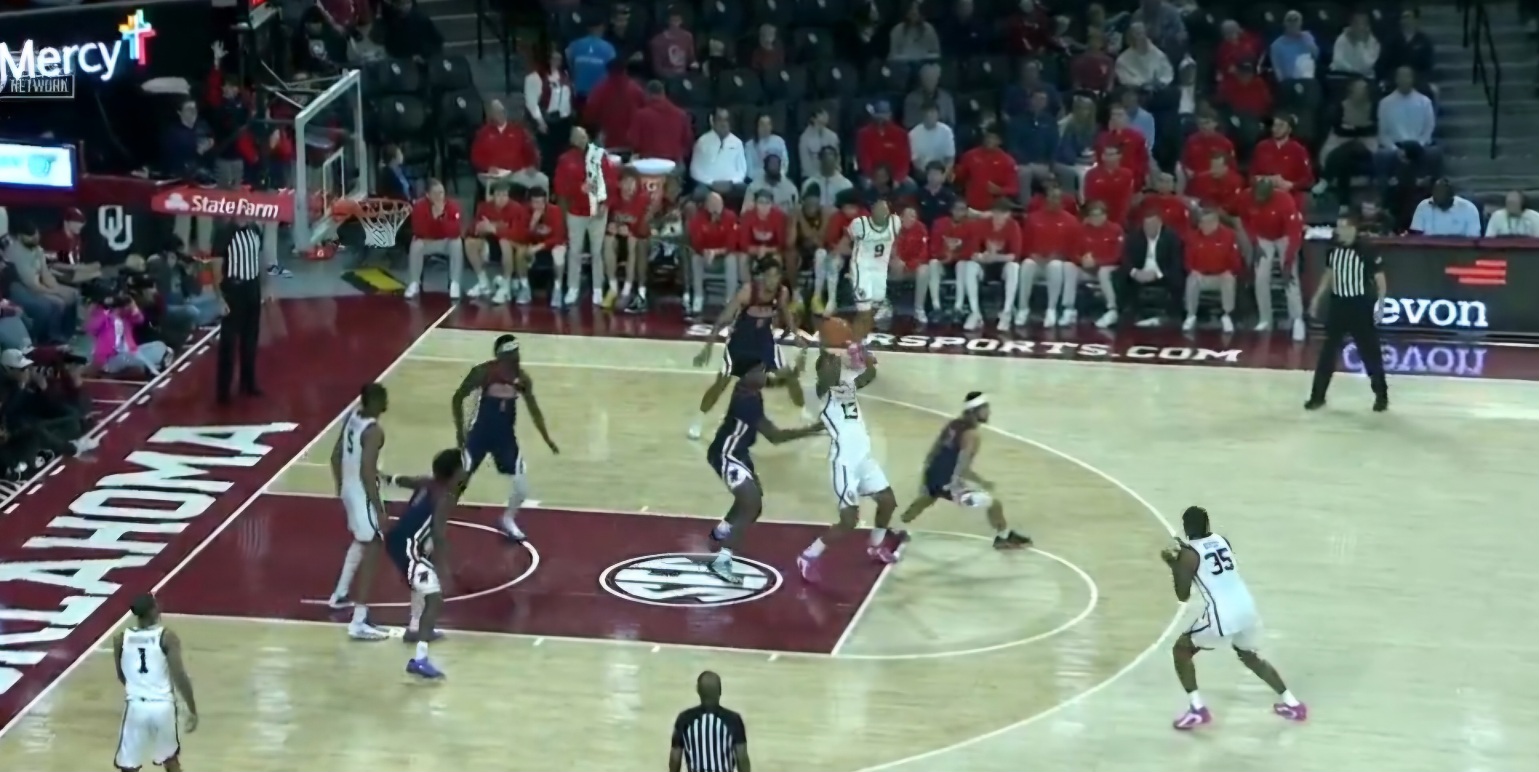
There are wins that feel emotional, and then there are wins that feel instructional.
Oklahoma’s victory over Ole Miss fell squarely into the second category. It wasn’t flashy. It wasn’t loud. It didn’t rely on a miracle shooting night or a single player going supernova for 40 minutes. Instead, it unfolded with the quiet inevitability of a team that understood the moment, understood the opponent, and — most importantly — understood itself.
That distinction matters, because this wasn’t just another non-conference data point. This was Oklahoma stepping into the SEC for real, under bright lights, against a physical opponent that wanted to test its toughness and patience.
And Oklahoma passed.
The First Half Told You What Ole Miss Wanted
Ole Miss didn’t arrive in Norman looking to trade baskets. The Rebels came with a clear plan: slow the game, muck it up, and see if Oklahoma would blink when possessions became harder to earn.
For a half, it worked.
The Sooners led just 43–41 at the break. The pace was uneven. Shots didn’t always fall. There were moments where Oklahoma looked like a team still feeling out its footing in a new league.
But here’s the part that matters: there was no panic.
Oklahoma didn’t force tempo. It didn’t chase points. It didn’t abandon structure. It played through discomfort — and that’s often the difference between teams that survive the SEC and teams that merely pass through it.
The Turning Point Wasn’t Loud — It Was Surgical
Early in the second half, Oklahoma delivered the sequence that decided the game.
It wasn’t a highlight dunk or even a string of highlight plays. It was something far more telling.
Xzayvier Brown hit a pull-up three. Then he hit another. Ole Miss went cold. Mohamed Wague vacuumed up offensive rebounds. Possessions stacked. The lead grew.
Within five minutes, a two-point game had turned into a double-digit cushion — and Ole Miss never truly climbed back into striking distance.
That stretch wasn’t accidental. It was the result of discipline.
Oklahoma didn’t change who it was. It simply executed better.
That’s how conference games are won.
Xzayvier Brown’s Control Was the Difference
Brown won’t always lead the highlight shows. His game isn’t built on spectacle. But against Ole Miss, he delivered something far more valuable than volume scoring: control.
He picked his spots. He punished sagging coverage. He didn’t turn a tight game into a rushed one. And when Oklahoma needed separation, he provided it without hijacking the offense.
That’s the kind of guard play that translates in this league.
The SEC chews up teams that don’t value possessions. Brown not only valued them — he dictated them.
Mohamed Wague’s Impact Went Beyond the Box Score
If Brown controlled the game from the perimeter, Wague owned it in the margins.
Ole Miss wanted to make Oklahoma uncomfortable inside. They wanted physicality. They wanted bodies leaning and bumping and grinding.
Wague didn’t flinch.
His offensive rebounds during the decisive second-half run were deflating. They didn’t just create second chances — they broke Ole Miss’ belief that stops would matter.
There are few things more demoralizing than forcing a contested miss and still giving up the possession. Oklahoma did that repeatedly, and Wague was at the center of it.
That kind of interior presence doesn’t just help you score. It helps you close.
What This Win Actually Says About Oklahoma
The temptation after an SEC opener is to overreact — to crown a contender or dismiss flaws too quickly. That’s not the point here.
This win didn’t prove Oklahoma is ready to run the league.
What it proved is something more important: Oklahoma is built correctly for it.
The Sooners didn’t need perfect shooting.
They didn’t need transition chaos.
They didn’t need the game to be easy.
They needed to be steady.
And they were.
That’s a significant evolution for a program that, in recent years, too often relied on things going right to look right.
Porter Moser’s Team Looks Comfortable in the Grind
One of the quiet storylines of this game was the sideline.
Moser didn’t coach like a man hoping the SEC wouldn’t expose his team. He coached like someone who knew exactly what he had and exactly what the game required.
Rotations were patient. Adjustments were subtle. Mistakes weren’t met with panic substitutions. This wasn’t a coach clinging to a script — it was a coach confident in his system.
That confidence trickled down.
Oklahoma didn’t speed up when Ole Miss tried to slow it down.
It didn’t tense up when the game tightened.
It trusted the work.
That’s how teams mature.
The Win Was About Floor, Not Ceiling
If last week’s Stetson game showed Oklahoma’s offensive ceiling, Ole Miss revealed its floor.
And floors matter more in January than ceilings do.
Oklahoma won without a historic shooting night.
It won without overwhelming athletic mismatches.
It won by being organized, physical, and composed.
Those are repeatable traits.
The SEC doesn’t reward teams that peak early. It rewards teams that don’t crater when things get hard.
This game suggested Oklahoma understands that.
Ole Miss Didn’t Collapse — Oklahoma Took Control
It’s important to say this plainly: Ole Miss didn’t give this game away.
They competed.
They defended.
They executed their plan for long stretches.
Oklahoma simply wore them down.
That’s a meaningful difference.
When a team wins because the opponent collapses, the lessons are fragile. When a team wins because it imposes itself slowly and methodically, the lessons stick.
The Bigger Picture Moving Forward
This win doesn’t guarantee Oklahoma anything in the SEC. There will be tougher environments. Deeper rosters. More talented backcourts.
But what it does guarantee is this:
Oklahoma won’t be overwhelmed by the league’s rhythm.
They won’t mistake physicality for chaos.
They won’t confuse pace with urgency.
They won’t need perfect conditions to compete.
Those are the traits of a team that belongs.
Why This Win Should Be Taken Seriously
It’s easy to dismiss a home win as expected. It’s harder — and more accurate — to recognize what it reveals.
Oklahoma didn’t win because Ole Miss was overmatched.
It won because it was prepared.
Prepared to play slow.
Prepared to play physical.
Prepared to adjust without abandoning identity.
That’s how programs survive their first real steps into a new league.
Final Thought
There will be louder wins this season. There will be nights when Oklahoma scores more, shoots better, or wins by larger margins.
But this one mattered.
Because this win wasn’t about proving how good Oklahoma can be.
It was about proving how stable it is.
And in the SEC, stability isn’t just valuable.
It’s essential.
Follow us on Instagram & Facebook