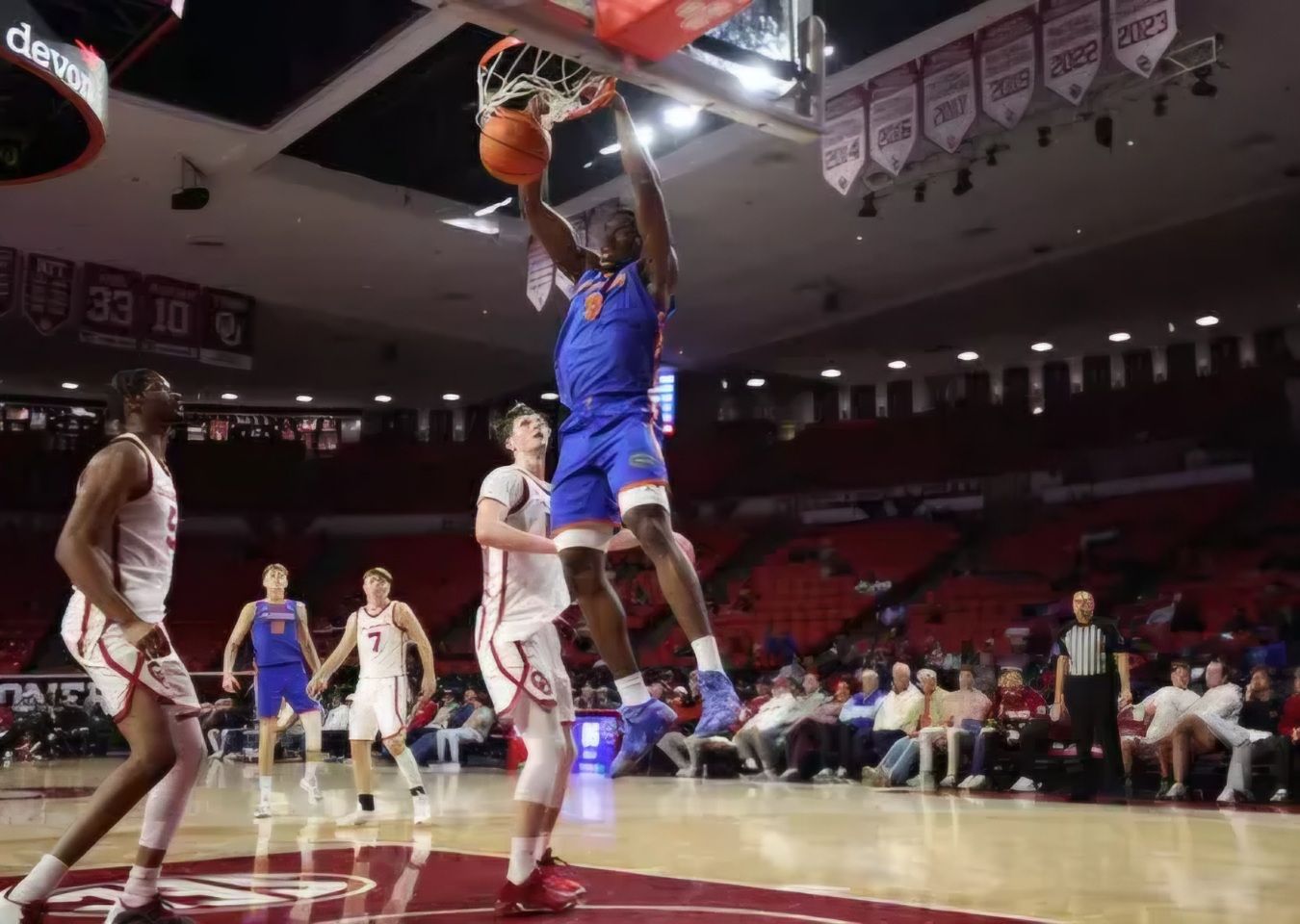
By the time the Lloyd Noble Center crowd began searching for reasons to believe on Tuesday night, the damage was already done.
Oklahoma’s 96–79 loss to No. 19 Florida will be remembered in the box score as another double-digit defeat, another SEC loss, another frustrating night in a growing skid. But the real story of this game — and the one that should worry Sooners fans far more than the final margin — unfolded much earlier and much closer to the rim.
This game was lost in the paint. And more importantly, it exposed a structural flaw in Oklahoma basketball that three-point shooting, effort, or late-game pride simply cannot mask.
The Moment That Told the Truth
There’s a tendency after losses like this to point to one shot, one whistle, or one missed rotation. But Florida didn’t steal this game from Oklahoma — they took it. The key moment wasn’t a buzzer-beater or a controversial call. It was Florida’s early 15–1 run in the first half, a stretch that turned a 7–6 Oklahoma lead into a growing realization that the Sooners were physically outmatched.
Once that run began, it never really stopped.
Florida turned the game into a wrestling match, and Oklahoma brought a fencing sword.
By the time the Gators extended the margin to 35–15 late in the first half, the outcome felt inevitable. The halftime score — 46–24 — wasn’t just a deficit. It was a statement. Florida dictated terms, controlled space, and imposed its will in every meaningful interior metric.
Points in the paint: Florida 60, Oklahoma 22
Rebounds: Florida 43, Oklahoma 31
Those aren’t just numbers. Those are symptoms.
Let’s be clear about something before the narrative turns lazy: this was not an effort loss.
Oklahoma didn’t quit. In fact, the Sooners showed real resolve in the second half, shooting a season-high 63% from three-point range and trimming the lead to as few as 15 points. Xzayvier Brown played with confidence and aggression, finishing with 24 points. Kirill Elatontsev provided a spark off the bench with 17.
That matters. It shows there is still belief in the locker room.
But effort only carries you so far when the matchup itself is broken.
Florida’s frontcourt — led by Rueben Chinyelu’s 19 points and 12 rebounds — treated the paint like private property. Thomas Haugh scored 21 without forcing the issue, simply taking what Oklahoma couldn’t prevent. The Gators didn’t need to get hot from outside or rely on gimmicks. They just went inside, again and again, until the Sooners broke.
And that’s the part Oklahoma can’t ignore.
This was Oklahoma’s third straight SEC loss, and each one has followed a familiar script: competitive moments drowned out by sustained physical disadvantage.
The SEC does not reward finesse without force. You can shoot well, move the ball, and execute sets — but if you cannot defend the rim or secure rebounds, you are living on borrowed time.
Florida exposed that reality brutally.
The Sooners shot just 29% in the first half, but that statistic doesn’t exist in a vacuum. Poor shooting nights happen. What can’t happen is allowing the opponent to dominate the glass and the restricted area simultaneously. That’s how small deficits become avalanches.
And once that avalanche starts, no amount of three-point shooting can dig you out.
A Troubling Pattern Under Moser
This loss also feeds into a narrative that Porter Moser has yet to fully shake during his Oklahoma tenure: strong nonconference stretches followed by uncomfortable conference reality.
Oklahoma entered SEC play with optimism, hovering around the bubble but very much alive in the NCAA Tournament conversation. Now, at 1–3 in conference play with losses stacking up, the Sooners are flirting with irrelevance faster than anyone in Norman wants to admit.
The troubling part isn’t just the losses — it’s how they’re happening.
Florida didn’t expose a one-night weakness. They highlighted a season-long concern: Oklahoma struggles against teams that can play through contact, control the paint, and punish switches inside.
The NET, the Bubble, and the Clock
Before Tuesday night, Oklahoma sat at No. 65 in the NET rankings. That number is going to fall. And while NET isn’t everything, it sets the tone for how the selection committee views you.
At 1–3 in SEC play, the Sooners are already chasing ground. The good news? The SEC offers opportunity. The bad news? Opportunity only matters if you seize it.
With 15 conference games remaining — most against teams inside the top 100 — Oklahoma has plenty of chances for Quad 1 and Quad 2 wins. But the margin for error is shrinking rapidly. Losses like this one don’t just hurt — they demand immediate answers.
Right now, Oklahoma doesn’t look like a team trending toward March. They look like a team hoping the math breaks their way.
That’s a dangerous place to live.
Which brings us to Alabama.
Hosting No. 18 Alabama on Saturday isn’t just another ranked matchup — it’s a referendum. Not on effort. Not on pride. On identity.
Can Oklahoma handle physicality for 40 minutes?
Can they defend the paint without collapsing?
Can they rebound well enough to turn stops into points?
Because if the answer is no, the opponent almost doesn’t matter.
Alabama won’t play Florida’s style exactly, but they will test Oklahoma’s toughness in their own way. Lose that game, and the conversation shifts from “bubble team” to “must-win mode” before January is even over.
Win it, and suddenly Tuesday night becomes a painful lesson instead of a season-defining warning.
The Truth Oklahoma Must Face
This Florida loss wasn’t about shooting variance or unlucky stretches. It was about basketball fundamentals that travel — and deficiencies that get exposed when they don’t.
You cannot give up 60 points in the paint and expect to win SEC games.
You cannot get outrebounded by double digits and control tempo.
You cannot spot quality teams 20-point first-half leads and expect late rallies to save you.
Florida didn’t just beat Oklahoma. They showed the Sooners exactly where they stand — and what they must fix.
The question now isn’t whether Oklahoma can respond.
It’s whether they will before the season slips through their fingers.
Follow us on Instagram & Facebook