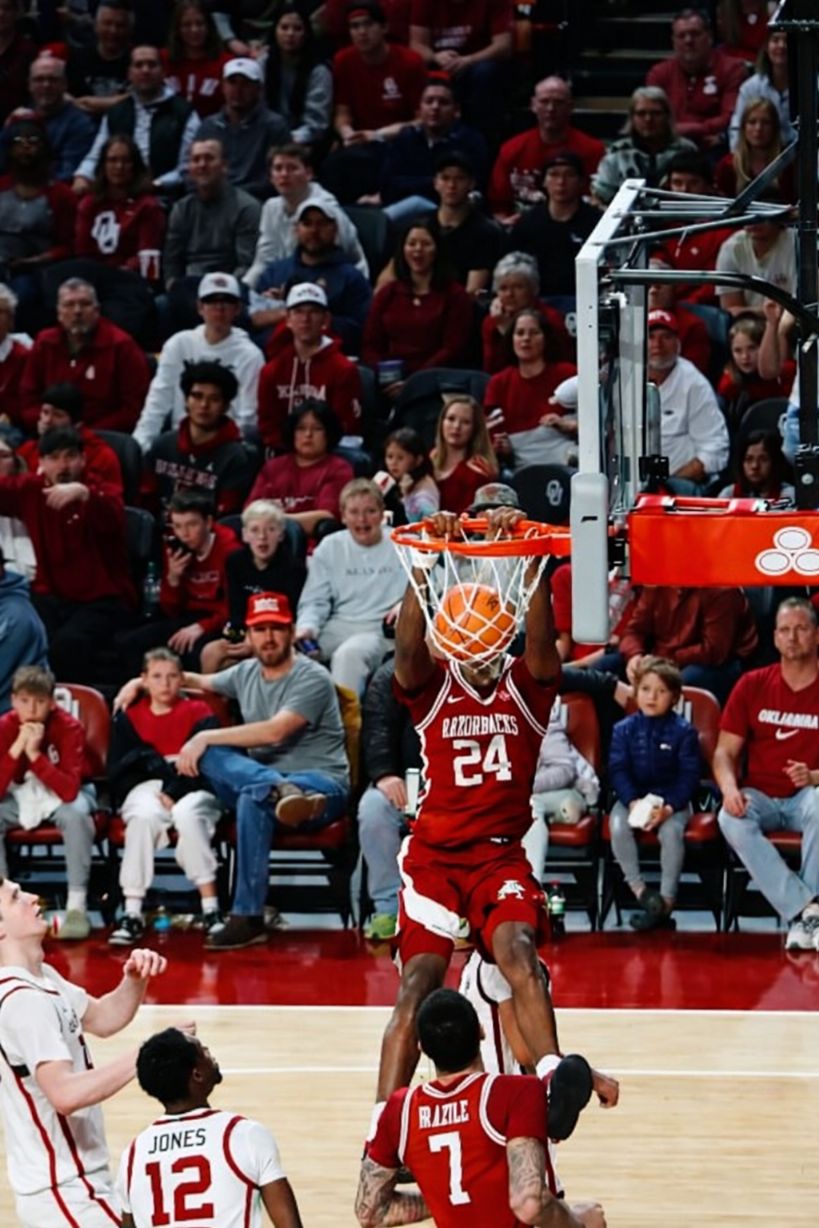
The final score said Arkansas 83, Oklahoma 79.
The box score said the Sooners hit more threes, won the rebounding battle, and shot better at the free-throw line.
The advanced metrics told a much less forgiving story.
When Oklahoma’s seventh straight loss ended Tuesday night at the Lloyd Noble Center, the reasons weren’t hidden in missed calls or late-game randomness. They were embedded in shot charts, possession efficiency, and the uncomfortable reality of what happens when one team lives at the rim while the other survives on jump shots.
Arkansas didn’t just beat Oklahoma. It solved them.
And the numbers show exactly how.
Possession Efficiency: Arkansas Maximized Every Trip
At a glance, Oklahoma’s offense wasn’t inefficient. The Sooners posted an offensive rating of 113.8 points per 100 possessions — a number that would normally put you in position to win at home against a ranked opponent.
The problem was Arkansas was even better.
The Razorbacks finished with an offensive rating of 119.5, fueled by elite efficiency and near-perfect decision-making. They took care of the ball, attacked advantageous matchups, and consistently generated high-value shots.
The difference between those two numbers — nearly six points per 100 possessions — doesn’t sound massive. Over the course of a tight, high-possession game, it was decisive.
That margin showed up late, when Oklahoma needed just one or two stops and couldn’t get them.
The Shot Profile Gap Was Enormous
Modern basketball isn’t just about how well you shoot. It’s about where you shoot.
This game was a case study in that principle.
Oklahoma leaned heavily on perimeter offense, attempting 27 three-pointers and converting 10 of them at a respectable 37 percent clip. Arkansas, meanwhile, made just two threes all night and finished at a brutal 12 percent from deep.
And yet, Arkansas won.
Why? Because the Razorbacks relentlessly attacked the interior and finished at an absurd rate. They shot 72 percent on two-point attempts, converting 33 of 46 shots inside the arc. That translated into 56 points in the paint — nearly double Oklahoma’s total.
When one team is scoring almost every time it gets into the lane, three-point math stops working.
This wasn’t Arkansas getting lucky. It was Arkansas getting exactly the shots it wanted.
Effective Field Goal Percentage Told the Real Story
Raw shooting percentages can be misleading. Effective field goal percentage (eFG%) adjusts for shot value, giving extra weight to three-pointers.
Even with that advantage, Oklahoma couldn’t close the gap.
Arkansas’s dominance on two-point attempts elevated its eFG% to a level Oklahoma simply couldn’t match, even with its perimeter success. The Razorbacks consistently converted shots worth the same or more value than Oklahoma’s made threes — without the variance.
In simple terms: Arkansas took fewer risky shots and made more of the easy ones.
That’s not just execution. That’s structure.
Turnover Control Shifted the Game’s Margin
Oklahoma didn’t lose this game because it turned the ball over excessively. But the turnover gap still mattered.
Arkansas committed just six turnovers in 40 minutes. Oklahoma had 12.
Those six extra empty possessions forced the Sooners to play a nearly perfect efficiency game just to keep pace. They didn’t.
What made the disparity more striking was who controlled it. Arkansas freshman Darius Acuff Jr. finished with nine assists and zero turnovers — a near-flawless point guard performance in a hostile road environment.
Every time Oklahoma threatened to flip momentum, Arkansas responded with composure.
That’s the difference between a good offense and a mature one.
The Paint Was Where Oklahoma Lost Control
Rebounding numbers suggested Oklahoma held its own. The Sooners finished with a slight 34–31 edge on the glass.
But rebounding totals don’t account for where the damage occurred.
Arkansas didn’t need second chances because it converted on first attempts. Oklahoma struggled to contain dribble penetration, failed to provide consistent help at the rim, and was repeatedly forced into rotations that came a half-second too late.
Porter Moser summed it up afterward with a phrase coaches reserve for uncomfortable truths: “We didn’t guard our yard.”
The metrics back that up completely.
Arkansas wasn’t settling. It was forcing Oklahoma to defend space it couldn’t protect.
Halftime Didn’t Change the Math — It Exposed It
Oklahoma led 48–44 at halftime, but the numbers underneath that lead were fragile.
The Sooners had shot extremely well from outside early, while Arkansas missed a handful of clean perimeter looks it normally converts. That imbalance corrected itself — not through threes, but through shot selection.
In the second half, Arkansas shot 50 percent from the field. Oklahoma dropped to 36 percent.
The Razorbacks didn’t suddenly catch fire. They simply kept doing what worked. Oklahoma, meanwhile, began chasing points rather than manufacturing them.
That’s when efficiency gaps widen.
Nijel Pack Was Brilliant — and That Wasn’t Enough
From an individual efficiency standpoint, Nijel Pack did almost everything Oklahoma could ask.
He finished with a game-high 22 points on 8-of-15 shooting and hit six three-pointers. His shot profile was clean, decisive, and productive. He kept Oklahoma afloat in the first half when Arkansas was gaining traction inside.
But advanced metrics don’t reward isolation brilliance if it isn’t scalable across a lineup.
As Arkansas adjusted and took away secondary options, Pack’s usage increased and Oklahoma’s margin for error shrank. The Sooners needed balance. They never found it.
Clutch Defense, Not Clutch Shooting, Decided It
Late-game narratives often focus on makes and misses. The final possession told a different story.
With Oklahoma down four and pushing for a tying score, Trevon Brazile’s block at the rim sealed the outcome. It wasn’t just a highlight — it was emblematic of the entire night.
Arkansas protected the paint when it mattered most. Oklahoma couldn’t.
That single play reflected the broader data: when the game tightened, Arkansas had answers inside. Oklahoma had hope from the perimeter.
Hope isn’t an efficient offense.
What the Metrics Say About Oklahoma Going Forward
This wasn’t a collapse. It wasn’t panic. It wasn’t a failure of effort.
It was a structural loss.
Oklahoma played well enough to compete but not well enough to control the most valuable real estate on the floor. Until that changes, close games will continue to lean away from them.
The advanced numbers don’t suggest a broken team. They suggest a team with a specific, fixable flaw — one that has now shown up repeatedly against SEC-level athletes.
Fix the interior defense. Reduce the reliance on variance. Create more rim pressure offensively.
Do those things, and the results change.
Ignore them, and the numbers will keep telling the same story — no matter how close the final score looks.
On Tuesday night, the metrics didn’t just explain Oklahoma’s loss.
They predicted it.
Follow us on Instagram & Facebook