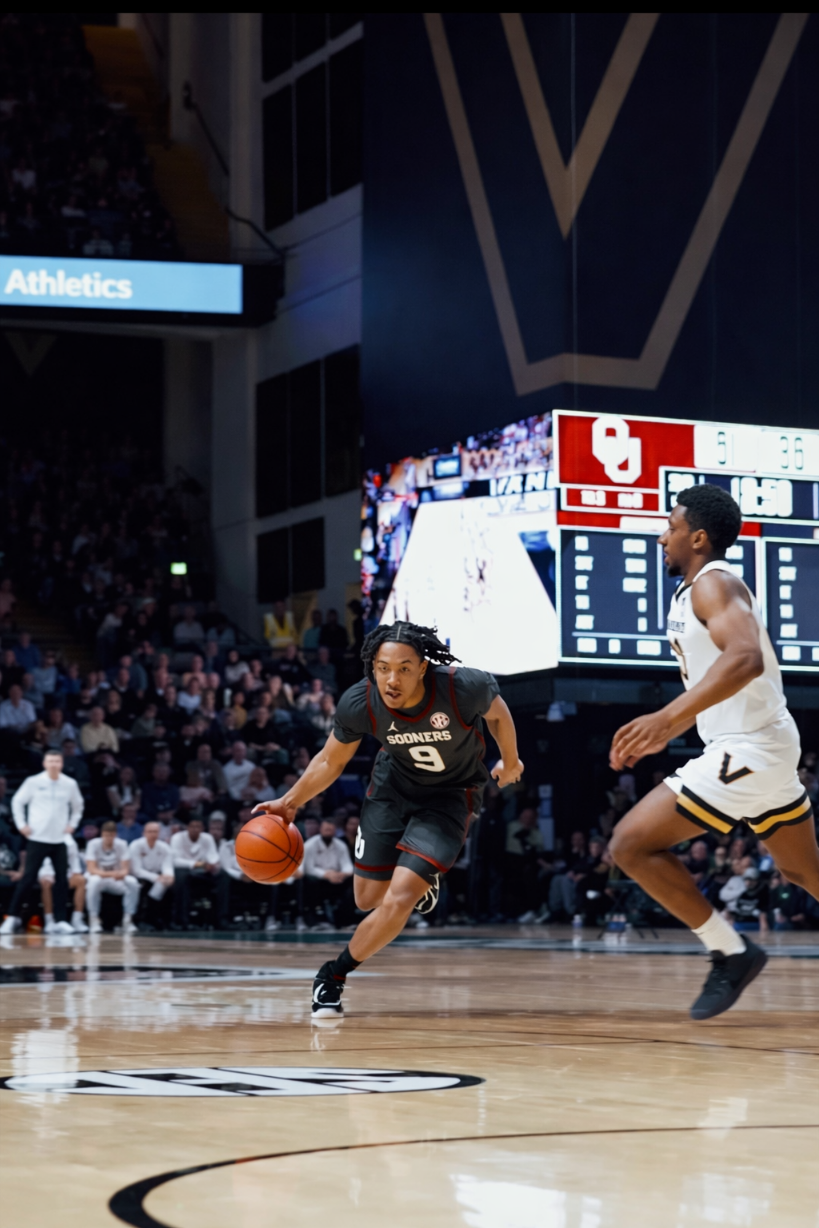
For nine games, Oklahoma basketball existed in a fog of inevitability. Not the dramatic kind that fuels comebacks or moral victories, but the slow, suffocating inevitability of a team that always seemed to know how the night would end — and could never stop it anyway. Competitive stretches dissolved into dry spells. Leads turned into liabilities. Confidence leaked out possession by possession. The SEC schedule became less of a gauntlet and more of a countdown.
That’s why Oklahoma’s 92–91 win at No. 15 Vanderbilt on Saturday wasn’t just an upset. It was an interruption.
And interruptions matter when a season is spiraling.
Let’s be clear from the outset: this was not a perfect win, and it certainly wasn’t a cleansing one. Oklahoma nearly turned a 21-point lead into a cautionary tale. They allowed 37 points to one player. They flirted with the exact collapse that defined the previous nine losses. If you’re looking for proof that everything is suddenly fixed, this game doesn’t offer it.
But if you’re looking for proof that this team hadn’t quit — that it could still execute, still respond, still hold its nerve in the most hostile moment imaginable — Nashville finally gave you something real to hold onto.
That matters more than style points right now.
For nearly 30 minutes, Oklahoma played its best basketball of the SEC season. Not just efficient — intentional. The Sooners led wire to wire, controlled tempo, and played with the kind of offensive clarity that had been missing for weeks. They shot a season-high 53.4 percent from the field. They attacked the paint instead of settling. They shared the ball. They looked like a team that knew who it was supposed to be.
Tae Davis set the tone early, scoring 14 of Oklahoma’s first 18 points and forcing Vanderbilt to defend honestly from the opening tip. Nijel Pack provided veteran steadiness, knocking down shots at a rhythm that prevented runs from ever gaining traction — at least early. Dayton Forsythe came off the bench and gave Oklahoma exactly what it hasn’t had during the losing streak: functional depth that didn’t bleed points.
And then there was Xzayvier Brown.
Brown didn’t just score 20 points. He authored the most important possessions Oklahoma has had all season. Fourteen of his points came in the second half, when the building grew louder and the margin grew thinner. And when everything threatened to unravel — when Vanderbilt’s Tyler Tanner had turned Memorial Gym into a personal stage — Brown walked to the line with 3.4 seconds left and did the simplest, hardest thing in basketball.
He made both free throws.
That’s it. No theatrics. No hesitation. Just composure.
That moment alone separates this game from the nine that came before it.
Because for weeks, Oklahoma hadn’t lacked talent. It lacked trust — in itself, in its execution, in the idea that the next possession wouldn’t collapse under pressure. Against Vanderbilt, that trust held just long enough.
Now, let’s talk about the part that shouldn’t be ignored.
Oklahoma nearly lost this game the exact same way it lost so many others.
After building a 21-point lead with just over 12 minutes remaining, the Sooners began playing not to lose instead of continuing to play to win. Turnovers crept in. Defensive rotations slowed. Offensive possessions shortened. Vanderbilt smelled it immediately.
Tyler Tanner scored 15 points in the final two minutes alone. Fifteen. Against a defense that knew exactly where the ball was going and still couldn’t slow him down. The Commodores cut the lead possession by possession until a banked-in three at the buzzer turned a four-point game into a one-point heart attack.
That matters, too.
Because while Oklahoma survived, it didn’t exactly exorcise its demons. It stared straight at them and barely blinked first.
So what does this win actually mean?
It doesn’t resurrect NCAA tournament dreams. Those were buried weeks ago. It doesn’t erase a 2–9 SEC record or magically undo defensive issues that have plagued this roster since January. It doesn’t suddenly turn Oklahoma into a top-half SEC team.
What it does do is far more important in the immediate sense.
It restores credibility.
For the first time since conference play turned ugly, Oklahoma proved it could carry a game from start to finish — even if the finish was chaotic. This was their first road win against an AP top-15 opponent since 2021. It was only Vanderbilt’s second home loss of the season. And most notably, it was a game Oklahoma led for 99 percent of the night.
That last stat matters more than the score.
Because during the losing streak, Oklahoma wasn’t just losing games — it was losing identity. It couldn’t close halves. It couldn’t survive runs. It couldn’t impose itself for long enough to matter. Against Vanderbilt, it finally did — even if it almost let go.
This win doesn’t absolve Porter Moser of scrutiny. It doesn’t quiet questions about late-game execution or defensive consistency. If anything, the frantic finish reinforces those concerns. But it does complicate the narrative that the locker room had fractured or that the team had mentally checked out.
You don’t walk into Memorial Gym, lead wire to wire, and knock down pressure free throws if you’ve quit.
That’s the takeaway.
Oklahoma is not suddenly good. But it is still dangerous — especially when its offense is balanced and decisive. Five starters scored in double figures. The ball moved. The paint was attacked. And for one night, the SEC’s grind didn’t swallow them whole.
Now comes the harder part.
Wins like this can either become turning points or trivia answers. Oklahoma has spent weeks collecting the latter. To make this one matter, the Sooners have to follow it with consistency — not perfection, consistency. Better starts. Smarter finishes. Fewer possessions where panic replaces purpose.
This win didn’t save the season.
But it saved the fight.
Follow us on Instagram & Facebook