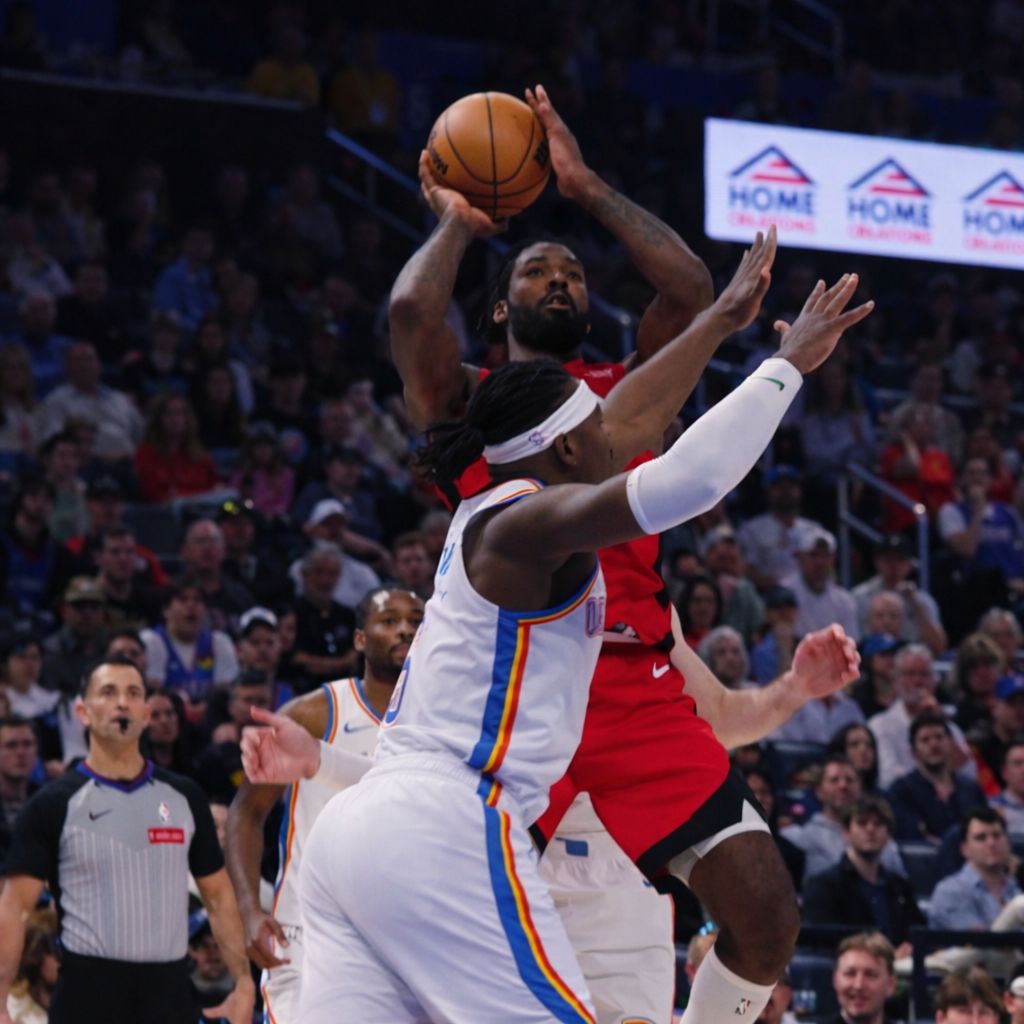
Oklahoma City’s 112–106 defeat to Houston on Saturday afternoon landed squarely in the frustration zone. It was uncomfortable, revealing, and ultimately clarifying in ways the standings won’t fully capture.
The Thunder lost a game they had every reason to believe they could steal, even while shorthanded. They also lost a game that exposed, in stark relief, what happens when elite structure is forced to survive without elite shot creation. Both truths can coexist, and in this case, they must.
At 40–13, Oklahoma City entered the night with the luxury of context. Missing reigning MVP Shai Gilgeous-Alexander and All-Star Jalen Williams, the Thunder were never supposed to look dominant. But they did something more dangerous early: they looked comfortable. Too comfortable.
A 15-point lead in the second quarter wasn’t an illusion. It was built on pace, ball movement, and a Houston team still trying to figure out how seriously it needed to take a depleted opponent. The Thunder spaced the floor, cut with purpose, and defended just well enough to stay ahead of the Rockets’ physicality. At halftime, Oklahoma City led 52–46 and had every reason to believe it could grind out another “next-man-up” win.
That belief didn’t survive the third quarter.
Houston outscored Oklahoma City 34–22 coming out of the locker room, and the game flipped not with a single knockout punch, but with a slow suffocation. The Thunder went five full minutes without a made field goal late in the third. The Rockets turned defensive pressure into transition offense. And suddenly, the fragility of Oklahoma City’s offense — something that had been masked by ball movement and effort — was fully exposed.
This was not about effort. It was about hierarchy.
Without Gilgeous-Alexander and Williams, the Thunder didn’t just lose scoring. They lost inevitability. They lost the player who can look at a possession gone wrong and still manufacture a bucket. They lost the release valve. And once Houston figured out it could switch, crowd driving lanes, and live with contested jumpers from role players, Oklahoma City ran out of answers.
The numbers tell the story cleanly. Seventeen turnovers. Twenty-seven points conceded off those mistakes. A free throw percentage of 64 percent in a six-point loss. Those aren’t anomalies — they’re symptoms of a team being pushed beyond its offensive margin.
Cason Wallace’s 23 points were admirable. Isaiah Joe’s 21 were necessary. Chet Holmgren’s 17 points and 14 rebounds provided interior stability. But none of that replaced what Oklahoma City didn’t have: a player who bends the defense simply by existing on the floor.
That absence defined the game.
The Thunder briefly tied the score at 91–91 with seven minutes left, and for a moment, it felt like Houston might let them hang around too long. That moment ended when Tari Eason decided it was his game. His season-high 26 points weren’t flashy; they were violent in their timing. Cuts, putbacks, downhill drives — every basket came when Oklahoma City desperately needed a stop. Alperen Şengün’s triple-double (17 points, 12 rebounds, 11 assists) gave Houston a steady center of gravity. And when the game reached the final possessions, Kevin Durant did what closers do: he took the air out of the building with a jumper that felt inevitable the moment he rose.
That shot wasn’t about nostalgia or boos. It was about contrast.
Durant didn’t dominate the game. He didn’t need to. His 20 points came quietly, professionally, and decisively — exactly the type of presence Oklahoma City lacked when the offense stalled. And that’s the uncomfortable truth Thunder fans have to sit with after this one: structure can carry you far, but stars close games.
This loss wasn’t an indictment of Oklahoma City’s depth. If anything, it reinforced how well this roster is constructed. The Thunder competed for 48 minutes without their two best scorers. Jared McCain made his debut and didn’t look overwhelmed. Kenrich Williams, Cason Wallace, Isaiah Joe — these players didn’t just survive; they functioned.
But functioning is not finishing.
The third quarter collapse wasn’t about conditioning or complacency. It was about Houston deciding to press harder and Oklahoma City not having a counterpunch. When the Rockets switched more aggressively, the Thunder’s read-and-react offense stalled. When passing lanes disappeared, there was no isolation bailout. When the whistles came, missed free throws turned manageable moments into compounding problems.
That’s where the opinion sharpens: this loss mattered not because Oklahoma City lost, but because it showed exactly where their margin lives.
When the Thunder are healthy, their margin is wide. Gilgeous-Alexander warps coverage. Jalen Williams punishes closeouts. Holmgren stretches the floor vertically and horizontally. Together, they turn good possessions into great ones. Remove two of those pieces, and suddenly every mistake costs more.
That doesn’t make Oklahoma City fragile. It makes them normal.
Houston, meanwhile, deserves credit — and scrutiny. The Rockets won the game they were supposed to win, but not without revealing their own limitations. A fully stocked roster needed a third-quarter surge and late-game shot-making to put away a team held together by duct tape. Eason’s emergence was real. Şengün’s playmaking continues to evolve. But the fact that Oklahoma City tied the game in the fourth at all should linger longer than the final score.
For the Thunder, this was a reminder disguised as a disappointment. You can win on culture. You can survive on depth. But you cannot close consistently without elite creation. That’s not a flaw — it’s a reality of professional basketball.
There will be no overreaction inside the organization, nor should there be. At 40–13, Oklahoma City has earned the benefit of the doubt. But this game belongs in the mental file marked “reference,” not “footnote.” It showed how quickly advantages shrink when precision slips. It showed how turnovers multiply when pressure rises. And it showed why MVPs matter most when games stop being fair.
The Thunder didn’t lose belief Saturday night. They lost control. And sometimes, that lesson is the more valuable one.
They’ll get another test Monday night in Los Angeles. Health will determine much of what follows. But Houston provided a clear snapshot of the stakes: when Oklahoma City has its stars, it’s a contender. When it doesn’t, it’s still competitive — just not inevitable.
Saturday proved that difference matters.
Follow us on Instagram & Facebook