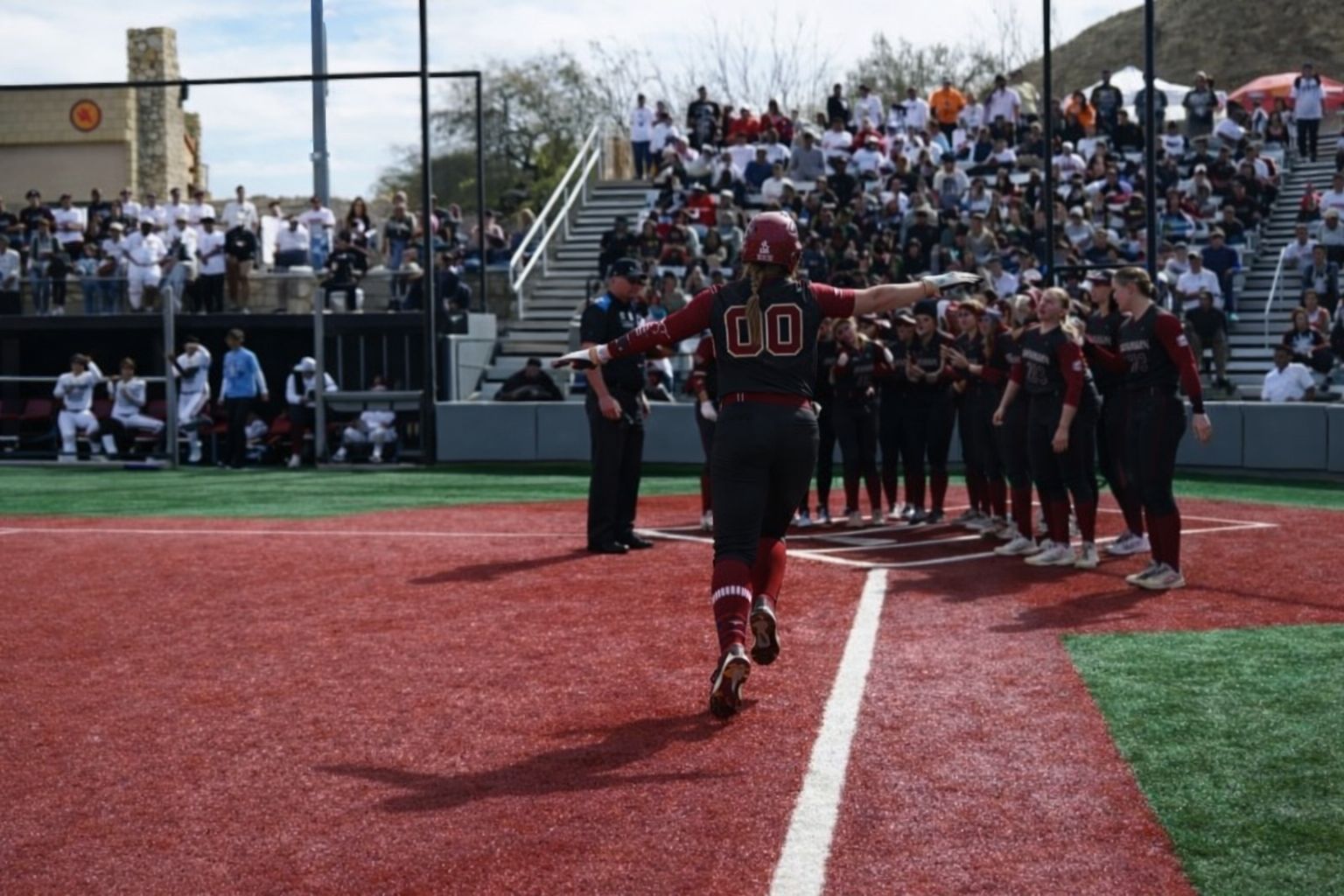
There are box scores that shout. There are box scores that whisper. And then there are box scores like Oklahoma softball’s 34–0 demolition of UTEP that do something far more unsettling to the rest of the sport: they teach.
Anyone can look at the final line and shake their head at the absurdity of it. Thirty-four runs. Zero allowed. A game that felt less like a competition and more like a scrimmage that accidentally made it onto the schedule. But if you’re actually trying to understand what makes the Oklahoma Sooners softball terrifying in 2026, the runs are not the story.
The walks are.
Ten of them.
In a game where Oklahoma could have justified swinging at anything within shouting distance of the plate, the Sooners instead turned patience into a weapon. Not passive patience. Not survival patience. Weaponized patience—the kind that drains pitchers, coaches, and entire dugouts of hope.
That’s the part that should keep the rest of the country awake at night.
Ruthless Selectivity, Not Swing-Happy Excess
Human nature kicks in quickly during blowouts. Hitters expand the zone. They hunt highlight swings. They chase personal milestones. They try to do too much because the moment allows it—and because, frankly, most teams would tolerate it.
Oklahoma didn’t.
Against the UTEP Miners, the Sooners refused to bail out struggling pitchers. They refused to turn the game into batting practice. They refused to confuse dominance with recklessness.
Instead, they drew 10 walks against 25 hits. They saw pitch after pitch. They extended innings not by swinging harder, but by swinging less.
That’s not accidental. That’s organizational.
This is the “Sooners Identity” in its purest form: control the strike zone, force pitchers to come to you, and punish mistakes only after patience has done its damage. You can scout power. You can scheme against speed. You cannot game-plan against a lineup that simply will not swing at balls—even when they’re winning by three touchdowns.
The Fifth Inning Was the Tell
If you want the clearest evidence that this wasn’t just early-game discipline before boredom set in, look at the fifth inning.
Six of Oklahoma’s 10 walks came in that frame alone. Four of them were consecutive bases-loaded walks.
Read that again.
Four straight times, with the bases full, Oklahoma hitters stood in and let runs walk home rather than expanding the zone to chase history. That sequence directly fueled a 14-run explosion that pushed the game toward program-record territory.
This is where the column’s argument sharpens.
The Sooners were not chasing the 35-run record. They were chasing the process.
That matters because records are situational. Process is transferable. And when postseason pressure hits—when umpires tighten zones, when aces live on the corners, when one bad swing can end a season—this is the muscle memory that wins championships.
The two-RBI double by Isabela Emerling, followed by an inside-the-park home run from Abby Dayton, finally broke the walk parade and felt almost like punctuation. Not the point. Just the exclamation mark after the lesson had already been taught.
Post-Dynasty Questions, Immediate Answers
This game also served as a direct rebuttal to the quiet skepticism surrounding Oklahoma’s post-dynasty era.
When legendary bats like Tiare Jennings and Jayda Coleman moved on, the question wasn’t whether Oklahoma would still be talented. The question was whether the standard would soften.
Would the Sooners still value quality at-bats when they no longer had generational stars anchoring the lineup? Would patience erode as new faces tried to prove themselves?
The 2025 season may have left some doubts, but Saturday’s answer was emphatic.
This wasn’t a lineup leaning on superstardom. This was a lineup leaning on culture.
The Gasso System—installed, refined, and relentlessly enforced by Patty Gasso—does not care who you are. It cares how you think. And more importantly, how you wait.
Take A Deeper Dive Into Oklahoma Softball
Exclusively on our subscription page.
– Sooners Stop One Run Short Of History In 34-0 Demolition Of UTEP
– Freshmen Fuel The Machine As No. 4 Oklahoma Run-Rules Idaho State, 10-1
– How One Inning Told TYhe Whole Story In A 12-2 Run-Rule Win
The Youth Buy-In Is the Real Signal
Perhaps the most important takeaway wasn’t what Oklahoma did—it was who did it.
Freshman Allyssa Parker and sophomore Chaney Helton didn’t approach their at-bats like players trying to announce themselves to the sport. They approached them like players already fluent in the program’s language.
They didn’t chase. They didn’t rush. They didn’t sell out for power just because the scoreboard allowed it.
That’s how you know leadership has transferred successfully—not because veterans say the right things, but because young players do the right things when no one would blame them for doing otherwise.
This is championship DNA being inherited, not recreated.
Isabela Emerling and the Art of Pressure
No player embodied the night’s theme better than Isabela Emerling, who led the team with two walks. That stat won’t trend on social media. It won’t make highlight reels.
But in the context of Oklahoma softball, it’s invaluable.
Every walk forces another pitch. Every pitch increases stress. Every stressful pitch compounds mechanical breakdowns. This is how blowouts become avalanches—not through raw aggression, but through inevitability.
By the time Oklahoma finally swings at a pitch worth swinging at, the pitcher is already beaten.
Why This Terrifies the Rest of the Country
Power can be neutralized. Speed can be contained. Even elite defenses can survive hot lineups for short stretches.
But patience? Patience travels.
It doesn’t slump. It doesn’t tighten under pressure. It doesn’t disappear when the stage gets bigger. In fact, it becomes more lethal.
That’s why the approximate 10-to-1 walk-to-strikeout ratio from this game matters more than the 34 runs. It’s the kind of statistical profile that shows up in Oklahoma City in June—not because it’s flashy, but because it’s sustainable.
You can’t pitch around a team that won’t chase. You can’t steal momentum from a lineup that’s content to let you self-destruct. And you can’t intimidate hitters who are perfectly willing to win by doing nothing more than standing still.
Final Thought
The scoreboard will fade. Records may or may not fall. But the message from this game will linger.
Oklahoma isn’t just bigger and faster than you. They’re more patient than you.
And that—far more than 34 runs—is what should scare the rest of the country.
Follow us on Instagram & Facebook
One Reply to “Oklahoma’s 10 Walks Were Scarier Than the 34 Runs”