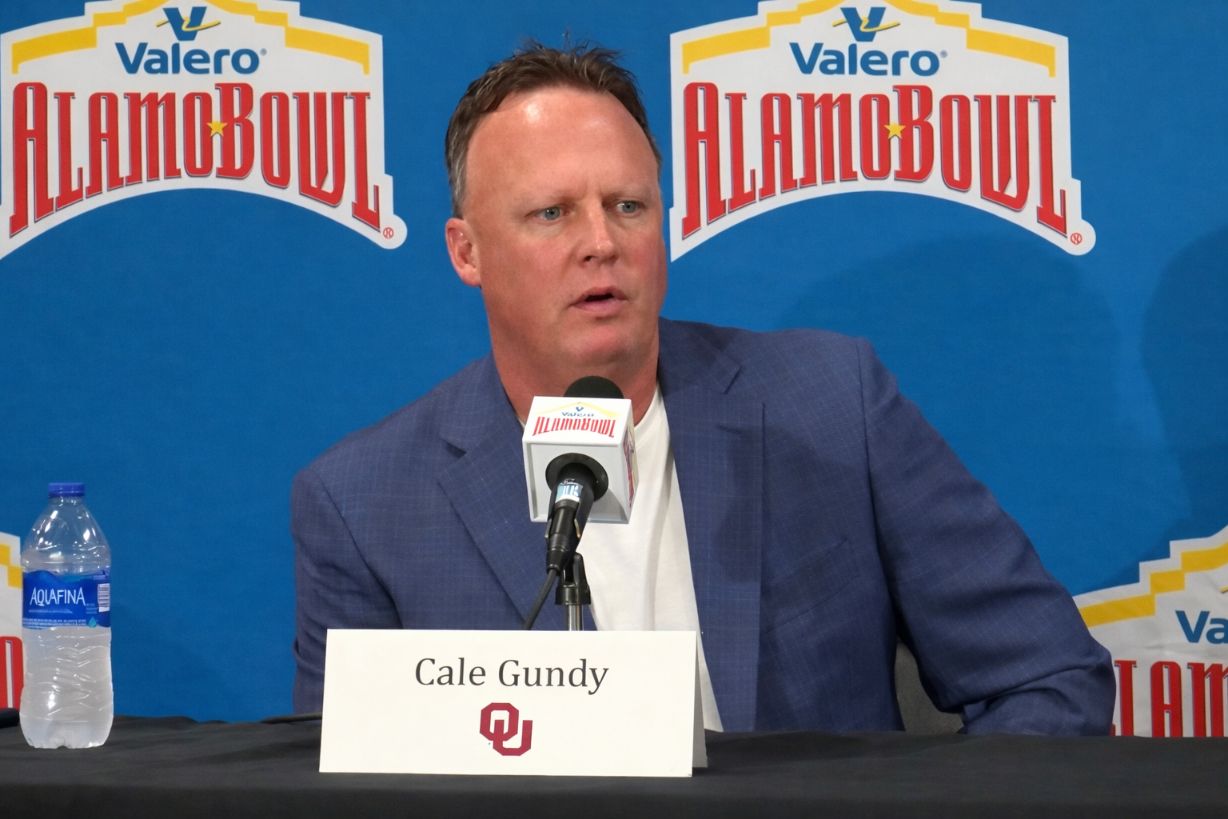
There is a reason the name Cale Gundy won’t go away in Norman, no matter how many times Oklahoma football tries to sprint toward its future.
Nostalgia is powerful in college football. Sometimes it’s dangerous. Sometimes it clouds judgment. But sometimes—when paired with context, humility, and time—it becomes a necessary mirror. The question surrounding Gundy’s potential return as Oklahoma’s running backs coach isn’t whether he can coach. That argument was settled years ago. The real question is whether Oklahoma, under Brent Venables, is prepared to reconcile accountability with redemption in an era that rarely allows room for both.
This is not a simple football hire. It is a referendum on how programs grow.
Gundy’s résumé is not just impressive; it’s foundational. For more than two decades, he was part of the internal wiring of Oklahoma football, a steady hand through multiple coaching transitions. He coached legends, molded first-round talent, and played a direct role in shaping the program’s offensive identity across eras. That includes mentoring players who later became standard-bearers for Oklahoma excellence, including the very man whose departure created this vacancy: DeMarco Murray.
And yet, in August of 2022, Gundy’s career at Oklahoma ended abruptly. One moment. One mistake. One word read aloud that should never have been spoken. He resigned, and Venables—then still establishing his authority—made it clear the decision aligned with the program’s values.
That context matters. Accountability mattered then. It still matters now.
But accountability is not the same as exile.
The loudest voices advocating for Gundy’s return aren’t message-board diehards chasing the ghosts of 2008. They’re former players. They’re men whose careers and lives were shaped under his watch. Chief among them is Dede Westbrook, whose public endorsement was emotional, unapologetic, and deeply personal.
That should give anyone pause.
Players are not obligated to defend former coaches after controversy. In fact, silence is usually the safer choice. When former players speak up anyway—especially years later—it suggests something deeper than nostalgia. It suggests trust.
Still, trust alone doesn’t run a modern SEC program.
Venables inherited a program in transition and immediately set about changing its culture. He emphasized standards. Structure. Accountability. In many ways, the Sooners’ recent rise back into national relevance has been built on those pillars. Rehiring Gundy would not simply be a football decision—it would be a philosophical one. It would require Venables to publicly acknowledge that growth is possible on both sides of a difficult moment.
That is not an easy ask.
Critics of a potential reunion argue that rehiring Gundy would undermine the very values Venables claimed to protect in 2022. They argue it would open the door to revisionism, to excusing behavior because of success or popularity. Those concerns deserve respect.
But they are incomplete.
What often gets lost in this debate is that Gundy did not fight the consequences. He did not lawyer up. He did not point fingers. He resigned. He stepped away. He disappeared from the sideline and the recruiting trail. For nearly four years, he has not attempted to force his way back into the spotlight. That matters, too.
If accountability means consequences, then redemption requires evidence of learning. Time away is not a technicality—it is part of the process.
This brings us back to Oklahoma’s present reality.
The Sooners are searching for a running backs coach at a critical moment. Spring practice looms. Recruiting never sleeps. Murray was not just a developer of talent; he was a relationship builder, a magnet in living rooms across the region. Replacing him is not about finding a body to hold a whistle. It’s about stabilizing a position group and maintaining recruiting momentum.
Could Oklahoma go “outside the box” again? Absolutely. Venables has shown a willingness to make unconventional hires. That approach has yielded mixed results but undeniable buzz. A high-profile outsider might fit the program’s forward-facing branding.
But football isn’t only about headlines. Sometimes it’s about fit.
Gundy would walk into the building knowing the culture, the expectations, the pressure, and the standard. There would be no learning curve. No translation period. No wondering what “Oklahoma football” is supposed to look like in February or October.
The risk isn’t football-related. The risk is perception.
And perception, while powerful, is not permanent.
The truth is this: programs that claim to value growth must be willing to define what growth looks like. If growth only applies to players and not to coaches, then it isn’t growth—it’s branding.
Rehiring Gundy would not erase 2022. It would acknowledge it, contextualize it, and move forward with eyes open. It would require clear communication, firm expectations, and zero tolerance for anything resembling a repeat mistake. It would also require Venables to trust his own leadership enough to believe the program can withstand scrutiny.
That is the real test.
This is not about whether Oklahoma needs Cale Gundy. It’s about whether Oklahoma believes in second chapters that are earned, not demanded.
College football is littered with programs that cling too tightly to the past. It is also full of programs that discard people entirely in the name of optics. The healthiest programs tend to exist somewhere in between—where accountability and humanity are not mutually exclusive.
If Venables decides to look elsewhere, that choice should be respected. He is the steward of this era, and consistency matters. But if he chooses to bring Gundy back, it shouldn’t be framed as weakness or regression. It should be framed as confidence—the confidence to believe that people, like programs, can learn, change, and come back better.
Oklahoma football has always been about legacy. Not just trophies and banners, but people. The decision ahead will reveal what kind of legacy this era wants to leave behind.
Sometimes the boldest step forward isn’t finding something new.
It’s deciding what—and who—is worth bringing back.
Follow us on Instagram & Facebook