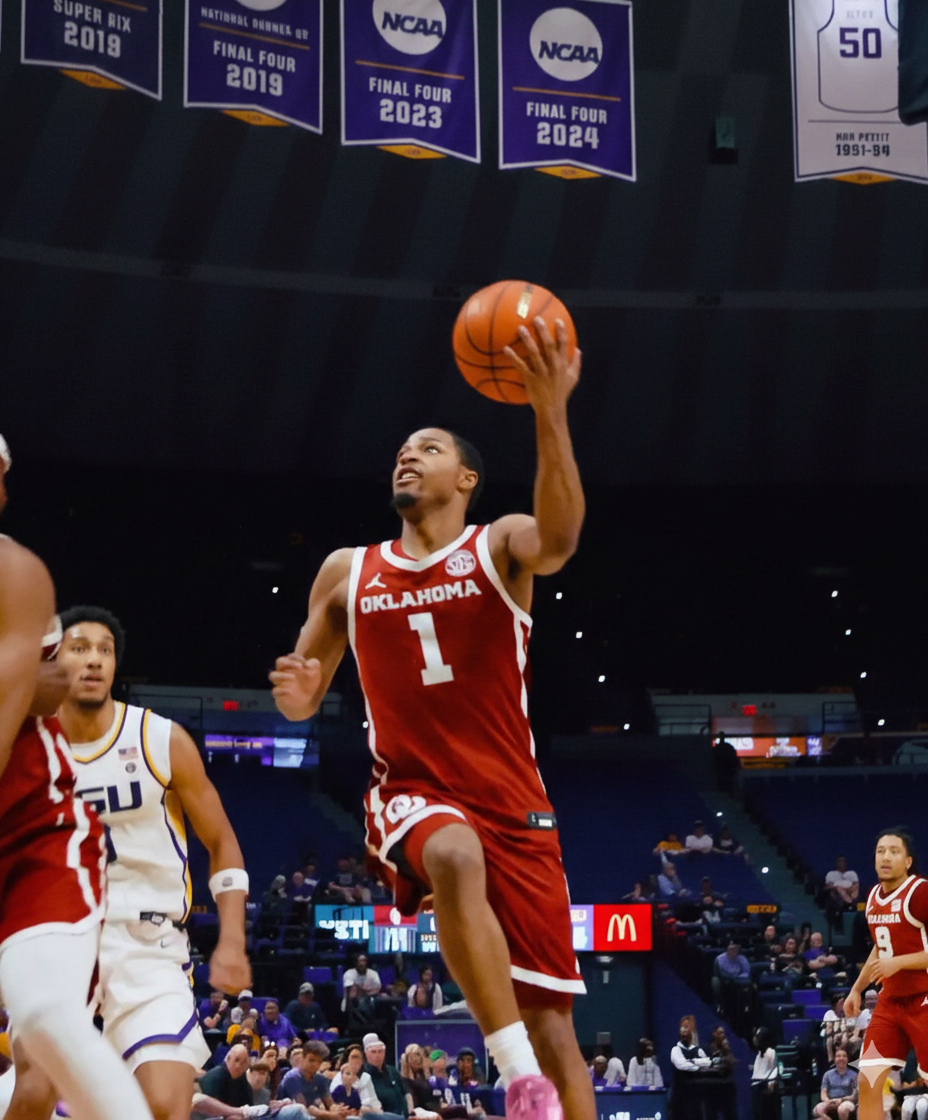
For weeks, the conversation around the Oklahoma men’s basketball has centered on what it wasn’t.
Not tough enough in the paint.
Not consistent enough defensively.
Not efficient enough late.
Not ready enough for the weekly grind of the Southeastern Conference.
Saturday in Baton Rouge didn’t erase the season. It didn’t rewrite the standings. It didn’t suddenly place Oklahoma in NCAA Tournament conversations.
But the 83–67 road win over LSU did something arguably more important at this stage of February:
It proved this team has figured something out.
Inside the Pete Maravich Assembly Center, a building that can suffocate visiting teams when LSU senses blood, Oklahoma didn’t flinch. It didn’t just survive a road environment. It controlled it.
That matters.
Because for much of this season, Oklahoma has been a team reacting to momentum instead of dictating it.
Saturday was different.
After falling behind 5–0, the Sooners detonated a 10–0 run in under 90 seconds and never trailed again. That’s not a coincidence. That’s identity emerging. When LSU trimmed the lead to five midway through the second half, Oklahoma answered with another blitz — an 18–4 stretch that ballooned the lead to 19.
Two runs. Two kill shots. Both delivered with conviction.
That’s not luck. That’s growth.
The Backcourt Has Found Its Voice
If Oklahoma is going to salvage this season and carry momentum into March, it will be because its guards have decided they’re done waiting.
Nijel Pack (21 points) looked like the most confident scorer on the floor. Five made threes. A dagger at the end of the first half. Eleven second-half points that ensured LSU never sniffed a comeback.
But this wasn’t just about shot-making. It was about command.
Pack wasn’t hunting heat-check threes. He was manipulating space. Using ball screens with patience. Forcing LSU to pick its poison.
Xzayvier Brown (20 points) complemented him perfectly. Six-of-10 from the field. A flawless 6-for-6 from the line. During that decisive second-half surge, Brown buried a transition three that felt less like a bucket and more like a declaration: We’re not letting this slip.
And then there was Dayton Forsythe, continuing his steady climb from promising reserve to trusted closer. Thirteen points off the bench. Another perfect night at the stripe. No wasted possessions. No rushed decisions.
Together, they combined for 54 points.
But the number that matters more? Efficiency.
Thirty-three field-goal attempts for those 54 points. Seventeen-for-18 as a team from the free-throw line — 94 percent.
This wasn’t a chaotic scoring explosion. It was controlled demolition.
For a team that has struggled at times with late-game execution, that kind of discipline is not small.
It’s transformative.
Defense: The Real Statement
The box score says LSU shot 35 percent from the field and 26 percent from three. That tells part of the story.
The film tells the rest.
Oklahoma wasn’t scrambling. It wasn’t gambling. It wasn’t overhelping and rotating into disaster.
It was connected.
Closeouts were balanced. Weak-side help arrived on time. Ball pressure funneled LSU into mid-range attempts instead of rim attacks.
LSU’s leading scorer, Max Mackinnon, needed 20 shots to get 17 points. That’s not accidental inefficiency. That’s defensive intent.
And then there’s Mohamed Wague.
Ten points. Nine rebounds. Three blocks. Five offensive boards.
But his impact goes beyond statistics. Wague changes how opponents finish at the rim. He alters trajectories. He forces hesitation. Even when he doesn’t block a shot, he contaminates it.
The difference Saturday was that Oklahoma’s perimeter defense and interior anchor were finally in sync. Guards stayed in front. Wague cleaned up behind them. That combination suffocated LSU’s rhythm.
For the first time in weeks, Oklahoma looked like a team whose defensive principles weren’t just discussed in practice — they were trusted in games.
Porter Moser’s Patience Is Starting to Pay
This season has tested patience in Norman.
There were stretches when Oklahoma couldn’t close. Stretches when the offense stalled into isolation. Stretches when physical SEC opponents imposed their will.
Through it all, Porter Moser has insisted the growth was coming.
Saturday was evidence that it might actually be.
Oklahoma has now won four of its last six games. That’s not a hot streak against bottom-feeders — it’s a sign of adjustment. Rotations have tightened. Guard responsibilities are clearer. Defensive communication is sharper.
Most importantly, the team’s confidence looks internal instead of hopeful.
Earlier in the year, Oklahoma felt like a group searching for validation. On Saturday, it played like a team that expected to win.
That distinction matters in March.
Context Matters — But So Does Trajectory
At 15–14 overall and 5–11 in SEC play, Oklahoma is not storming toward the NCAA Tournament. The math is what it is.
But the SEC Tournament isn’t seeded by November losses. It’s shaped by who’s playing their best basketball when the calendar flips.
Right now, Oklahoma looks far more dangerous than its record suggests.
If you’re a higher seed in Nashville, you don’t want to see a team with three confident guards who can all handle, shoot, and close — especially one that just demonstrated it can defend for 40 minutes.
The Sooners’ largest SEC road win since joining the conference isn’t just a statistical footnote. It’s a signal.
They’re no longer shrinking from the league’s physicality. They’re adapting to it.
The Missouri Test
The regular-season home finale against Missouri now carries weight beyond pride. It’s a chance to lock in momentum. To to add another conference win to their current hot streak. It’s a chance to put themselves in position to enter the SEC Tournament believing the ceiling is higher than the seed.
Momentum in college basketball is fragile. It evaporates quickly if not reinforced.
But if Oklahoma defends the way it did Saturday and continues to shoot with this level of discipline, it won’t just be competitive in Nashville.
It will be dangerous.
What Saturday Really Meant
This wasn’t a miracle performance. It wasn’t an unsustainable shooting night masking deeper flaws.
It was balanced.
Forty-seven percent from the field — solid, not outrageous. Elite free-throw shooting — repeatable. Defensive intensity — consistent from tip to horn.
This was a blueprint.
And for the first time in a season defined by inconsistency, Oklahoma has one.
There’s something fitting about that clarity arriving on the road. Away from expectations. Away from narrative. Just a team and a game and the simple requirement of execution.
In Baton Rouge, Oklahoma didn’t look like a rebuilding program.
It looked like a group that finally understands how it needs to play to win in this league.
And if that understanding holds?
March might not be over for the Sooners just yet.
Follow us on Instagram & Facebook