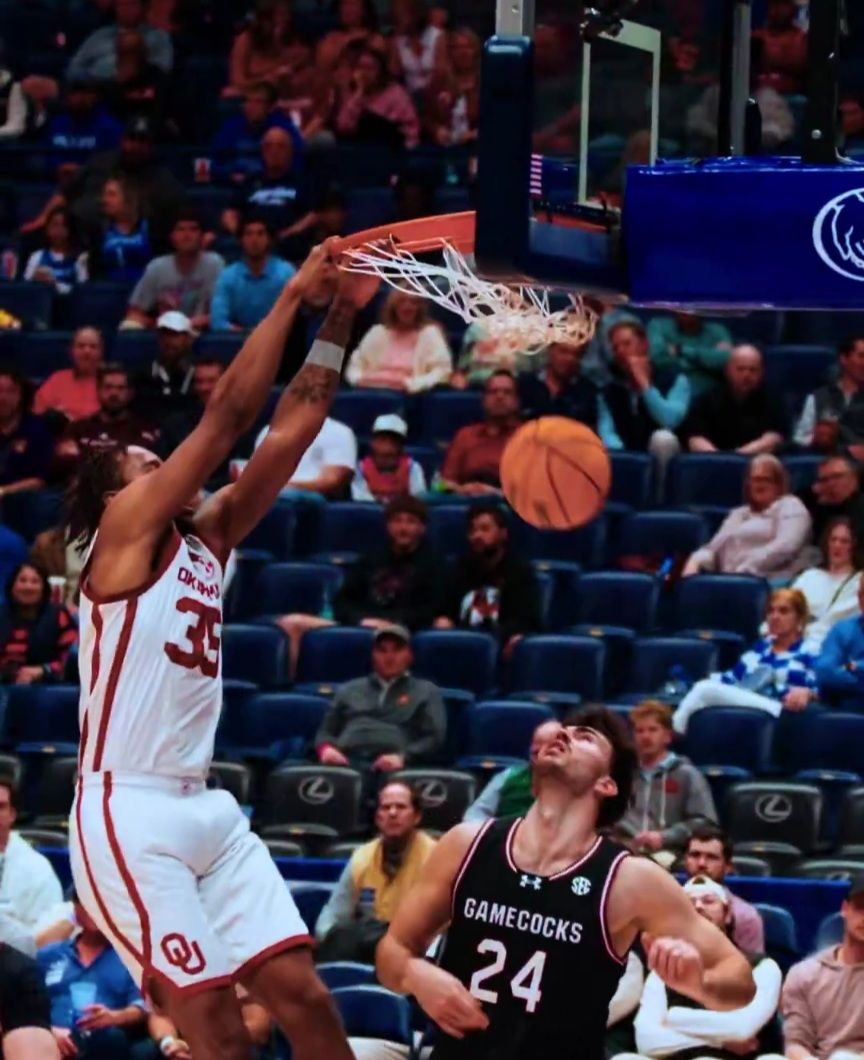
The music inside Bridgestone Arena had barely settled Wednesday night when the reality of the moment began to sink in for Oklahoma Sooners men’s basketball.
For twenty minutes, their postseason felt like it might end before it truly began. For the next twenty, they played like a team determined to keep March alive.
Behind a clinical second half and a scorching offensive performance, Oklahoma erased a 13-point first-half deficit and rolled past the South Carolina Gamecocks 86–74 in the opening round of the SEC Men’s Basketball Tournament. The victory sends the 11th-seeded Sooners into Thursday’s second round against the sixth-seeded Texas A&M and, perhaps more importantly, keeps their NCAA Tournament hopes alive.
It also served as a reminder of how dangerous Oklahoma can be when its offense finds rhythm and its defensive structure tightens.
A Rough Opening — and a Sudden Momentum Shift
Early in the first half, Oklahoma looked like a team still adjusting to the postseason stage.
South Carolina came out firing from deep, repeatedly exploiting ball-screen actions that forced Oklahoma’s interior defenders to retreat toward the rim. That drop coverage left the Gamecocks’ perimeter shooters with rhythm looks, and they took advantage. By the midway point of the first half, South Carolina had built a double-digit lead, eventually stretching it to 39–28 late in the period.
At that moment, Oklahoma’s season felt dangerously close to slipping away.
The Sooners’ perimeter shots weren’t falling, their defensive rotations were a step slow, and the Gamecocks were dictating tempo. But one player refused to let the deficit spiral further.
Tae Davis became Oklahoma’s stabilizing force.
Davis scored 15 of his 18 points in the first half, attacking the rim, drawing contact, and keeping the Sooners within striking distance. His physical drives forced South Carolina to collapse defensively, which eventually opened space for Oklahoma’s shooters.
Then came the run that flipped the emotional tone of the night.
After trailing by 11 late in the half, Oklahoma surged on a 14–3 run that completely erased the deficit before the break. A Davis three-pointer ignited the sequence, followed by transition baskets and improved defensive pressure that forced hurried possessions from South Carolina.
By halftime, the scoreboard read 42–42 — a remarkable turnaround considering where the game had been just minutes earlier.
But the real shift was still coming.
The Halftime Adjustment
The biggest change in the game came on the defensive end.
During the first half, Oklahoma’s ball-screen coverage relied heavily on drop defense. That meant the Sooners’ big men stayed near the paint while South Carolina guards navigated screens at the top of the floor. The result was predictable: the ball-handler turned the corner easily, and trailing shooters found space for open three-pointers.
At halftime, head coach Porter Moser made a decisive schematic change.
Instead of dropping into the paint, Oklahoma’s bigs began hedging aggressively on high ball screens. Players stepped out above the screen to momentarily trap or redirect the ball handler, forcing South Carolina guards to move laterally rather than downhill.
The difference was immediate.
Instead of penetrating “north–south” toward the rim, the Gamecocks were pushed “east–west” across the perimeter. That disruption broke the rhythm of their offense and delayed their timing on kick-out passes.
The numbers tell the story.
After hitting eight three-pointers in the first half, South Carolina managed just three in the second. Their perimeter efficiency cratered to 21.4 percent from beyond the arc as Oklahoma’s hedging coverage repeatedly forced rushed decisions.
Once the Sooners regained defensive control, their offense followed.
The Offensive Catalyst: Freeing Nijel Pack
While the defensive shift changed the tone of the game, Oklahoma’s offensive explosion sealed it.
Leading that charge was veteran guard Nijel Pack, who delivered a game-high 24 points and buried five three-pointers.
Pack’s scoring surge didn’t happen by accident. Oklahoma’s coaching staff began deliberately running off-ball screening actions designed to free him along the perimeter.
One of the most effective was a classic “hammer” action.
In this set, Oklahoma initiated a drive on the wing while Pack waited in the weak-side corner. As the defense collapsed toward the ball, a baseline back screen — the hammer screen — freed Pack behind the play. With the defense focused on stopping the drive, Pack repeatedly slipped into open space for corner threes.
Several of his biggest baskets came from that exact look.
The Sooners also ran “floppy” sets that forced defenders to chase Pack through multiple staggered screens across the baseline. By the time he caught the ball, his defender was often trailing, giving Pack just enough separation to launch.
Those actions produced nine of his 24 points and completely changed the spacing of Oklahoma’s offense.
Once South Carolina began overreacting to Pack, the floor opened for everyone else.
The Efficiency Gap
The box score shows Oklahoma winning by 12 points. The advanced numbers suggest the second half was even more dominant.
Oklahoma finished the game shooting 60 percent from the field and 44 percent from three-point range, an extraordinary level of efficiency in postseason play.
Even more telling was the Sooners’ offensive efficiency in the final twenty minutes.
They produced approximately 1.35 points per possession in the second half — an elite figure that would rank among the best offensive performances of the season.
Ball movement was the driving force behind that efficiency. Oklahoma assisted on a large majority of its second-half baskets, repeatedly turning defensive stops into transition opportunities.
The Sooners also controlled the fast-break battle, scoring 14 points in transition compared to just one for South Carolina.
The lineup that proved most devastating featured Pack alongside Xzayvier Brown, Davis, Derrion Reid, and Wague. That five-man unit generated a decisive scoring margin, combining perimeter shooting, defensive mobility, and transition speed.
Reid’s performance was particularly impactful.
The sophomore forward delivered 20 points on an efficient 6-of-8 shooting night while providing relentless defensive energy. His hustle plays — including a chasedown block late in the first half — helped ignite transition opportunities that deflated South Carolina’s momentum.
Brown added 14 points, while Davis finished with 18.
By the midpoint of the second half, Oklahoma had transformed a tight game into a comfortable lead.
And they never let it slip.
The Bubble Implications
Beyond advancing in the conference tournament, the win carried significant weight for Oklahoma’s postseason future.
Entering the SEC Tournament with an 17–14 record, the Sooners were squarely on the NCAA Tournament bubble. A loss to South Carolina would have most definitely ended their at-large hopes.
Instead, Oklahoma avoided a damaging defeat and added another win to its résumé.
Analysts projected the Sooners entering the night near the edge of the field — hovering between “First Four Out” and “Last Four In.” Wednesday’s victory likely nudges them toward the safer side of that line.
But their path is far from secure.
Thursday’s matchup against Texas A&M now carries enormous stakes. The Aggies represent a stronger opponent and a more valuable résumé opportunity.
Another win would likely solidify Oklahoma’s position inside the projected tournament field.
For now, though, the Sooners are simply focused on surviving and advancing.
March Momentum
In tournament settings, momentum can change in an instant.
Oklahoma experienced both sides of that reality Wednesday night.
They spent the first half scrambling to recover from a double-digit deficit. Then they delivered one of their most efficient stretches of basketball all season.
It was the kind of performance that defines March — resilience, adjustments, and timely scoring.
For a team fighting to extend its season, the formula couldn’t have been clearer.
Oklahoma adjusted.
Oklahoma responded.
And Oklahoma is still playing.
Follow us on Instagram & Facebook