There are box scores that summarize a game, and then there are numbers that explain it.
Oklahoma’s 8–7 comeback win over Arkansas on Friday night at Love’s Field falls firmly into the latter category—a game where every critical moment, every swing, and every decision can be traced through the numbers that defined it.
This wasn’t just a victory. It was a statistical case study in resilience, efficiency, and championship-level response.
4–0: The Deficit That Framed Everything
Start with the number that shaped the night: four.
That’s how many runs Oklahoma trailed by in the third inning after Arkansas struck early and decisively. The Razorbacks used aggressive at-bats and situational execution to build a 4–0 lead, highlighted by a two-run single from Karlie Davison and a two-run home run from Tianna Bell.
For most teams, a four-run deficit against a top-10 opponent is a problem.
For Oklahoma, it’s become part of the formula.
Friday marked the 15th comeback win of the season for the Sooners—and notably, it tied their largest deficit overcome all year. Once agian, we get a look at Oklahoma’s identity. This is a roster built not just to score early, but to respond late.
1 Swing, 4 Runs: The Emerling Effect
If “four” defined the problem, one swing defined the solution.
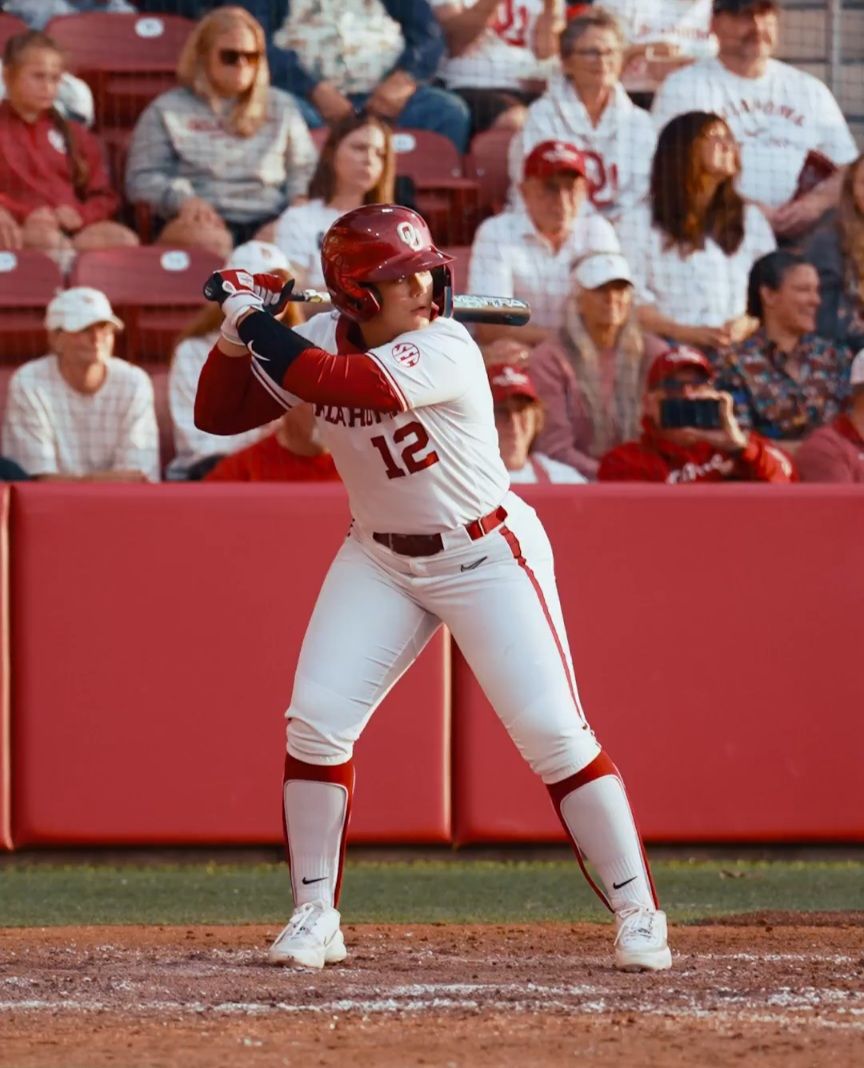
Redshirt-senior Isabela Emerling stepped to the plate in the third inning with the bases loaded and delivered the most important number of the night: four RBIs on a single pitch.
Her opposite-field grand slam tied the game at 4–4 and instantly reset the momentum inside Love’s Field.
But the deeper numbers behind Emerling’s swing tell an even bigger story:
- 9 career grand slams, tied for third in NCAA history
- Oklahoma is now 23–0 when Emerling homers
- The blast marked part of OU’s season-long trend of power production, pushing the team to 152 home runs on the year
That last number matters in context. Oklahoma now sits just 10 home runs shy of the NCAA single-season record, and performances like Friday are exactly how that record comes into reach.
Emerling’s swing didn’t just tie the game—it reaffirmed a pattern. When she delivers power, Oklahoma doesn’t lose.
8 Runs on 8 Hits: Efficiency Over Volume
At first glance, Oklahoma’s offensive output looks balanced: 8 runs on 8 hits.
But the real story is how those runs were generated.
This wasn’t a game where the Sooners overwhelmed Arkansas with sheer volume. Instead, they maximized key opportunities:
- Timely extra-base hits (Emerling’s grand slam, Lexi McDaniel’s double)
- Productive outs (Kasidi Pickering’s sacrifice fly)
- Situational execution (Ailana Agbayani’s RBI fielder’s choice)
It’s a reminder that Oklahoma’s offense isn’t just powerful—it’s precise.
Even more telling: Oklahoma has now produced 52 innings of four runs or more this season. That consistency shows up in games like this, where one explosive inning can erase even the largest deficits.
5th Inning Flip: The Hidden Turning Point
While Emerling’s grand slam will dominate headlines, the numbers point to the fifth inning as the true inflection point.
After Arkansas reclaimed a 5–4 lead on Ella McDowell’s solo home run, Oklahoma responded immediately—and efficiently.
Key sequence:
- Gabbie Garcia single (she finished 2-for-2 with two walks)
- Emerling hit by pitch
- Productive groundout moves runners
- Agbayani RBI fielder’s choice ties the game
- McDaniel’s pinch-hit double gives OU its first lead
That inning featured just two hits, but produced two runs and permanently shifted control of the game.
It also showcased two critical trends:
1. Garcia as a table-setter
Reaching base four times in four plate appearances (2 hits, 2 walks), Garcia quietly drove the offense. Oklahoma thrives when its leadoff presence creates pressure—and Friday was a textbook example.
2. Freshman impact in high-leverage moments
McDaniel’s go-ahead double wasn’t just timely—it was strategic. As a pinch hitter, she entered cold and delivered immediately, reinforcing Oklahoma’s depth and late-game flexibility.
6th Inning Insurance: The Margin That Mattered
Championship teams understand the value of separation.
Oklahoma added two more runs in the sixth inning, pushing the lead to 8–5:
- Kendall Wells RBI single
- Pickering sacrifice fly
Those numbers may seem routine, but they proved decisive.
Without those two runs, Arkansas’ late rally in the seventh would have flipped the result.
Instead, they created just enough cushion for Oklahoma to survive.
7–0: Thriving in Tight Games
The final margin brings us to one of the most telling numbers of the season:
7–0 in one-run games.
After Arkansas scored twice in the seventh to cut the deficit to 8–7, Oklahoma found itself in a familiar position—protecting a narrow lead with everything on the line.
This is where elite teams separate themselves.
It wasn’t perfect. Arkansas strung together hits, applied pressure, and brought the tying run into scoring position. But Oklahoma executed when it mattered most.
Freshman Allyssa Parker entered with two outs and delivered the final one, earning her first career save.
Seven one-run games. Seven wins.
That’s not luck. That’s composure.
19–2: Lowry’s Resilience
In a game defined by offense, Audrey Lowry’s line deserves context.
- 6.2 innings pitched
- 7 runs allowed
- 19th win of the season
On paper, it’s not her sharpest outing. But numbers don’t always capture impact.
Lowry’s ability to stabilize after early damage—stranding runners in key innings and keeping the deficit manageable—gave Oklahoma the chance to come back.
Sometimes, the most important number isn’t ERA—it’s innings survived.
31 Straight: Love’s Field Advantage
Friday’s win extended another streak that continues to define Oklahoma’s dominance:
31 consecutive home victories.
That number reflects more than just comfort—it reflects control. Love’s Field has become a place where deficits don’t feel permanent and late innings favor the home side.
Add in a crowd of 4,468, and the Sooners once again leveraged their environment into an edge.
43 of 46: Power as a Constant
One of the most staggering numbers of Oklahoma’s season showed up again Friday:
43 games with a home run in 46 contests.
Emerling’s grand slam ensured that trend continued, reinforcing what may be the most reliable metric of Oklahoma’s success:
When the Sooners leave the yard, they dictate the game.
The Final Number: 15 Comebacks
Circle back to where this started.
15 comeback wins.
That’s the defining number—not just of this game, but of Oklahoma’s season.
Because Friday night wasn’t about perfection. It was about response:
- Down 4–0 → respond with a grand slam
- Down 5–4 → respond with a two-run inning
- Lead cut to one → respond with a shutdown finish
Every challenge met with an answer.
Every deficit met with belief.
Inside the Numbers, Beyond the Numbers
The box score says Oklahoma won 8–7.
The numbers say something more:
They say this is a team that doesn’t panic at four-run deficits.
They say power and precision coexist in the same lineup.
They say freshmen are ready for the biggest moments.
They say close games aren’t coin flips—they’re controlled outcomes.
And most importantly, they say that even after a rare stumble, Oklahoma still knows exactly how to respond.
That’s what Friday night proved.
Not just that the Sooners won.
But that, by every meaningful number, they remain exactly who they’ve been all season.
Follow us on Instagram & Facebook