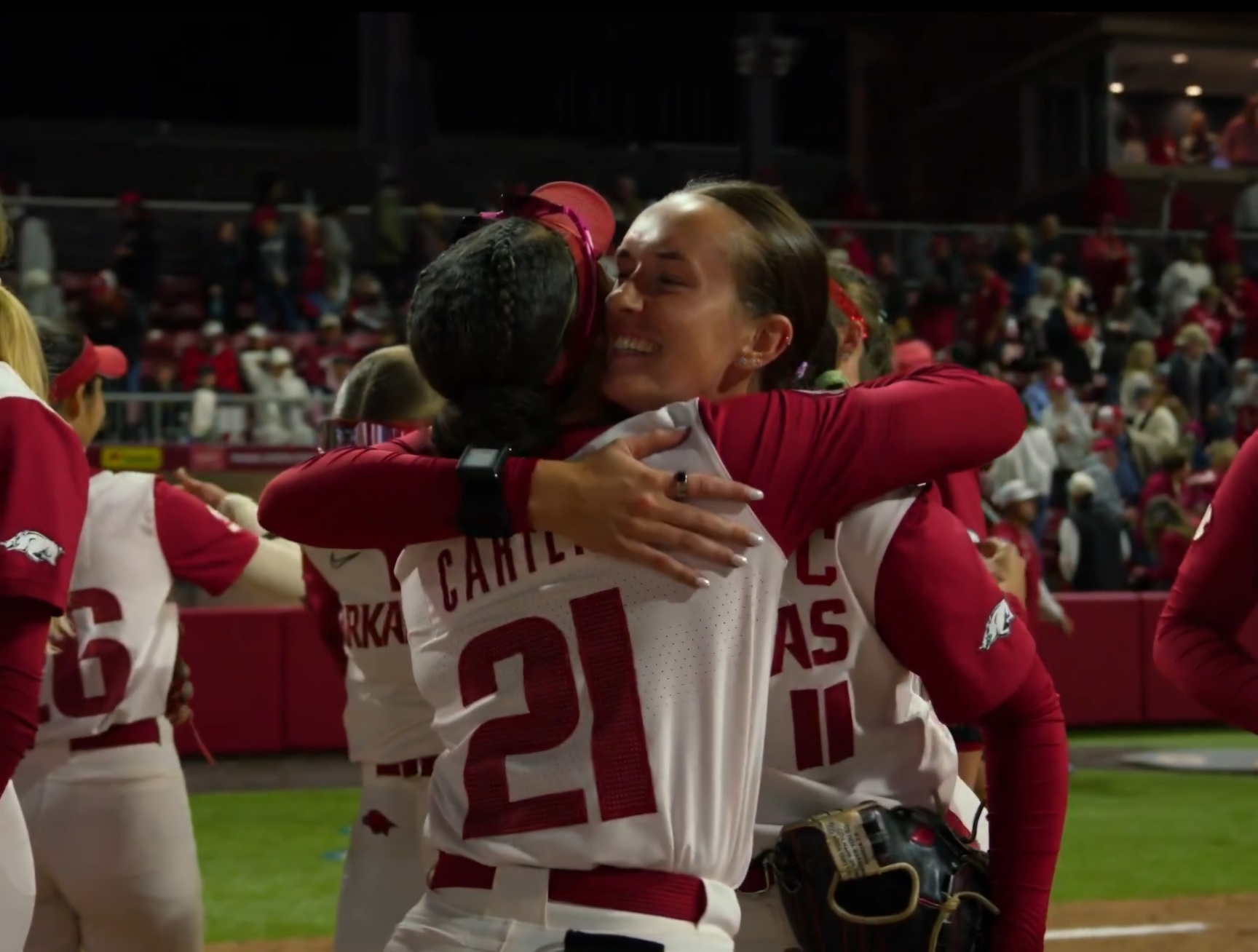
Some losses look routine in a box score. This one doesn’t hold up under that kind of simplification.
No. 1 Oklahoma fell 3–2 to No. 6 Arkansas on Saturday night at Love’s Field, but the numbers behind it reveal something far more unusual: a game where Oklahoma pitched well enough to win, defended well enough to win, and still came up short because the margins never tilted in its favor.
This was an “Inside the Numbers” loss—one defined less by volume and more by precision, scarcity, and the rare disruption of Oklahoma’s usual formula.
31: A Streak Ends at Home
Start with the number that immediately reframes the night: 31.
That’s how many consecutive home games Oklahoma had won before Saturday. It was the longest active home winning streak in the nation, stretching back over a year and turning Love’s Field into a near-automatic advantage.
Now it’s gone.
That matters not just historically, but psychologically. Oklahoma has built its identity on control—of environment, of tempo, of outcomes. When a streak like that ends, it signals something deeper than a single result. It signals vulnerability.
And it happened in a game where the Sooners never lost control in the way the scoreboard might suggest—they just never fully took it.
3–2: The Margin That Flipped the Script
The final score—3–2—represents more than just a one-run loss.
It represents Oklahoma’s first defeat in a one-run game this season, dropping them to 7–1 in that category. For a program that has made a habit of closing tight games with surgical precision, that number stands out.
In previous one-run scenarios, Oklahoma found the extra at-bat, the extra baserunner, the extra execution.
On Saturday, those extras never came.
4 Hits, 0 Walks: A Broken Offensive Engine
If there’s a single statistical line that defines this game, it’s this:
- 4 hits
- 0 walks
- 2 runs (both solo home runs)
That’s not just a quiet night—it’s a structural breakdown of how Oklahoma typically wins.
This offense is built on accumulation: baserunners, pressure, pitch counts, and eventually, damage. Walks are often the ignition point. They force pitchers into mistakes, stretch innings, and create the multi-run bursts that define Oklahoma’s dominance.
Arkansas eliminated that entirely.
No walks means no traffic. No traffic means no innings. And no innings means even the most powerful swings—like the two Oklahoma home runs—become isolated moments instead of turning points.
It’s not that Oklahoma didn’t hit. It’s that they never connected.
2 Solo Home Runs: Power Without Pressure
Both of Oklahoma’s runs came the same way:
- Isabela Emerling: 262-foot solo home run (5th inning)
- Kendall Wells: solo home run (6th inning)
On most nights, two home runs are enough to tilt the game.
On this night, they weren’t.
Why? Because of what didn’t happen around them.
No one was on base. No rally followed. No inning extended.
Even more striking: Oklahoma had been 23–0 in games where Emerling homered prior to Saturday. That streak ended here, reinforcing just how disconnected the offense was from its usual rhythm.
Power showed up. Support did not.
4 Hits Allowed: Pitching That Deserved More
Defensively and in the circle, Oklahoma delivered a performance that typically wins.
- 4 hits allowed
- 0 walks issued by Sydney Berzon
- 2 earned runs allowed by Berzon over 4.2 innings
That’s winning baseball.
Berzon, in particular, was exceptional in relief. After entering in the third inning, she retired 8 of the first 9 batters she faced, stabilizing the game and holding Arkansas to a 1–0 lead deep into the contest.
Her command was sharp. Her pace was controlled. And she forced Arkansas into limited opportunities.
But in a game defined by slim margins, one swing changed everything.
1 Swing, 2 Runs: The Decisive Blow
With the game tied 1–1 in the sixth inning, Arkansas’ Tianna Bell delivered the moment that separated the teams:
- 2-run home run
- 3–1 lead
In a game where offense was scarce, that swing carried disproportionate weight.
Arkansas didn’t need multiple rallies. They needed one mistake, one pitch, one opportunity.
They got it—and capitalized.
59 Pitches: Berzon’s Workload
Another number worth noting: 59 pitches.
That’s the season high for Berzon, reflecting both her efficiency and her importance in this game. She wasn’t just filling innings—she was controlling them.
And yet, even that level of performance wasn’t enough to overcome the lack of offensive support.
1 Play Here, 1 Play There: Defensive Margins
In a game where neither team recorded a multi-hit performance from any player, defense became a defining factor.
Oklahoma made several elite plays:
- Ella Parker’s wall-saving catch in the second inning
- Abby Dayton’s diving grab in the third
Those moments prevented additional runs and kept the deficit manageable.
But Arkansas matched them.
- Reagan Johnson’s diving catch in right-center robbed Kasidi Pickering of extra bases in the fifth
That play may have quietly changed the inning—and the game.
When hits are scarce, every ball in play matters more. Arkansas made sure Oklahoma never turned those moments into momentum.
5 Outs: The Finish
The final stretch of the game belongs to one number sequence:
5 outs.
Arkansas reliever Robyn Herron entered in the sixth inning and retired every batter she faced, retiring the final five Sooners to end the game.
No contact. No pressure. No chance.
Against the nation’s top-ranked lineup, that’s not just effective—it’s dominant.
It also highlights the central theme of the game: Oklahoma never made Arkansas uncomfortable.
33: Wells Closing in on History
Even in defeat, one number continues to build:
33 home runs for Kendall Wells.
Her sixth-inning blast pulled Oklahoma within one and brought her within one home run of Jocelyn Alo’s program record (34).
In a game where offense was hard to come by, Wells’ ability to produce in isolation stands out.
But like everything else Saturday, it came alone.
4,526: A Record Crowd, a Rare Silence
The environment mattered.
- 4,526 fans—a season high at Love’s Field
That crowd has grown accustomed to late-game surges, offensive explosions, and home dominance.
Instead, they witnessed something far rarer:
A game where Oklahoma never found its rhythm—and couldn’t manufacture one late.
The Final Numbers That Matter
Pull it all together, and the defining numbers tell a clear story:
- 31: Home winning streak ended
- 7–1: Now Oklahoma’s record in one-run games
- 4: Hits for Oklahoma
- 0: Walks drawn
- 2: Solo home runs (no runners on)
- 4: Hits allowed by Oklahoma pitching
- 5: Consecutive batters retired to end the game
Individually, none of these numbers are overwhelming.
Together, they explain everything.
Inside the Numbers, Outside the Norm
This wasn’t a loss built on collapse.
It was built on disruption.
Arkansas removed walks. They limited baserunners. They matched defensive plays. And when the moment came, they delivered the one swing that mattered most.
Oklahoma, meanwhile, played a game that looked structurally sound—but statistically incomplete.
The Sooners didn’t lose because they were overpowered.
They lost because they were disconnected.
And in a sport where margins are thin, that’s all it takes.
Now, the numbers reset.
And the only one that matters next is 1—as in one game left to decide the series.