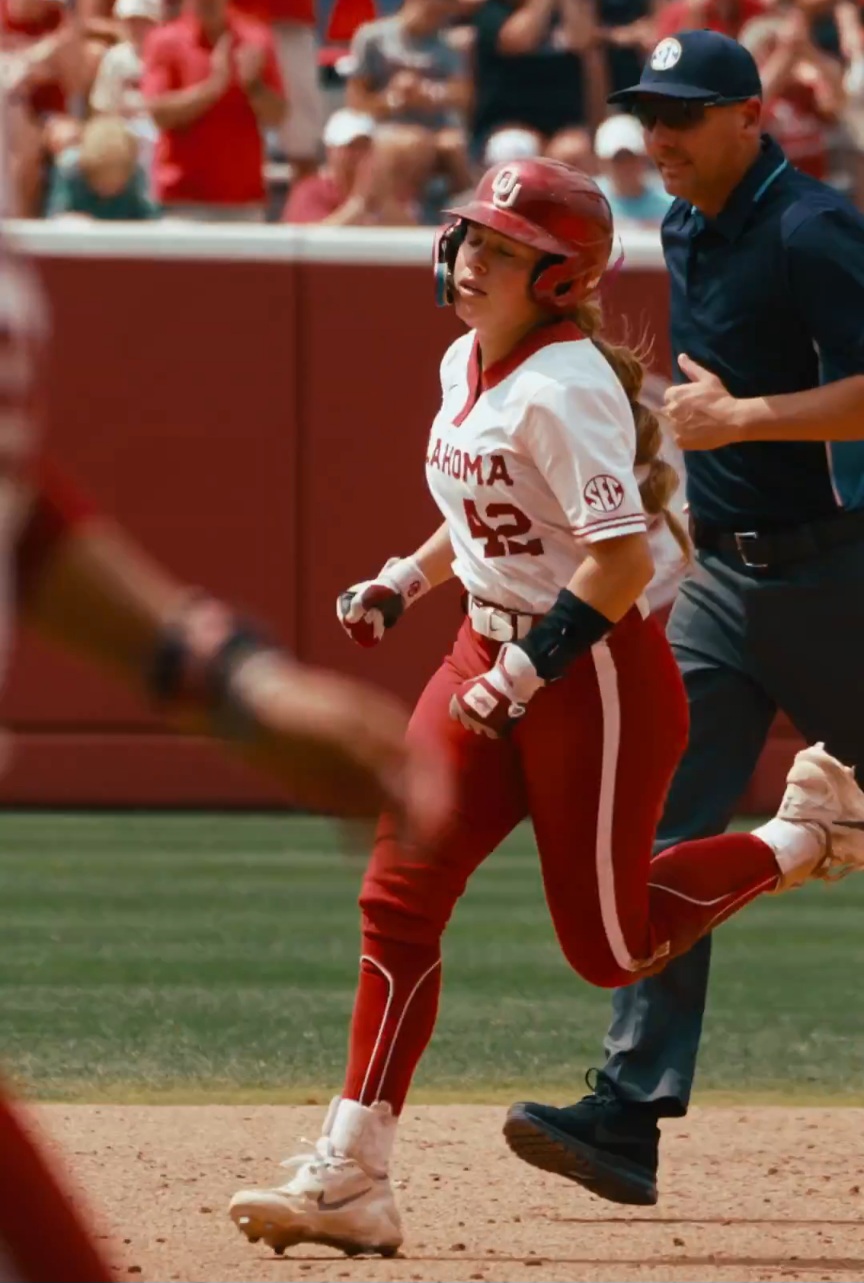
At this point in the season, the conversation around the No. 1 Oklahoma Sooners is no longer about whether they’re elite. That’s long been established. The real question—the one that continues to evolve by the week—is just how deep that excellence runs.
On Wednesday, that answer became a little clearer.
Oklahoma placed four players—Gabbie Garcia, Kai Minor, Ella Parker and Kendall Wells—on the USA Softball Collegiate Player of the Year Top 25 list, the most of any program in the country. In a sport defined by individual dominance as much as team success, Oklahoma didn’t just show up on the list. It took it over.
No other team matched four selections. Only six programs placed multiple players.
And in typical Oklahoma fashion, the details behind those names are what elevate this from impressive to defining.
A Roster Built on Layers, Not Labels
Awards lists often skew toward upperclassmen—players with years of production, established résumés, and national recognition. This year’s Top 25 is no different, featuring 21 upperclassmen.
Which makes Oklahoma’s presence even more striking.
Two of its four selections—Minor and Wells—are freshmen. Garcia is just a sophomore. Parker, meanwhile, is a first-time honoree enjoying a breakout campaign.
This isn’t a veteran-heavy roster peaking late.
It’s a layered lineup where impact isn’t tied to experience—it’s tied to performance.
And that’s what makes Oklahoma so difficult to game-plan against. There’s no obvious weak point. No easy lane through the lineup. Every inning presents a different kind of pressure.
Kendall Wells: The Record Breaker Redefining the Standard
Start with the name that has become synonymous with history this season: Kendall Wells.
The freshman catcher isn’t just having a great year. She’s rewriting what a freshman season looks like in college softball.
Wells leads the nation with 36 home runs, already setting single-season records for Oklahoma, the SEC, and NCAA freshmen. Her numbers are staggering across the board:
- .377 batting average
- 36 home runs
- 79 RBIs
- 63 runs scored
- 1.113 slugging percentage
But numbers only tell part of the story.
What separates Wells is when those numbers happen. Early innings, late innings, tight games, blowouts—it doesn’t matter. Her presence changes how opponents pitch to everyone around her. She forces adjustments before stepping into the box.
And as the season enters its final stretch, every at-bat carries added weight. She’s not just producing—she’s chasing history.
Gabbie Garcia: The Engine in the Middle
If Wells is the headline, Garcia might be the heartbeat.
The sophomore shortstop has taken a significant leap from her freshman campaign, already surpassing her previous totals in runs, hits, doubles, home runs, RBIs, and walks. That kind of across-the-board improvement doesn’t happen by accident—it’s the result of refinement.
Garcia enters the final stretch with:
- 22 home runs
- 66 RBIs (third in the SEC)
But her impact goes beyond production.
She’s the connective tissue of the lineup—the player who extends innings, capitalizes on traffic, and delivers in high-leverage moments. Whether it’s a clutch extra-base hit or a defensive play that halts momentum, Garcia’s fingerprints are consistently on Oklahoma’s biggest moments.
Her inclusion on this list isn’t just deserved. It’s overdue recognition of a player who has quietly become one of the most complete in the conference.
Kai Minor: Speed, Contact, and Disruption
Then there’s Kai Minor, the kind of player who forces defenses to rethink everything.
The freshman outfielder leads Oklahoma with 66 hits and is hitting .440, the top mark among SEC freshmen and one of the best in the nation. But labeling her as just a high-average hitter undersells what she brings.
Minor is disruption.
- 56 runs scored
- 11 doubles
- 5 triples
- 7 home runs
- 17 stolen bases
She doesn’t wait for innings to develop—she creates them.
A single turns into pressure. Pressure turns into mistakes. Mistakes turn into runs.
In a lineup filled with power, Minor provides the contrast that makes Oklahoma even more dangerous. She doesn’t need the long ball to change a game. She can do it with one swing, one sprint, one read.
And for a freshman to play that role at this level speaks to both her skill and her composure.
Ella Parker: The Breakout Star With No Holes
Every great team has a player who moves from “important” to “indispensable” over the course of a season.
For Oklahoma, that’s Ella Parker.
The right fielder is putting together a career year:
- .430 batting average
- 19 home runs
- 57 RBIs
- Perfect fielding percentage
- 3 outfield assists
Her offensive numbers stand on their own, but it’s the combination of production and reliability that makes her invaluable.
She doesn’t give away at-bats. She doesn’t give away outs.
And defensively, she’s been flawless.
In a sport where small mistakes can swing games, Parker has removed that variable entirely. That consistency is what turns good teams into championship teams.
The Bigger Picture: What Four Finalists Really Means
It’s easy to view this as an awards story.
It’s not.
This is a roster construction story.
Because what Oklahoma has built isn’t just a lineup of stars—it’s a lineup where stars overlap, complement, and elevate each other.
Power hitters surrounded by contact hitters. Speed paired with discipline. Defense backing everything up.
And most importantly, production that doesn’t drop off from one spot to the next.
That’s why Oklahoma leads the nation in finalists.
It’s not about having the best player.
It’s about having too many to ignore.
What Comes Next
The USA Softball Collegiate Player of the Year race is far from over.
The list will narrow:
- Top 10 on May 13
- Top 3 on May 18
- Winner announced ahead of the Women’s College World Series
Historically, the award has gone to players who combine elite production with team success. Oklahoma checks both boxes.
But having four players in the Top 25 doesn’t guarantee anything individually.
What it does guarantee is visibility.
Every game from here on out becomes part of the evaluation. Every series, every postseason moment, every high-leverage at-bat adds to the narrative.
And if Oklahoma continues its current trajectory, don’t be surprised if more than one Sooner is still standing deep into that finalist process.
The Standard in Norman
There’s a reason Oklahoma continues to operate at the top of the sport.
It’s not just recruiting. It’s not just development.
It’s the ability to create an environment where multiple players can thrive at the highest level simultaneously.
Four Top 25 finalists isn’t a coincidence.
It’s a reflection of a system that produces excellence—and then multiplies it.
And as the postseason approaches, that might be the most dangerous thing of all.
Because while other teams search for their best player to carry them forward, Oklahoma doesn’t have to look very far.
They have four of them.