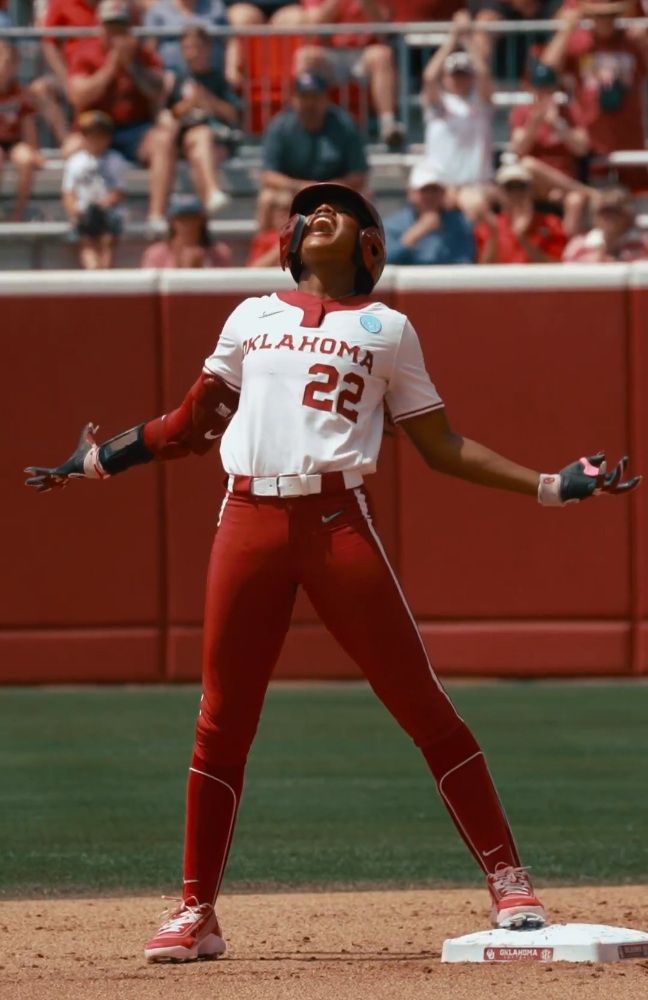
Dynasties are not supposed to reload this fast.
That is the uncomfortable truth the rest of college softball is now being forced to confront.
For years, opposing programs convinced themselves that eventually the Oklahoma machine would slow down. Maybe it would happen after the graduation of legends like Jocelyn Alo. Maybe it would happen after the departure of veteran championship cores. Maybe the transition into the Southeastern Conference would finally level the playing field.
Instead, Oklahoma just produced two of the three finalists for the NFCA Freshman of the Year award.
Kai Minor and Kendall Wells are not merely breakout freshmen enjoying a hot season. They are evidence that Patty Gasso has built something much larger than a championship roster.
She has built a self-sustaining ecosystem.
And that should terrify the rest of the sport.
Because what this honor really says about Oklahoma softball is not that the Sooners recruit elite talent. Everybody already knew that. It says Oklahoma has reached the point where greatness is no longer cyclical.
It is structural.
That is the difference.
Most elite college programs rise and fall with superstar classes. A great recruiting cycle produces a title contender. A few graduating seniors later, the inevitable rebuilding phase begins.
That is not happening in Norman anymore.
Oklahoma is no longer rebuilding.
Oklahoma is replicating.
This Is Bigger Than Individual Awards
On paper, the accomplishment is staggering enough by itself.
Minor and Wells became just the third pair of teammates in history to both reach the NFCA Freshman of the Year Top Three in the same season. Oklahoma previously accomplished it in 2021 with Jayda Coleman and Tiare Jennings. Before that, only Florida managed it in 2016 with Amanda Lorenz and Kelly Barnhill.
That alone places this freshman class in historic territory.
But the deeper significance lies in what kind of players these freshmen already are.
Minor is not a role player developing slowly into relevance. She is arguably the most complete freshman in the country.
A .446 batting average.
Seventy-nine hits.
A perfect 1.000 fielding percentage in center field.
Seventeen doubles.
Six triples.
Seventeen stolen bases.
Twenty-seven multi-hit games.
That is not freshman production.
That is All-American production.
Meanwhile, Wells has spent the season detonating record books.
Thirty-seven home runs.
Eighty-one RBIs.
An SEC Freshman of the Year award.
The NCAA freshman home run record.
The Oklahoma single-season home run record.
An SEC single-season home run record.
And perhaps most impressively, she did all of it while handling one of the most pressure-filled defensive positions in the sport behind the plate.
Most freshmen arrive at powerhouse programs hoping to survive.
These two arrived intending to dominate.
And they did.
Immediately.
Oklahoma Has Created the Most Dangerous Development System in College Softball
Here is the opinion that many around the sport are becoming increasingly uncomfortable admitting:
Oklahoma’s true advantage is no longer recruiting.
It is development.
The Sooners are not simply landing elite prospects. Plenty of major programs sign elite recruits. The difference is that Oklahoma consistently accelerates players into fully formed stars faster than anyone else in the country.
That is the real story behind Minor and Wells.
Under most circumstances, freshmen are supposed to fluctuate emotionally. They are supposed to struggle with SEC pitching. They are supposed to hit walls during postseason pressure.
Instead, Minor and Wells look completely operational inside Oklahoma’s championship infrastructure.
Why?
Because Gasso has created an environment where young players are absorbed into an established culture instead of being asked to create one themselves.
That matters.
When freshmen arrive in Norman, they are immediately surrounded by veterans who already understand how to prepare, how to handle pressure, and how to survive expectations. The standard is already in place before they step on campus.
That accelerates growth.
It eliminates hesitation.
And most importantly, it creates confidence.
Minor plays center field with the calm of a fourth-year starter because Oklahoma’s culture teaches players to trust preparation over emotion.
Wells swings with absurd freedom because Oklahoma’s offensive system encourages aggressive conviction rather than fear of failure.
These freshmen are not anomalies.
They are products of the system.
That is what should concern the rest of the sport.
The SEC Was Supposed to Slow Oklahoma Down
Remember the conversation entering Oklahoma’s move into the SEC?
The assumption was that the week-to-week grind of the nation’s deepest softball conference would finally wear the Sooners down. The physicality would increase. The pitching depth would improve. The margin for error would shrink.
Instead, Oklahoma responded by placing two freshmen at the center of the conference.
Not upperclassmen.
Not transfers.
Freshmen.
That is absurd.
Wells became the first SEC Freshman of the Year in Oklahoma history while simultaneously becoming one of the most dangerous power hitters in the nation.
Minor became one of the most complete two-way players in college softball before finishing her first season.
And they did it in the sport’s toughest conference.
This is why Oklahoma’s dominance feels different from past dynasties.
Most dynasties eventually age out.
Oklahoma keeps getting younger.
That changes the long-term equation for the entire sport.
The Scariest Part? They Complement Each Other Perfectly
What makes Minor and Wells even more devastating together is how stylistically different they are.
Minor is pressure.
Wells is punishment.
Minor stresses defenses with contact, speed, doubles, triples, and relentless table-setting. She forces opponents into uncomfortable defensive positioning and creates chaos on the bases.
Then Wells arrives and changes the scoreboard instantly.
Together, they form the exact kind of offensive ecosystem that makes Oklahoma almost impossible to survive over seven innings.
You cannot pitch around Wells because Minor constantly creates traffic.
You cannot focus solely on Minor because Wells can destroy a game with one swing.
That balance matters.
And it reflects a larger truth about how Oklahoma constructs rosters now.
The Sooners are no longer recruiting isolated stars. They are recruiting interconnected skill sets that amplify one another.
That is sophisticated roster engineering.
And it is why Oklahoma continues to stay ahead of the sport tactically.
This Says Something Enormous About Patty Gasso
At some point, these conversations always circle back to the same conclusion.
Patty Gasso is no longer simply coaching great teams.
She is shaping the future of the sport.
The easiest thing for a dynasty to lose is hunger. Sustaining internal motivation after years of championships is extraordinarily difficult. Eventually, comfort usually creeps in.
Yet Oklahoma somehow continues producing freshmen who arrive desperate to compete immediately instead of waiting their turn.
That is culture.
That is leadership.
And that is why Gasso’s program remains the standard.
The most remarkable part of Oklahoma’s continued dominance is not the championships anymore. It is the continuity.
The names change.
The production does not.
That is incredibly rare in college athletics.
Here’s the Reality the Sport Must Accept
There was a time when Oklahoma softball felt like a great era.
Now it feels institutional.
That distinction matters.
Because eras end.
Institutions endure.
Minor and Wells are the latest evidence that Oklahoma is no longer operating on temporary momentum. The Sooners have built a system capable of regenerating elite talent faster than the rest of the sport can catch up.
And that reality creates an uncomfortable question for everybody else chasing Oklahoma.
If the Sooners can lose legendary seniors, transition into the SEC, endure enormous expectations, and still place two freshmen among the three best newcomers in America… then when exactly is the drop-off supposed to happen?
Right now, there is no evidence it is coming.
In fact, the opposite appears true.
Oklahoma is not fading.
Oklahoma is evolving.
And the terrifying part for the rest of college softball is that the next great Sooner dynasty may have already started with two freshmen.
Follow us on Instagram & Facebook