On Monday’s We Offer Free Previews Of Our Subscription Content. Find Articles Like This Every Day As A Subscriber. Enjoy!
For almost a decade, the road to the Women’s College World Series ran directly through Norman. Every spring eventually ended the same way: the Oklahoma Sooners standing in Oklahoma City, still alive, still dangerous, still carrying the weight of college softball’s modern dynasty.
That streak ended on May 24, 2026.
Mississippi State stormed into Love’s Field and did what nobody had done since 2015 — eliminate Oklahoma before the WCWS. The Bulldogs stunned the Sooners in the Norman Super Regional, punctuating the upset with a suffocating 6-0 shutout in Game 3 that snapped Oklahoma’s streak of nine consecutive Women’s College World Series appearances.
For most programs, that kind of ending would trigger existential questions.
For Oklahoma, it may become the beginning of another monster era.
Because beneath the heartbreak, beneath the silence of Love’s Field after the final out, and beneath the uncomfortable reality of a season ending early by Oklahoma standards, there was another truth hiding in plain sight:
The Sooners’ 2026 offense — arguably the most explosive lineup in NCAA softball history — was powered primarily by underclassmen.
And now those players return angry.
That should terrify the rest of college softball.
Under legendary head coach Patty Gasso, Oklahoma finished 52-10, captured another SEC regular-season championship, smashed offensive records across the sport, and became the first program in NCAA history to feature five players with at least 20 home runs in a single season. Yet the defining image of the year became Mississippi State celebrating on Oklahoma’s home field while the Sooners walked quietly toward an unfamiliar offseason.
Dynasties are judged differently. At Oklahoma, greatness is no longer measured merely by conference titles, 50-win seasons, or statistical dominance. The standard is Oklahoma City. The standard is playing for national championships.
So yes, 2026 ended in failure by the program’s own expectations.
But if you zoom out from one devastating weekend, the larger picture becomes impossible to ignore.
The Sooners are not rebuilding.
They are reloading around a young offensive nucleus that already rewrote the NCAA record book before most of its stars could legally order a drink.
Start with the obvious centerpiece: Kendall Wells.
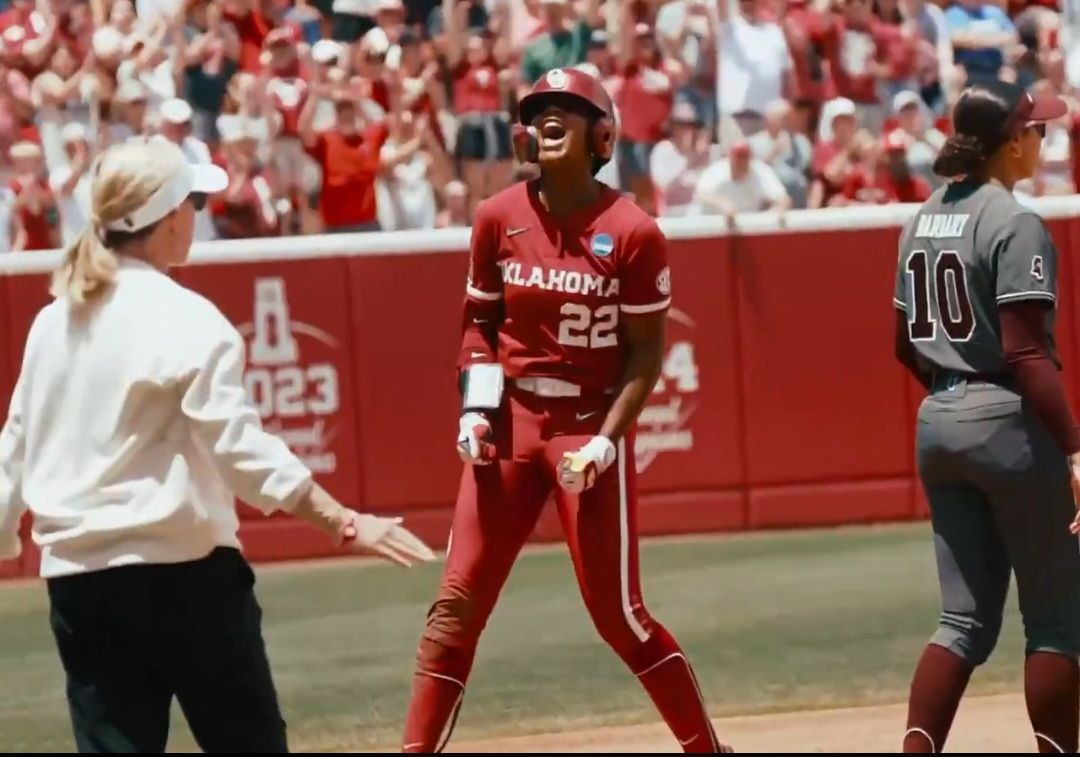
No player better represents both the pain of 2026 and the promise of 2027 than the freshman catcher who authored one of the greatest debut seasons college softball has ever seen.
Wells didn’t merely arrive in Norman. She detonated onto the national stage.
Her 39 home runs finished as the second-highest single-season total in NCAA history. She broke legendary Oklahoma records previously held by Jocelyn Alo, became an NFCA Freshman of the Year finalist, and served as the thunderous centerpiece of a lineup that terrorized opposing pitchers for four months.
And somehow, the scariest part for the rest of the country is this:
She was only a freshman.
That matters because history suggests players make their biggest developmental jump between Year 1 and Year 2. Wells just produced a generational offensive season while still learning how to navigate SEC softball, postseason pressure, scouting adjustments, and the daily grind of a championship program.
Imagine what she becomes with another offseason in Gasso’s system.
Now add the fact that Wells is not carrying this alone.
Ella Parker returns after posting one of the most efficient offensive seasons in the country, finishing with a jaw-dropping OPS north of 1.400 while cementing herself as one of the sport’s elite pure hitters. Kai Minor’s elite speed and high-average efficiency actually hold the strategic key to Oklahoma’s 2027 redemption. By pairing Minor’s rare ability to consistently get on base with the raw, structural power of Kendall Wells, and the reliability of Parker’s bat, Gasso has created an unstoppable “lightning and thunder” dynamic that ensures the lineup will not suffer another sudden, season-ending offensive drought.
That trio alone would make Oklahoma a national title contender.
But the deeper truth about the 2026 Sooners is that the postseason collapse had far less to do with a lack of talent and far more to do with the volatile cruelty of softball in May.
Against Mississippi State, Oklahoma’s weaknesses surfaced all at once.
In Game 1, defensive miscues and pitching instability fueled an 11-9 collapse that snapped the Sooners’ 18-game Super Regional winning streak. In Game 3, the offense simply froze. Oklahoma managed just three hits while Bulldogs left-hander Delainey Everett authored the performance of her life.
It was stunning precisely because it felt so abnormal.
Oklahoma didn’t lose because the roster lacked championship ability. Oklahoma lost because even historic offenses can go cold for one weekend, and because the sport’s margins become microscopic in elimination softball.
The key long-term question isn’t whether 2026 ended badly.
It’s whether the experience hardens the players who lived through it.
History says it probably will.
Some of Gasso’s greatest championship teams were built after painful postseason lessons. The 2026 roster now carries emotional scar tissue that cannot be replicated through practice drills or regular-season victories.
The young core learned what pressure feels like when an entire dynasty rests on every pitch. They learned what happens when momentum slips away in postseason softball. They learned how fragile championship runs can be.
Those lessons tend to matter later.
The development of Audrey Lowry may ultimately symbolize that growth better than anyone.
Lowry’s weekend against Mississippi State captured the emotional volatility of Oklahoma’s season. She struggled during the Game 1 collapse, then responded by throwing a complete-game masterpiece in Game 2 to keep the Sooners alive.
That bounce-back mattered.
Championship-caliber aces are not defined by never failing. They are defined by how they respond after failure. Lowry proved she possesses the competitive wiring Oklahoma needs moving forward.
And perhaps most importantly, she gained that experience before even reaching her upperclassman years.
The broader roster structure also favors Oklahoma entering 2027.
The Sooners are not staring at a massive graduation cliff. Unlike some powerhouse programs that cycle through senior-heavy cores, Oklahoma’s offensive engine remains largely intact. The lineup that shattered NCAA home run records is returning with postseason humiliation fresh in its memory.
That combination — elite talent mixed with lingering bitterness — is often combustible in the best possible way.
Then comes the final piece of the equation: recruiting.
Oklahoma’s incoming class is once again viewed among the nation’s best, particularly in areas the Sooners need most. The 2026 team overwhelmed opponents with power, but the Super Regional exposed inconsistencies in pitching depth and situational offensive execution.
The incoming talent appears designed specifically to address those issues.
That’s how sustainable dynasties survive disappointment.
They evolve before anyone else does.
The easiest reaction after Oklahoma’s Super Regional exit is to declare the dynasty over. That’s what sports conversations do after shocking endings. They rush toward dramatic conclusions.
But dynasties rarely collapse because of one upset weekend.
More often, they reset, adapt, and return meaner.
The reality is that Oklahoma still possesses the sport’s most intimidating offensive foundation. Gasso still leads the gold standard program in college softball. Love’s Field still houses a national superpower. And the players who experienced the pain of May 24 will spend the next eight months thinking about it.
That matters.
Because the most dangerous version of Oklahoma has never been the one celebrating.
It has always been the one responding.
And after watching a historic season end in silence, the Sooners head into 2027 with something they haven’t carried in years:
A reason to feel hungry again.
Follow us on Instagram & Facebook