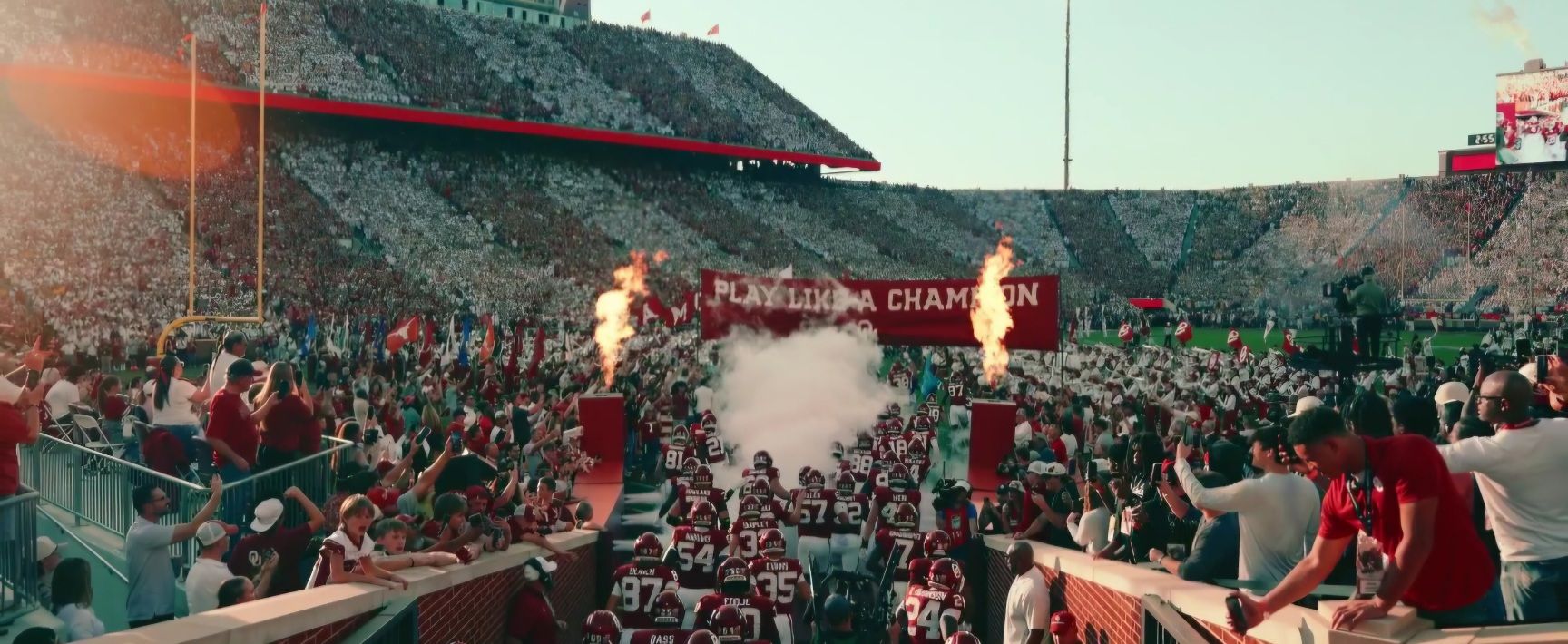
There is nothing quite like the final week of the offseason.
For months, Oklahoma fans have been debating the depth chart, dissecting recruiting classes, arguing about preseason rankings and wondering just how good this 2026 team can actually be.
Now, the talking is almost over.
Game week has arrived!
No. 10 Oklahoma will open the 2026 season Friday night against UTEP at Gaylord Family-Oklahoma Memorial Stadium, with kickoff scheduled for 7 p.m. CT on SEC Network+. The unusual Friday opener gives the Sooners an opportunity to get the season started a day earlier than originally planned—and gives everyone in Norman the first real look at a team carrying significantly higher expectations than it did a year ago.
And make no mistake: Oklahoma should win this football game.
That’s not disrespect to UTEP. It’s simply the reality surrounding a Sooners team that went 10-3, finished with a top-15 national ranking and reached the College Football Playoff in 2025. Oklahoma has considerably bigger objectives in 2026.
Because while the Miners are standing between Oklahoma and a 1-0 start, Michigan and Georgia are standing immediately behind them.
The Sooners travel to Ann Arbor on Sept. 12 before returning home to face New Mexico and then traveling to Athens on Sept. 26 to meet Georgia. Texas follows Oct. 10.
In other words, Oklahoma doesn’t have the luxury of spending September figuring itself out.
This week is about answering questions.
Here are three of the biggest ones facing the Sooners as game week begins.
1. Is Oklahoma Finally Healthy Enough to Show Us What It Really Has?
The first question is perhaps the most important one.
What does Oklahoma look like when its key pieces are healthy and operating together?
That starts with quarterback John Mateer.
The redshirt senior enters his second season in Norman after a 2025 campaign that showed both his enormous potential and the difficulty of maintaining that level of production through injury. Mateer ultimately threw for 2,885 yards and 14 touchdowns while completing 62.2% of his passes. He also accounted for 3,316 yards of total offense.
But the statistics don’t completely explain why expectations are so high for him entering 2026.
Mateer has now spent another offseason in Ben Arbuckle’s system.
He knows the terminology.
He knows the coaching staff.
He knows the receivers.
He knows what Arbuckle wants from him.
And, most importantly, he enters the season healthy.
That continuity could be enormously important for an offense that has to mature quickly.
The same applies to the offensive line.
The Sooners have spent considerable time and resources reshaping the unit, and the group has been one of the major storylines throughout the offseason. There was, however, a late camp development involving center Jake Maikkula that created another question mark heading into the opener. Recent depth-chart projections have had Oklahoma adjusting its center situation because of his injury, and it looks like Ryan Fodje is going to start in a position he’s never played before.
That’s precisely why Friday matters.
Nobody expects UTEP to replicate what Michigan’s defensive front will throw at Oklahoma.
Nobody expects the Miners to look like Georgia.
But Oklahoma needs to discover who can play together—and who can be trusted—before the schedule becomes unforgiving.
The same principle applies defensively.
Brent Venables enters Year 5 with a defense that was already one of the country’s best in 2025. Oklahoma allowed only 15.5 points and 272.5 yards per game last season while holding opponents to 77.3 rushing yards per game.
Now the question is whether the returning talent and new additions can keep that standard intact.
Friday is the first opportunity to see how Venables handles his rotations.
How many snaps does David Stone receive?
How quickly does the linebacker rotation settle?
Which young defensive backs emerge?
How aggressively does Venables attack?
The answers may not be definitive after one game.
But they will provide the first clues.
2. What Is Ben Arbuckle Going to Unleash?
This is the question that should have Oklahoma fans watching the offense particularly closely.
What does Year 2 of the John Mateer-Ben Arbuckle partnership actually look like at Oklahoma?
The obvious temptation is to judge the offense by the scoreboard.
If Oklahoma scores 45 points, everyone will feel good.
If Oklahoma scores 28, some people will immediately start wondering what’s wrong.
That’s the wrong way to watch this game.
The more interesting question is how Oklahoma moves the football.
Arbuckle has had an entire offseason to build the offense around Mateer.
That’s a major difference from last season.
The quarterback and coordinator are no longer learning one another in real time. There is now a shared language and an established foundation.
That continuity is one of the reasons national observers are so bullish on Oklahoma entering 2026. The Sooners return both their starting quarterback and offensive coordinator for a second season together, while the program is coming off a 10-win campaign and its first CFP appearance since 2019.
So what should fans watch?
Start with tempo.
Does Arbuckle push the pace?
Does Oklahoma consistently get to the line quickly?
Does Mateer appear comfortable changing protections and making pre-snap adjustments?
Then watch the formations.
How much motion does Oklahoma use?
How frequently does Arbuckle spread the field?
How does he incorporate the tight ends?
Does he establish the running game early?
And perhaps most importantly, how much does he use Mateer’s athletic ability?
Mateer’s legs are an important part of what makes him difficult to defend.
But Arbuckle doesn’t need to put everything on film Friday night.
That’s the balancing act.
Michigan is coming.
Georgia is coming.
Texas is coming.
There is absolutely no reason to hand those coaching staffs a complete offensive blueprint in the season opener.
In fact, the perfect offensive performance against UTEP might be one that looks devastatingly efficient while still leaving plenty of questions unanswered.
Get Mateer comfortable.
Establish the run.
Get the receivers involved.
Let the offensive line build confidence.
Score points.
Get out healthy.
Save the good stuff for Ann Arbor.
That’s the assignment.
3. What Should Oklahoma Fans Actually Expect Friday Night?
This might be the most difficult question because expectations around this Oklahoma program have changed dramatically.
A year ago, the Sooners were picked 10th in the SEC preseason media poll.
They finished tied for fifth.
They went 6-2 in conference play.
They beat Alabama, Tennessee and Missouri during the regular season.
They earned a College Football Playoff berth.
And now?
Oklahoma was picked seventh in the 2026 SEC preseason media poll, but the expectations surrounding the program are considerably higher than that ranking suggests. The Sooners also enter the season ranked No. 10 nationally.
So what constitutes a successful Friday night?
First, Oklahoma needs to win comfortably.
There shouldn’t be a fourth-quarter nail-biter.
The Sooners have too much talent, too much experience and too much depth for that.
Second, Oklahoma needs to play clean football.
This may actually be more important than the final margin.
Avoid unnecessary penalties.
Protect the football.
Don’t blow assignments.
Don’t give UTEP cheap points.
Those are the things that can become disastrous against Michigan or Georgia.
Third, the defense needs to look like the defense we saw in 2025.
Oklahoma’s defense doesn’t have to pitch a shutout.
But it should control the line of scrimmage.
It should tackle.
It should create negative plays.
It should make UTEP uncomfortable.
The Sooners finished 2025 allowing just 4.28 yards per play, 195.2 passing yards per game and 77.3 rushing yards per game.
That’s the standard.
Friday night should offer an early indication of whether that standard remains intact.
And finally, Oklahoma needs to get out of this game healthy.
That’s easy to overlook when everyone is caught up in the score.
But the real prize isn’t beating UTEP by 30 or 40 points.
The real prize is being 1-0 with a healthy roster and a better understanding of who this team is.
The UTEP Game Isn’t the Destination
That’s the biggest thing to remember this week.
UTEP is the opponent.
Michigan is the measuring stick.
And Georgia is waiting two weeks later.
That’s why this opener is more important than it appears.
Oklahoma doesn’t need to prove that it can beat UTEP.
It needs to prove that it is ready to begin the process of becoming the team it believes it can be.
There are legitimate reasons for optimism.
Mateer is healthy.
Arbuckle is back.
Venables has continuity.
The Sooners are coming off their first CFP appearance under Venables.
The defense returns enough talent to remain among the nation’s best.
And Oklahoma has addressed several of the weaknesses that held the 2025 offense back, particularly in the running game. The Sooners averaged only 118.5 rushing yards per game last season, a number the staff has made a priority to improve.
But none of that matters once the ball is kicked off.
That’s what makes this week so exciting.
The predictions are finished.
The preseason rankings are finished.
The depth-chart debates are almost finished.
Now we get to see.
Can John Mateer make the Year 2 leap?
Can Ben Arbuckle build an offense capable of surviving the SEC?
Can Brent Venables’ defense remain elite?
And perhaps most importantly:
Is Oklahoma ready for the brutal September that awaits it?
Friday night should provide the first answers.
It doesn’t have to provide all of them.
The Sooners simply need to look like a team that understands what’s coming.
Because after UTEP, there won’t be much time to figure it out.
Ann Arbor is next.
And if Oklahoma wants to be playing meaningful football in December, the foundation needs to be laid now.
The season starts Friday night. The real test starts soon after.