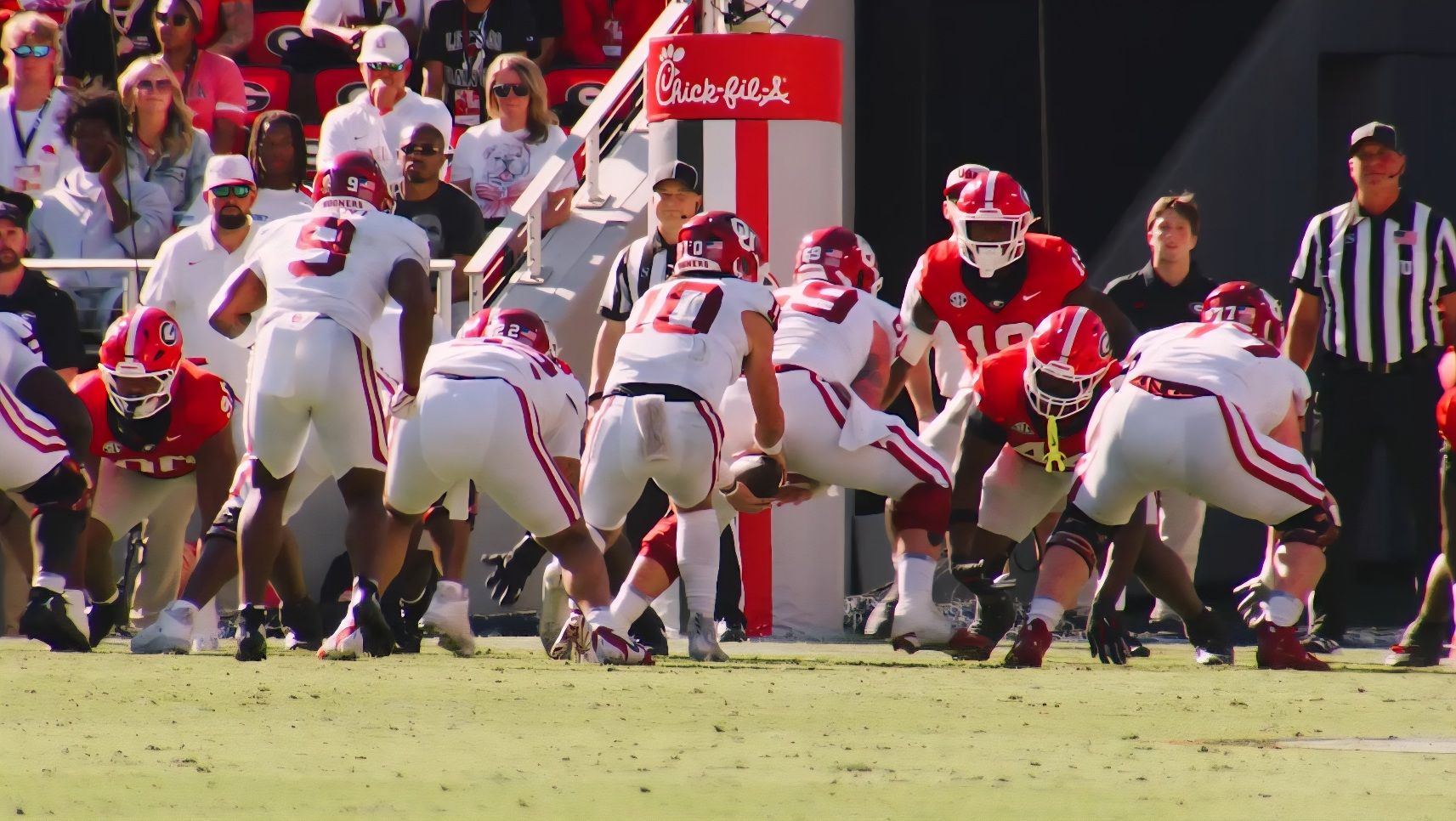
There is a temptation to treat Oklahoma’s bye week as a chance to forget what happened in Athens.
It should be the opposite.
The 41-13 loss to Georgia gave Brent Venables and his staff their clearest evaluation point of the season. Oklahoma is 2-2, 0-1 in the SEC, and the Sooners now have two weeks before stepping into the Cotton Bowl against No. 1 Texas.
That makes this less of a traditional bye week and more of an evaluation week.
The question isn’t simply whether Oklahoma can play better.
It is who needs to play more, who needs to play differently and where does the current roster simply not have enough margin for error?
The answer becomes clearer when the Georgia film is paired with the PFF grades, snap counts and John Mateer’s advanced metrics.
There are legitimate questions along the offensive line. There are skill-position players who have not received enough opportunities to establish themselves. And there is a quarterback whose statistical profile has moved in the wrong direction over the first month of the season.
That doesn’t mean Oklahoma needs to blow up the roster.
It means the Sooners need to be much more honest about what their current personnel is telling them.
I. The Portal Question: Is Oklahoma Getting Enough From Its Offensive-Line Construction?
The offensive line is where the bye-week evaluation begins.
But it is important to diagnose the problem correctly.
This isn’t simply a story about Oklahoma’s center or left tackle failing to hold up. In fact, Jake Maikkula played all 72 offensive snaps against Georgia and earned a 70.0 PFF grade. Ryan Fodje also played all 72 snaps at left tackle and graded at 60.4.
The instability showed up more prominently at the other interior positions.
Noah Best played only 16 snaps at right guard and received a 44.6 overall PFF grade. Heath Ozaeta played 50 snaps at right guard and received a 44.2 grade. Eddy Pierre-Louis played 64 snaps and graded at 63.4.
That is a meaningful difference.
Oklahoma essentially spent the afternoon trying to find the right combination while playing one of the best defensive teams in the country.
And that is where the portal and roster-building discussion becomes legitimate.
Oklahoma has had to manage injuries to important pieces, most notably Michael Fasusi, who missed his third consecutive game against Georgia. Fasusi’s absence matters because he was one of Oklahoma’s most reliable offensive linemen as a freshman in 2025, allowing only four sacks on 395 pass-blocking snaps according to PFF data.
Venables also acknowledged before the Georgia game that the offensive-line inconsistency had been affected by injuries and missed time.
That is not an excuse.
It is a roster-management reality.
The bye week therefore needs to answer a very specific question:
What is Oklahoma’s best five-man offensive line when everyone who can reasonably play is available?
And then comes the second question:
What is the best five-man line if one of those players isn’t available?
Because the Georgia game demonstrated that Oklahoma doesn’t have the luxury of discovering those answers against Texas.
The Red River Rivalry is next.
II. The Snap-Count Audit: Three Players Worth a Harder Look
Evaluation week should not only be about finding problems.
It should be about identifying solutions.
1. Elijah Thomas — More Than a Rotation Receiver
Elijah Thomas played 48 snaps against Georgia, but his 52.9 PFF grade ranked near the bottom of Oklahoma’s offensive contributors.
That doesn’t automatically mean his role should shrink.
It may mean the opposite.
Thomas is a player Oklahoma needs to determine more about.
The Sooners have struggled to consistently create separation and explosive plays through the passing game, while Isaiah Sategna III has increasingly become the offense’s most dependable target.
Sategna caught eight passes for 81 yards against Georgia and played 61 snaps, earning a 69.5 PFF grade. He is established.
The evaluation question is whether Thomas can become the complementary vertical threat that forces defenses to account for another receiver.
That doesn’t require force-feeding him 12 targets.
It requires giving him enough meaningful opportunities to determine whether his skill set translates against SEC-caliber defensive backs.
Forty-eight snaps is already significant playing time.
The next step is making those snaps matter.

Take a deeper dive into our Oklahoma Football coverage, with articles like this, exclusively with a Heartland Sports Subscription on Facebook.
2. Tory Blaylock — The Running Back Rotation Needs an Answer
Oklahoma’s running game produced only 65 yards against Georgia.
Lloyd Avant received 35 snaps and earned a 61.4 PFF grade. Tory Blaylock played 12 snaps and graded at 61.7. Jonathan Hatton played 13 and graded at 57.9, while Xavier Robinson received only three offensive snaps.
Those numbers don’t scream that one player has earned a massive workload increase.
They do suggest Oklahoma needs to determine whether it is getting enough variation from the rotation.
Blaylock is particularly interesting because he has already demonstrated that he can carry a substantial workload. He led Oklahoma’s returning running backs with 480 rushing yards and four touchdowns as a freshman.
If the current run game is producing predictable results, the answer cannot simply be giving Avant more carries.
The staff needs to determine which back best fits the run concepts Arbuckle wants to use against Texas.
That could still be Avant.
It could involve more Blaylock.
It could involve Robinson.
But Evaluation Week should produce an answer rather than another committee by default.
3. Danny Okoye — Give the Young Edge Rusher a Bigger Test
The defensive side of the ball offers a different evaluation opportunity.
Danny Okoye played only 19 snaps against Georgia, but he produced a 71.1 PFF grade, the kind of efficiency that deserves attention when the defense is trying to manufacture more pressure.
That number is particularly interesting because Okoye had already shown flashes against New Mexico, where he played 30 snaps and earned a 67.2 PFF grade.
This isn’t an argument that Okoye should suddenly become a 50-snap player.
It is an argument that Oklahoma should find out what happens when he receives a larger workload.
Against Georgia, Okoye was considerably more efficient on a limited number of opportunities than several veterans who received heavier workloads.
That’s exactly the kind of question a bye week is designed to answer.
III. The John Mateer Diagnostic: The Numbers Are Getting Harder to Ignore
This is the most important evaluation of the entire two-week period.
John Mateer does not suddenly become a different quarterback because he threw three interceptions or lost two fumbles.
But his statistical profile is telling Oklahoma something.
And the staff has to listen.
| Game | Comp. | Yards | TD | INT | PFF Grade | QBR |
|---|---|---|---|---|---|---|
| UTEP | 11/17 | 225 | 3 | 0 | 77.3 | 91.5 |
| Michigan | 17/33 | 189 | 1 | 1 | 54.7 | 61.1 |
| New Mexico | 19/25 | 238 | 2 | 2 | 68.6 | 58.4 |
| Georgia | 25/34 | 231 | 2 | 1 | 44.8 | 49.8 |
The progression is obvious.
Against UTEP, Mateer looked like the quarterback Oklahoma believed it was getting when he transferred from Washington State.
Against Michigan, the efficiency dropped.
Against New Mexico, the completion percentage improved, but two interceptions remained.
Against Georgia, the raw passing statistics were respectable — 25 completions on 34 attempts for 231 yards and two touchdowns — but the three turnovers fundamentally changed the game.
PFF’s 44.8 grade was his second-lowest grade since arriving at Oklahoma. His only lower grade was the 29.5 he received in last year’s Cotton Bowl against Texas.
The season-long PFF picture is also sobering.
Through four games, Mateer has an overall grade of 58.0 and a passing grade of 52.1. PFF has credited him with three big-time throws and eight turnover-worthy plays on 127 dropbacks. His average time to throw is 2.85 seconds.
But there is another number worth watching.
His rushing ability remains an important part of his value.
PFF has him with a 68.0 rushing grade, and he has 36 designed runs through four games.
That creates a fascinating evaluation problem for Ben Arbuckle.
Is Mateer’s decline primarily a quarterback problem?
Is it protection?
Is it play sequencing?
Is it a combination of all three?
The answer is almost certainly more complicated than one number.
But the solution cannot be pretending the numbers don’t exist.
IV. The Protection and Quarterback Problems Are Connected
This is where Oklahoma’s evaluation needs to become more sophisticated.
If the staff believes Mateer is pressing because he doesn’t trust the protection, simply telling him to “play better” won’t fix the problem.
If the staff believes Mateer is creating unnecessary pressure by holding the ball or attempting throws that aren’t there, changing the offensive line alone won’t fix the problem.
The answer may be architectural.
Get the ball out earlier.
Create defined reads.
Use motion to identify coverage.
Build in answers against pressure.
Give Mateer opportunities to use his legs.
And, perhaps most importantly, make sure the protection plan matches the personnel actually available.
The Georgia game produced four Oklahoma turnovers and 17 Georgia points off those turnovers. Mateer accounted for three of the four Oklahoma turnovers. That is too much negative value for any offense to overcome.
But the same game also showed that Oklahoma possessed the ball for 35:27 and ran 69 offensive plays compared with Georgia’s 53.
The offense wasn’t simply incapable of moving the football.
It was incapable of consistently turning possession into points.
That distinction matters.
V. The Two-Week Evaluation Checklist
This is what Oklahoma’s staff should emerge from the bye week knowing:
| Area | Question Oklahoma Must Answer |
|---|---|
| Offensive line | What is the best five-man combination? |
| Right guard | Can Ozaeta/Best provide enough consistency, or is another option needed? |
| Fasusi | Is he healthy enough to reclaim left tackle? |
| Running back | Who gives Arbuckle the best combination of vision, explosiveness and pass protection? |
| Receiver | Can Thomas become a legitimate explosive complement to Sategna? |
| Tight end | How much can Rocky Beers remain involved as both a receiver and formation piece? |
| Edge | Does Okoye deserve a larger role based on his efficiency? |
| Quarterback | How does Oklahoma restore Mateer’s decision-making and confidence? |
| Scheme | How much of the offense needs to change versus simply being executed better? |
That last question may be the most important.
Because Oklahoma does not have time for an offensive identity crisis.
Red River Will Be the First Real Test of the Answers
The calendar has given Oklahoma an unusual opportunity.
The Sooners don’t play this weekend.
They play Texas on October 10.
The Longhorns enter that game 4-0 and ranked No. 1.
That means the coaching staff has roughly two weeks to turn the Georgia film into personnel decisions.
Not panic.
Not wholesale changes.
Decisions.
Who belongs on the field?
Who deserves more opportunities?
Which combinations actually work?
And perhaps most importantly, what does Oklahoma have to do to make John Mateer look like the quarterback it expected when he arrived?
The Georgia loss was ugly.
The bye week doesn’t need to be.
If Venables and his staff use these two weeks correctly, the Sooners can come out of the break with something they haven’t consistently had through the first four games:
a much clearer understanding of exactly what this roster is — and exactly what it needs to become.