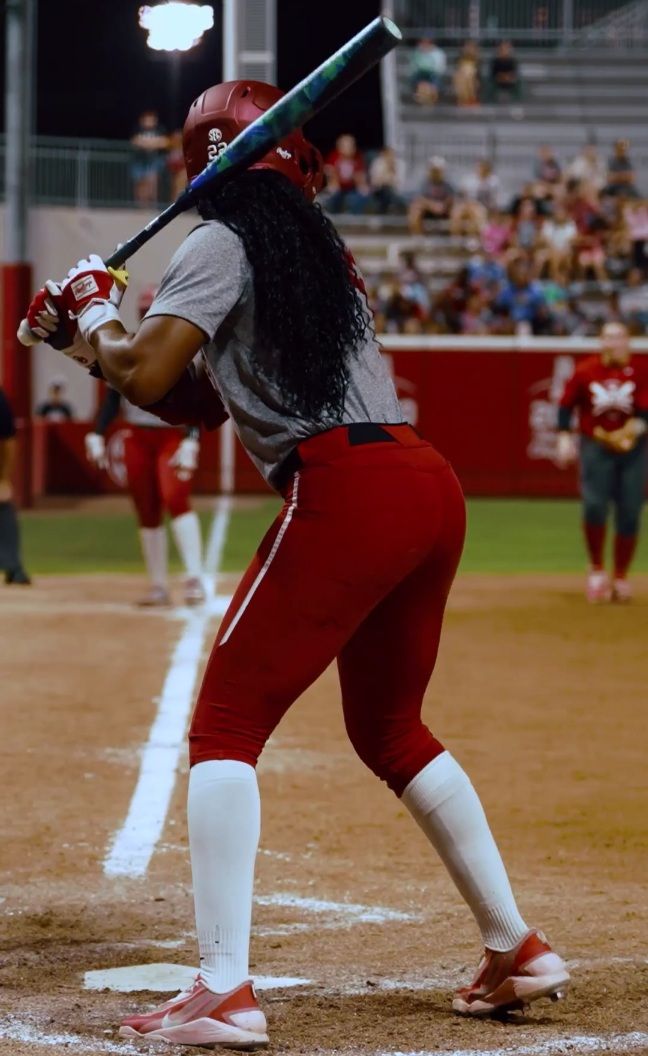
There was no official broadcast. No box score waiting to be dissected. No reason to treat the evening as anything more than another October scrimmage.
And yet, for anyone inside Love’s Field on Wednesday night, Oklahoma’s second Battle Series game felt like considerably more than that.
The Sooners turned the second installment of their fall intrasquad series into an offensive fireworks display, with Kai Minor producing a remarkable 6-for-6 night with seven RBIs and two stolen bases, Kendall Wells launching two home runs and freshman pitcher Ella Kate “EK” Smith providing one of the evening’s most intriguing moments by hitting her first home run of the fall.
One week after rain and lightning cut Battle Series Game 1 short after roughly three innings, the Sooners finally got a full night of competitive work.
The final score of an intrasquad game isn’t really the point.
The evaluations are.
And there were plenty of them.
1. Kai Minor may have been the loudest statement of the night
There are good nights.
There are great nights.
And then there is going 6-for-6 with seven RBIs and two stolen bases.
Minor’s performance was the kind that makes you stop taking notes for a moment and simply watch.
The sophomore outfielder already entered this fall with a significant résumé. During Oklahoma’s 2026 season, Minor was one of the Sooners’ most productive offensive players, leading the team in batting average for much of the season and establishing herself as one of the premier young hitters in the country.
So Wednesday wasn’t necessarily about discovering that Minor can hit.
We’ve already seen that.
What made this night so interesting was the combination.
Six hits.
Seven RBIs.
Two stolen bases.
And a towering three-run home run.
That’s the profile of a player who can change an inning without needing three or four opportunities to do it.
She can get on base.
She can create pressure with her legs.
And apparently, the power continues to develop.
That’s a dangerous combination.
The home run was particularly noteworthy because it came after Minor had already established herself as a nightmare for the defense. Once a player can beat you with contact and speed, adding legitimate home-run power changes the equation.
And that’s what Oklahoma has with Minor.
She doesn’t simply extend innings.
She can manufacture runs all by herself.
2. Kendall Wells reminded everyone that Oklahoma’s power isn’t going anywhere
If Minor supplied the all-around offensive explosion, Kendall Wells supplied the thunder.
Wells has already demonstrated that her bat can dictate games.
She did it again Wednesday, launching two home runs.
That shouldn’t be treated as a surprise.
Wells had one of the most remarkable freshman seasons in Oklahoma history in 2026, setting the SEC single-season home run record and ultimately establishing an NCAA freshman home-run record.
What is worth watching now is what happens when that power is combined with the rest of Oklahoma’s offensive depth.
Because Wells isn’t operating in a vacuum.
Across the field, there are players like Minor, Gabbie Garcia and the rest of a roster that doesn’t appear interested in giving opposing pitching many places to breathe.
That’s what made Wednesday’s game so revealing.
This wasn’t simply one player getting hot.
The offense kept coming.
3. Gabbie Garcia continues to look like one of the roster’s stabilizing pieces
Lost somewhat in Minor’s ridiculous stat line was another big offensive performance from Gabbie Garcia, who collected four hits and drove in three runs.
That’s important.
Because as much attention as Oklahoma’s young players deserve, championship teams still need established players who can stabilize the lineup.
Garcia provides that.
Her ability to put together multi-hit performances while moving around the lineup gives Gasso another valuable piece in what is becoming a fascinating offensive puzzle.
And this is where fall ball becomes particularly useful.
The coaching staff isn’t simply asking, Who can hit?
That’s the easy question.
It’s asking:
Who can hit here?
Who looks comfortable at the top?
Who can drive runners in?
Who can protect the middle of the order?
Who changes the way a pitcher has to attack the hitter behind her?
Who can handle moving around?
Those answers won’t be finalized in October.
But every night like Wednesday provides another piece of information.
4. EK Smith might be one of the most fascinating two-way players to watch
Then there was Smith.
The freshman has already generated plenty of interest as a pitcher, but Wednesday offered another reminder that her value isn’t necessarily limited to the circle.
Smith pitched and hit her first home run of the fall.
That’s precisely the kind of player development opportunity these Battle Series games are designed to provide.
The Oklahoma roster features nine newcomers, including six freshmen. Smith is one of those newcomers.
And while it’s far too early to declare what her role will be once the regular season begins, the ability to contribute in multiple ways is intriguing.
The bigger question is whether Smith can eventually make herself useful enough in both areas that Gasso has a reason to keep exploring the possibilities.
Wednesday certainly didn’t hurt that case.
5. The pitching staff got a very different kind of test
Here’s the uncomfortable truth about fall ball:
Sometimes the pitchers are going to get hit.
Especially when they’re throwing against Oklahoma’s own lineup.
That’s what makes evaluating the pitching performance from Wednesday more complicated than simply looking at how many runs crossed the plate.
Oklahoma cycled through Audrey Lowry, Miali Guachino, Allyssa Parker, Keegan Baker and Smith, giving Gasso an extended opportunity to evaluate the staff in live competition.
And the offense made sure nobody could coast through it.
That’s actually valuable.
A pitcher doesn’t get better by exclusively throwing to hitters she can dominate.
She gets better by learning what happens when a hitter gets comfortable.
When an opponent doesn’t chase.
When a mistake gets punished.
When she has to execute the next pitch instead of dwelling on the last one.
That is especially important for a staff that will eventually have to deal with the SEC.
Saturday’s fall-ball outing against Tarleton State produced 10 scoreless innings from six Oklahoma pitchers, with 14 strikeouts and only one walk.
Wednesday was a much different environment.
The hitters were familiar.
The hitters were talented.
And the competition was designed to expose weaknesses.
That’s exactly what October should be doing.
The bigger story: Gasso has a fascinating roster problem
And that’s probably the most significant takeaway from the night.
Oklahoma doesn’t appear to have a shortage of talented players.
It has a distribution problem.
How do you get all of them on the field?
How do you construct a lineup that maximizes Minor’s speed without sacrificing power?
Where does Wells fit most naturally?
How do you get Garcia’s bat into the most advantageous spot?
How much does Smith’s two-way ability affect her potential role?
And what happens when the freshmen who are making noise in October start pushing veterans for playing time?
Those are good problems.
They are also problems that don’t have to be solved yet.
The official Oklahoma roster lists 12 returners and nine newcomers, giving Gasso a substantial amount of experience to blend with a large influx of new talent.
That is why I wouldn’t leave Love’s Field on Wednesday night thinking Oklahoma’s lineup is set.
It isn’t.
I would leave thinking the competition for those spots could be fascinating.
Don’t let the offensive explosion fool you
There is one major caveat to everything that happened Wednesday night.
This is still fall ball.
The Battle Series is an intrasquad competition.
There is no opponent across the field trying to exploit Oklahoma’s tendencies.
There is no SEC scouting report.
There is no conference championship riding on the outcome.
And there is certainly no reason to take a 6-for-6 performance and project it directly onto the spring.
The purpose of this period is evaluation.
The next Battle Series game is scheduled for Oct. 14 at 6:30 p.m., and the program’s schedule now lists that contest for viewing on 1Oklahoma.
That next game will matter for a different reason.
Now that Gasso has seen these players in multiple competitive environments, the questions become more specific.
Who gets more innings?
Who moves defensively?
Who gets more at-bats?
Who moves up the order?
Who disappears from the lineup?
Those decisions will tell us considerably more than the final score.
The one thing we can say with confidence
We don’t know what Oklahoma’s 2027 lineup will look like.
We don’t fully know who will start where.
We don’t know which freshman will emerge as a regular.
We don’t know how the pitching staff will ultimately be structured.
But after three fall competitions, one thing is becoming increasingly difficult to ignore:
There is a lot of offensive firepower in this Oklahoma lineup.
Goose Hutchens announced herself against Tarleton State.
Now Kai Minor has produced an outrageous night against her own teammates.
Kendall Wells has continued to demonstrate her home-run power.
Gabbie Garcia has provided veteran production.
And EK Smith has shown that she may be capable of contributing in more than one way.
That’s not a finished team.
It’s not even close.
It’s a laboratory.
But it’s a pretty entertaining laboratory.
And for Oklahoma fans who had to wait through a rain-shortened opener, Wednesday night finally provided the first real extended look at what Patty Gasso has to work with.
The answers are still coming.
But the questions are getting a lot more interesting.