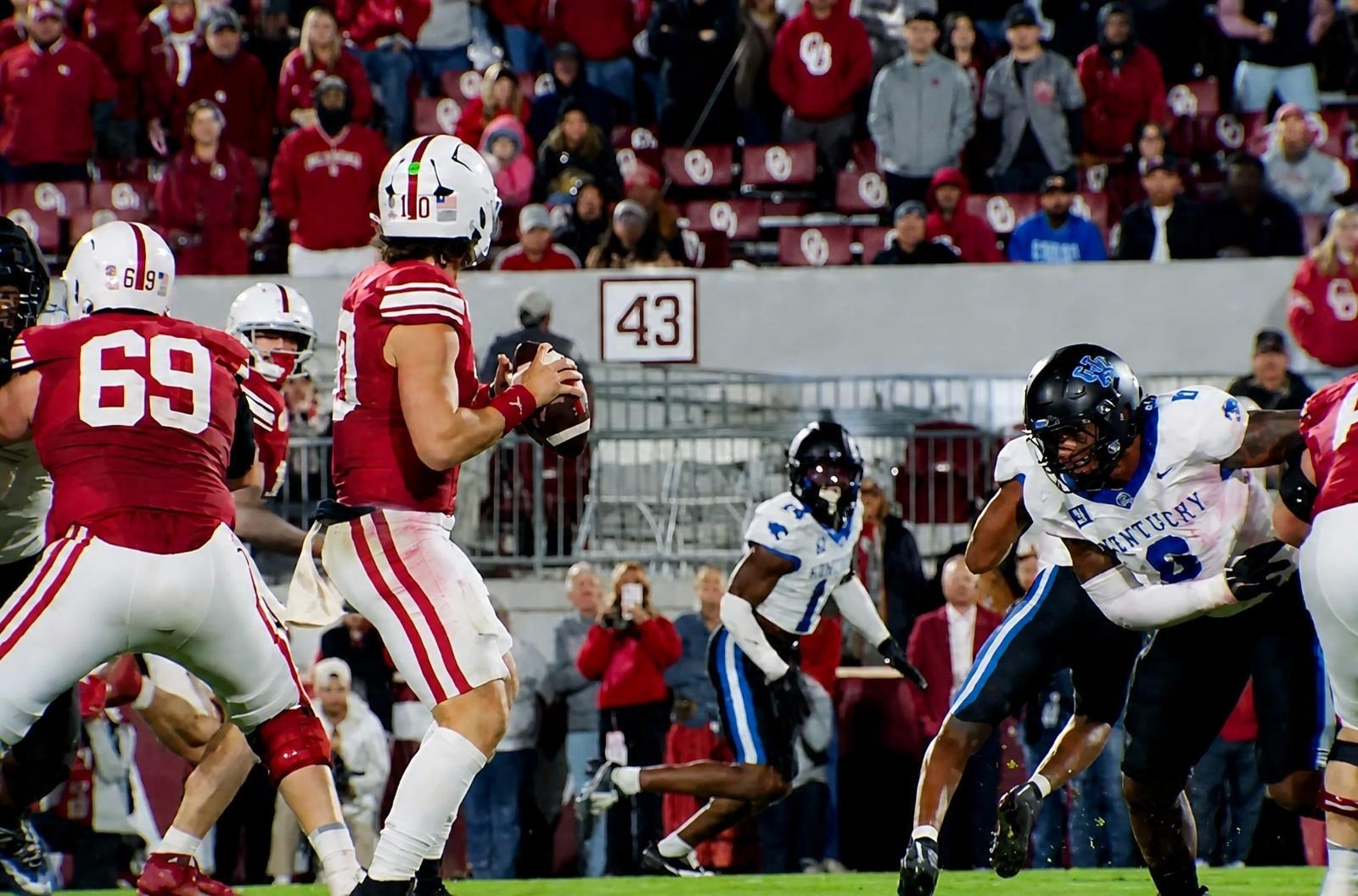
For three quarters, Oklahoma’s defense looked good enough to carry the Sooners to another statement victory. Then the turnovers kept coming, the offense ran out of answers, and a game Oklahoma appeared to have under control became a devastating 21-13 loss to No. 15 Kentucky.
The Sooners led 13-7 entering the fourth quarter. They held Kentucky’s offense in check, watched true freshman defensive end Jake Kreul announce himself with a spectacular performance, and appeared poised to make the most of a hard-fought SEC home opener.
But Oklahoma could not overcome its own mistakes.
Kentucky intercepted John Mateer three times, picked off a pass on a fake field goal, and finished with a 4-0 advantage in turnovers. Jordan Castell returned one of his interceptions 41 yards for a backbreaking touchdown with just over a minute remaining, turning Oklahoma’s final opportunity into a desperate attempt to salvage a game that had slipped away. Ty Bryant then intercepted Mateer again to seal the Wildcats’ victory.
The Sooners outgained Kentucky 346-230. They had enough defensive production to win. They had opportunities to build a more comfortable lead.
What they didn’t have was the ball security required to finish the job.
And that is what makes this loss so frustrating.
The instant-reaction takeaway
- The good: Oklahoma’s defense limited Kentucky to 230 total yards, and freshman defensive end Jake Kreul recorded 2.5 sacks and three tackles for loss.
- The bad: The Sooners turned the ball over four times, including three interceptions by Mateer.
- The turning point: Ty Bryant’s interception late in the third quarter set Kentucky up in Oklahoma territory. The Wildcats converted that opportunity into the touchdown that gave them a 14-13 lead.
- The backbreaker: Castell’s 41-yard pick-six with just over a minute remaining extended Kentucky’s lead to 21-13.
- The coaching question: Oklahoma’s fake field goal ended with holder and punter Jacob Ulrich throwing an interception in the end zone, wasting an opportunity to put points on the board.
- The bottom line: The defense deserved a better result. The offense and special teams gave Kentucky too many opportunities to take it away.
1. The Jake Kreul coming-out party
The freshman gave Oklahoma a chance to win
If Oklahoma is searching for a reason to feel encouraged after a miserable night, it can start with Jake Kreul.
The true freshman defensive end delivered a performance that deserved to be part of the postgame conversation regardless of the final score. He finished with six tackles, 2.5 sacks and three tackles for loss, repeatedly disrupting Kentucky quarterback Kenny Minchey and making life uncomfortable for the Wildcats’ offense.
That is an impressive line for any defensive player. For a true freshman, it is a glimpse of what Oklahoma might have developing along its defensive front.
Kreul was not simply collecting statistics after the game had already been decided. His impact came while Oklahoma was fighting to control the matchup. His ability to get into the backfield helped the Sooners maintain pressure on Minchey and kept Kentucky from consistently operating comfortably.
The performance also highlighted an important part of Brent Venables’ defensive philosophy: pressure does not have to come from the same player or the same place on every snap.
A defensive front that can win one-on-one matchups gives the coordinator options. It can create pressure without always needing to send an extra defender, preserve bodies in coverage and force the quarterback to make decisions more quickly.
Kreul’s production suggests Oklahoma may have another player capable of contributing to that equation.
There is a difference between a promising freshman performance and a fully established defensive star, of course. One game does not guarantee consistent production, and the next opponents will have opportunities to study how he wins his reps.
But this was a meaningful step.
The Sooners need more players who can turn defensive possessions into genuine problems for opposing offenses. Kreul showed that he has the potential to become one of them.
And that makes the final result even more frustrating.
Oklahoma got the kind of individual defensive performance that can help win a game. It did not get enough complementary football to reward it.
2. The fourth-quarter collapse
The defense finally paid for the offense’s mistakes
For much of the night, Oklahoma had Kentucky where it wanted the Wildcats.
The Sooners entered the fourth quarter with a 13-7 lead. Kentucky had struggled to generate much offense in the third quarter, and Oklahoma’s defense had repeatedly prevented the Wildcats from turning possessions into points.
Then came the interception that changed the game.
Late in the third quarter, Mateer’s pass was tipped and intercepted by Ty Bryant, giving Kentucky the ball at Oklahoma’s 45-yard line. Instead of asking its offense to drive the length of the field, Kentucky suddenly had a short path to the end zone.
The Wildcats took advantage.
Minchey connected with tight end Willie Rodriguez for a 12-yard touchdown, putting Kentucky ahead 14-13 early in the fourth quarter. The score was Kentucky’s first second half touchdown after it had punted on each of its previous four full drives.
That sequence deserves attention because it illustrates the cost of a turnover beyond the immediate loss of possession.
Oklahoma’s defense had been doing its job. But an interception in its own territory forced the unit back onto the field with little margin for error. Kentucky needed only a short drive to turn one mistake into the lead.
The defense responded with another stop. After Oklahoma went three-and-out, Kentucky drove into scoring territory again, only for Kreul to sack Minchey on fourth-and-three from the Oklahoma five-yard line.
That was a major defensive play. Kreul kept the Wildcats from extending their lead, and Oklahoma got the ball back with an opportunity to regain control.
The Sooners could not capitalize.
Kentucky’s defense forced another three-and-out, and Oklahoma’s offense returned the ball without producing the drive it needed.
The game was still there for the Sooners. They had a defense capable of getting stops, and the deficit was only one point.
But the offense could not create separation, and the final mistake proved decisive.
With just over a minute remaining, Mateer threw another interception. Castell returned it 41 yards for a touchdown, pushing Kentucky’s lead to 21-13. Mateer threw one more interception on Oklahoma’s final possession, allowing Bryant to secure his second pick of the night.
The final score makes it easy to focus on the fourth quarter. The underlying problem, however, started much earlier.
Oklahoma’s defense was repeatedly asked to protect a narrow lead while the offense failed to give it enough breathing room. Eventually, the turnovers did more than shorten possessions. They put Kentucky in position to win the game outright.
That does not excuse every defensive mistake, and a good defense still has to finish. But it does put the loss in context.
Oklahoma’s defense did not suddenly become incapable of stopping Kentucky. The Sooners repeatedly handed the Wildcats favorable opportunities, and Kentucky finally made them count.
Take A Deeper Dive Into Our Oklahoma Football Coverage On Our Facebook Subscription Hub
Oklahoma Is Surging For DJ Tubbs, And The Numbers Show
The Pick-Six Protocol: How Peyton Bowen’s Football IQ Is Redefining Venables’ Defense
The Arbuckle Vindication: How Max-Protect and Vertical Spacing Finally Unlocked the SEC Schema
Help support Heartland Sports by Unlocking Exclusive, data-driven film room breakdowns, recruiting Update, high-leverage personnel matrix updates you won’t find anywhere else, and More by subscribing to our premium Oklahoma Sooners football coverage today.
3. The self-inflicted wounds
Four turnovers are too many to survive
Oklahoma did not lose because it lacked opportunities.
It lost because it repeatedly surrendered them.
The four-turnover margin tells the story in its simplest form. Kentucky intercepted Mateer three times and also intercepted Oklahoma’s fake field goal attempt. The Wildcats did not need to dominate the total yardage battle. They needed to capitalize on the possessions Oklahoma handed them.
And they did.
Mateer finished with 270 passing yards on 24-of-40 passing, but the three interceptions overshadowed much of that production. Oklahoma gained 346 total yards, outgaining Kentucky by 116, yet still lost by eight points.
That is a painful combination: enough offensive production to remain competitive, but not enough ball security to turn those yards into a victory.
The fake field goal: A gamble that produced nothing
The fake field goal was one of Oklahoma’s most damaging decisions of the first half.
The Sooners had moved the ball into scoring territory and lined up for a 28-yard field goal with 8:22 remaining in the second quarter. Instead of sending out kicker Tate Sandell, Oklahoma attempted a fake, with holder Jacob Ulrich throwing a pass toward Rocky Beers.
Kentucky defensive back Jordan Castell intercepted the throw in the end zone. Oklahoma came away with no points.
The issue is not that a fake field goal can never be the right call. Special-teams deception can create a favorable numbers advantage, catch a defense unprepared and produce a touchdown when executed correctly.
But the decision has to account for the circumstances.
Oklahoma had already moved the ball into field-goal range. Sandell had made a 44-yard field goal earlier in the game, and the Sooners were playing a low-scoring contest in which every possession mattered. A successful kick would have narrowed Kentucky’s lead to one point.
Instead, the fake produced an interception and no points.
That was a significant swing in a game ultimately decided by eight points. The Sooners had an opportunity to take a straightforward scoring option, but the trick play turned a promising possession into a wasted one.
The execution also matters. Castell was able to make the interception, and the throw never connected with Beers. Whatever the original design intended, Oklahoma did not get the result it needed.
The question for the coaching staff is not simply why the fake was called. It is whether the decision, the matchup and the execution justified the risk in that moment.
In a game where Oklahoma struggled to finish drives, passing up a field goal opportunity only to throw an interception is a decision that deserves a serious review.
Mateer has to be better with the football
The quarterback position comes with difficult decisions. Sometimes a quarterback must attempt a throw into a tight window, take a chance on a third-down conversion or try to create something when a play breaks down.
But there is a line between calculated aggression and giving the opponent opportunities it has not earned.
Mateer’s three interceptions were too costly to overcome.
The first major swing came when Bryant intercepted a tipped pass late in the third quarter. The next two interceptions came during Oklahoma’s fourth-quarter attempts to recover. Castell’s pick-six was the decisive blow, while Bryant’s final interception ended the Sooners’ last chance to mount a comeback.
Those plays were not all identical, and they should not be treated as though they were. A tipped pass is different from a throw into coverage, and a quarterback trying to rally his team late may be operating under different circumstances than one throwing in a tie game.
But the result is the same: Oklahoma cannot afford to turn the ball over at this rate.
Mateer did throw for 270 yards. There were productive moments in the passing game, and Rocky Beers’ 20-yard touchdown reception helped Oklahoma take a 10-7 halftime lead. The offense was not completely without answers.
Still, the Sooners needed their quarterback to protect the ball when the game tightened. Instead, the turnovers became the story.
The next step is not necessarily to ask Mateer to stop being aggressive. Oklahoma needs his playmaking ability. It needs him to extend plays when appropriate and challenge defenses when the opportunity is there.
It also needs better judgment about when a play is lost, when to throw the ball away and when the risk of a difficult pass outweighs the potential reward.
The same standard applies to the coaching staff. Arbuckle and the offensive staff must evaluate how they can put Mateer in better situations, improve protection and give him dependable answers when Kentucky-style pressure disrupts the initial read.
This was a collective offensive failure, but the quarterback’s decisions are central to fixing it.
The final verdict: The defense deserved better, but Oklahoma must own this loss
The Sooners have every reason to be disappointed.
They were coming off a signature win over Texas and had a chance to build on that momentum in front of their home crowd. Instead, they fell to Kentucky in a game that was there for the taking.
The defense showed legitimate promise. Kreul’s 2.5 sacks were a highlight, and Oklahoma held the Wildcats to 230 total yards. The Sooners even outgained Kentucky by more than 100 yards.
None of that changes the final score.
Four turnovers are too many. A fake field goal that ends in an interception is too costly. Three interceptions from the quarterback are too damaging in a game decided by eight points.
Oklahoma’s defense may have the ceiling of an elite unit. But the offense must become more reliable, and the coaching staff must make better decisions when points are available.
The Sooners do not need to abandon everything after one loss. They do need to confront what went wrong, own the mistakes and show that this performance will lead to meaningful changes.
The harsh truth: Oklahoma did enough defensively to win this game. It did not do enough offensively or on special teams to deserve to.
The loss belongs to the entire program. The response will tell us far more than the frustration of one Saturday night.
Postgame stat snapshot
| Category | Oklahoma | Kentucky |
|---|---|---|
| Final score | 13 | 21 |
| Total yards | 346 | 230 |
| Turnovers | 4 | 0 |
| Passing interceptions thrown | 3 | 0 |
| Jake Kreul sacks | 2.5 | — |