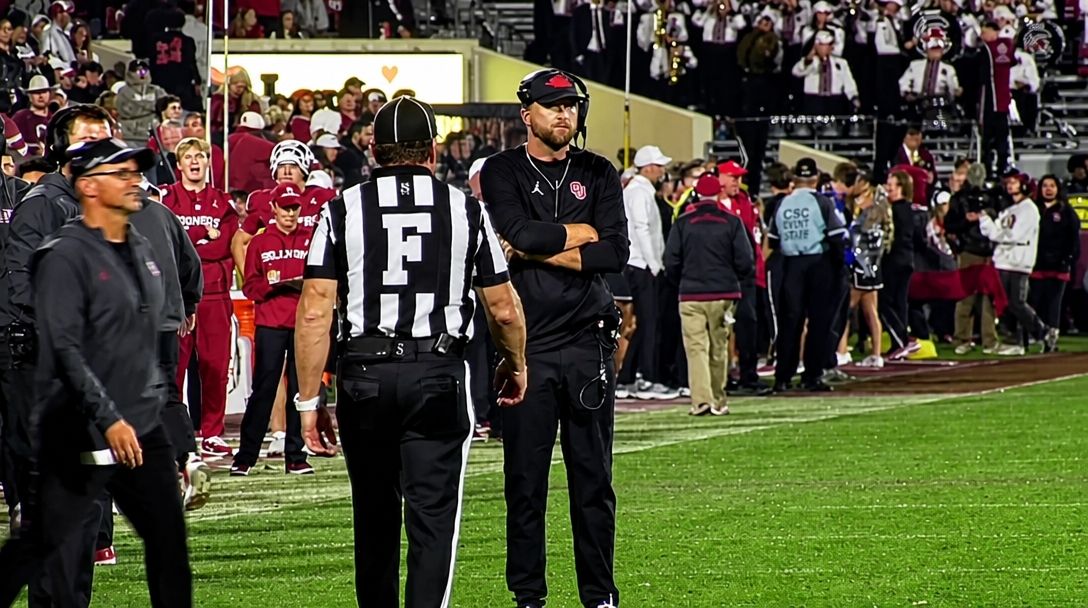
The chants finally became a decision.
Two days after Oklahoma’s offense struggled through another miserable performance in a 42-25 home loss to South Carolina, Brent Venables made the move many fans had been demanding. Ben Arbuckle is out as the Sooners’ offensive coordinator, marking the second time in three seasons that Venables has dismissed an offensive play-caller during the season.
The decision ends a partnership that arrived in Norman with considerable expectations. Arbuckle came from Washington State with quarterback John Mateer, bringing an offense that had produced explosive numbers in the Pac-12. Oklahoma made the College Football Playoff in Arbuckle’s first season, but the 2026 campaign has been a different story.
The Sooners are 4-4, their offense has struggled to produce consistently, and Saturday’s loss to South Carolina exposed just how far the unit had fallen. Oklahoma managed only 71 yards of offense in the first half while surrendering 307 to the Gamecocks. The late statistical surge couldn’t disguise the problems that had been building throughout the season.
Now Venables has to find a way to salvage the final four games while beginning the process of identifying the next permanent offensive coordinator.
Jason Witten will take over the play-calling responsibilities on an interim basis, with veteran offensive coach Kevin Wilson expected to provide support. Beyond that, the future remains unsettled.
Here’s what we know about Arbuckle’s departure, how the situation developed, what has been rumored about the relationship between Arbuckle and Venables, and which candidates could make sense for Oklahoma’s next offensive coordinator.
The Timeline: How Oklahoma Reached This Point
Saturday, Oct. 31 — South Carolina delivers the breaking point
Oklahoma’s 42-25 loss to South Carolina was the culmination of weeks of offensive frustration.
The Sooners managed just 71 yards in the first half and trailed 28-10 at halftime. The home crowd made its feelings clear, with audible boos and chants of “Fire Arbuckle” echoing through Gaylord Family–Oklahoma Memorial Stadium.
Oklahoma eventually finished with 359 total yards, but 241 came in the fourth quarter. Two late touchdown receptions by Ivan Carreon helped improve the final numbers without changing the larger picture.
The offense had failed to function when the game was still competitive.
Saturday night — Venables declines to discuss staff changes
Following the loss, Venables was asked directly whether he was considering changes to his offensive staff.
“Yeah, I’m not talking about anything like that,” he responded.
It was a noncommittal answer, but it didn’t necessarily mean Arbuckle’s position was secure. Venables had to address an increasingly frustrated fan base while evaluating a program that had fallen to 4-4.
Arbuckle, meanwhile, accepted responsibility for the performance.
“I own it,” he said. “If I’m frustrated at anybody, it’s with myself because I didn’t have them ready to come out and play.”
Sunday, Nov. 1 — Discussions turn into reports
Reports began circulating that Oklahoma was evaluating its offensive leadership. The initial expectation was that Venables would consider Kevin Wilson for an interim role because of Wilson’s extensive experience as an offensive coordinator and head coach.
The situation remained fluid, and there was no public confirmation of a final decision.
Monday, Nov. 2 — Arbuckle is dismissed
Multiple national and local outlets reported Monday that Oklahoma had relieved Arbuckle of his duties. A staff meeting was called at the Switzer Center as the program began reorganizing the offensive staff.
Venables confirmed the change in a statement:
“I have decided to make a change at offensive coordinator. My responsibility is to the whole team and what I believe is best for us right now. We need a change.”
Monday, Nov. 2 — Jason Witten gets the call
Rather than turning immediately to Wilson as the primary play-caller, Oklahoma elevated tight ends coach Jason Witten to handle the offensive play-calling responsibilities for the remainder of the season.
Wilson is expected to provide assistance, giving Witten an experienced voice in the offensive room as he prepares for his first opportunity to lead a college offense.
The decision sets up an unusual four-game audition for Witten, beginning with Saturday’s road trip to Florida.
The Facts We Know
There is plenty of speculation surrounding the decision, but several important details are established.
- Arbuckle is out. His tenure as Oklahoma’s offensive coordinator and quarterbacks coach lasted 21 games.
- This is Venables’ second midseason offensive coordinator dismissal in three seasons. Seth Littrell was fired seven games into the 2024 season.
- The offense regressed significantly in 2026. Oklahoma entered the South Carolina game averaging approximately 22 points per game, ranking 108th nationally in scoring.
- The yardage numbers were equally concerning. The Sooners ranked 111th nationally in total offense at approximately 336.9 yards per game.
- The running game never became dependable. Oklahoma’s rushing production was among the worst in the country, leaving the offense heavily dependent on the passing game.
- The Mateer-Arbuckle partnership didn’t deliver the expected results. Mateer arrived from Washington State with Arbuckle and initially generated Heisman conversation, but the offense never developed the consistency Oklahoma needed.
- Jason Witten is the interim play-caller. He joined Oklahoma’s staff in 2026 as tight ends coach after five seasons as the head coach at Liberty Christian School in Texas.
- Kevin Wilson is expected to assist. Wilson brings extensive college offensive experience, including previous coordinator and head coaching positions.
- The permanent job remains open. Witten’s interim assignment does not guarantee that he will be retained as the full-time offensive coordinator.
There is also a financial component. Arbuckle signed a three-year agreement averaging approximately $1.5 million annually. USA TODAY’s reporting indicates that the remaining contract obligation is subject to offsets if he takes another job, with approximately $1.875 million remaining under the reported terms.
That means Oklahoma’s decision carries a financial cost in addition to the challenge of finding another offensive coordinator.
The Rumors: What Was Happening Behind the Scenes?
The most interesting part of this story may be what happens behind closed doors.
There has been considerable discussion about the relationship between Venables and Arbuckle, particularly regarding offensive philosophy, quarterback accountability, and how much influence the head coach had over the offense.
It’s important to separate reporting from speculation. Neither Oklahoma nor the coaches involved have publicly confirmed a breakdown in their relationship or a specific internal dispute.
Still, several questions deserve attention.
1. The philosophical disagreement
One narrative circulating among Oklahoma observers is that Venables wanted a more physical, balanced offense capable of controlling the football and protecting the defense.
Arbuckle arrived with an Air Raid background and a reputation for throwing the football. The concern was whether his preferred offensive approach could consistently translate against SEC defenses, particularly with Oklahoma’s struggles along the offensive line.
Some reporting and analysis suggested that Venables’ expectations and Arbuckle’s offensive approach were not always aligned. But there is no verified public account establishing that Arbuckle refused specific instructions from Venables.
2. The Mateer question
Arbuckle brought Mateer to Norman, and the two had enjoyed success together at Washington State.
That relationship became a major talking point as Mateer struggled with consistency in Oklahoma. Some observers questioned whether the coaching staff was too committed to its original quarterback plan and whether Mateer should have faced more competition for the starting position.
There have also been rumors that Venables wanted greater accountability at quarterback.
What we know is that Mateer remained the primary quarterback throughout the struggles. What we don’t know is whether Venables directly pushed for a change or whether Arbuckle resisted such a recommendation.
3. The two-chefs-in-the-kitchen problem
Another theory centers on how much influence Venables had over the offensive operation.
Venables is a defensive-minded head coach, but he is ultimately responsible for the entire program. When an offense struggles, it is reasonable to expect him to have input on personnel, game planning, and situational decisions.
The rumor is that those conversations became increasingly difficult, with Arbuckle seeking autonomy while Venables pushed for changes.
There is no confirmed evidence that the two had a major personal falling-out. The more defensible conclusion is that the results created pressure on a working relationship that had to produce better football.
The important distinction: Arbuckle publicly accepted responsibility for the South Carolina performance. Claims that he resisted accountability, refused to adapt, or had a deteriorating personal relationship with Venables should remain in the rumor category until someone with direct knowledge provides substantiated details.
Why Jason Witten Instead of Kevin Wilson?
This was arguably the most surprising part of Monday’s news.
Wilson has extensive experience as a college offensive coordinator. He previously held the position at Oklahoma and Ohio State, served as head coach at Indiana and Tulsa, and currently works as Venables’ assistant head coach for offense.
Witten, on the other hand, is in his first season as a college assistant coach.
So why Witten?
The most obvious explanation is that Venables wants a different voice and a different approach for the final four games.
Witten is a former 11-time Pro Bowl tight end who spent 17 seasons in the NFL. He understands the physical demands of the position, the importance of blocking, and the details of the short-to-intermediate passing game. His tight ends room has also been one of the more productive areas of Oklahoma’s offense this season.
Before joining Oklahoma, Witten spent five seasons coaching Liberty Christian in Texas, where his teams won consecutive state championships in 2023 and 2024. He also called plays at the high school level.
That experience shouldn’t be confused with calling plays in the SEC. The jump is enormous.
Wilson’s presence should be important. He can provide the experience and institutional knowledge that Witten lacks at the college level, while Witten brings a fresh voice and the opportunity to establish a different offensive identity.
The arrangement also gives Venables a chance to evaluate Witten before making a permanent decision.
This is a gamble, but it is a calculated one. Oklahoma has four regular-season games remaining, and the offense needs a jolt.
The Candidate Board: Five Names to Watch
Oklahoma’s permanent offensive coordinator search will be one of the most important decisions of Venables’ tenure.
The program doesn’t simply need another offensive coordinator. It needs someone capable of establishing an identity, developing a quarterback, improving the running game, and building an offense that can compete consistently in the SEC.
The names below represent plausible coaching profiles and potential fits.
1. Chip Kelly — Northwestern Offensive Coordinator
Established Power-Four option
Kelly is the most experienced name on this list.
The former Oregon, Philadelphia Eagles, San Francisco 49ers, UCLA, and Ohio State coach brings decades of offensive experience. He joined Northwestern as offensive coordinator after his time with the Las Vegas Raiders and Ohio State.
Kelly’s offenses have historically emphasized tempo, spacing, quarterback decision-making, and an effective run game. His experience as a head coach would also be valuable for a program that needs someone capable of taking ownership of the entire offensive operation.
The biggest question is whether Kelly would want to leave Northwestern for another coordinator position, particularly with his extensive head coaching background.
Why it makes sense: Oklahoma needs an established offensive leader who can take control of the unit immediately.
Why it might not happen: Kelly may prefer another head coaching opportunity rather than taking a coordinator position.
2. Andy Kotelnicki — Kansas Associate Head Coach
Creative offensive fit
Kotelnicki is one of the more intriguing possibilities.
He previously coordinated successful offenses at Kansas and Penn State, building a reputation for creativity, pre-snap motion, misdirection, and a balanced approach to running and throwing the football.
He returned to Kansas in January 2026 as associate head coach after two seasons at Penn State.
Kotelnicki’s offenses have been particularly effective at creating explosive plays without relying exclusively on traditional drop-back passing. His ability to manufacture favorable matchups and create opportunities for multiple playmakers would be attractive in Norman.
He also has experience working with different quarterback styles and building an offense around personnel rather than forcing every player into the same system.
Why it makes sense: He offers the creativity Oklahoma has been missing while maintaining a more balanced offensive approach.
Why it might not happen: Kotelnicki has a strong relationship with Lance Leipold and has returned to Kansas in a prominent role. Oklahoma would have to make a compelling offer.
3. G.J. Kinne — Texas State Head Coach
Rising head-coach candidate
Kinne would bring an appealing combination of offensive creativity and regional familiarity.
A former Tulsa quarterback, Kinne has built a reputation as an offensive-minded head coach. His offenses have emphasized tempo, quarterback movement, and creating mismatches in space.
He would be an attractive candidate if Oklahoma wants a younger coach with head coaching experience and a clear offensive identity.
The question is whether Kinne would be interested in moving from a head coaching position to a coordinator role. Oklahoma is a major opportunity, but the move would require him to give up the responsibilities and autonomy that come with running his own program.
Why it makes sense: Kinne has experience building an offense and managing a program, and his background in the region makes the transition attractive.
Why it might not happen: A successful head coach may prefer to continue pursuing a larger head coaching opportunity.
4. Neal Brown — North Texas Head Coach
Experienced program builder
Brown is another name worth considering.
He has extensive experience as a head coach and offensive coach, including stops at Troy and West Virginia. His teams have generally operated with a balanced approach, emphasizing quarterback development and a productive running game.
A coordinator position at Oklahoma would represent a different type of opportunity, but Brown’s experience could appeal to a program looking for stability.
The question is whether his offensive philosophy and recent results would be enough to convince Venables that he is the right person to rebuild the unit.
Why it makes sense: Brown brings experience, leadership, and a history of developing offenses.
Why it might not happen: Oklahoma may prioritize a more dynamic offensive innovator, and Brown may prefer to remain a head coach.
5. Jason Witten — Oklahoma Interim Offensive Coordinator
Internal audition
Witten deserves a place on this list because he now has an opportunity to make a case for the permanent job.
His résumé is unusual for a college offensive coordinator, but his playing career, leadership background, and success at Liberty Christian make him an intriguing developmental candidate.
His immediate challenge is significant. He has to take over an offense in the middle of the season, work with a quarterback who has struggled with consistency, and prepare for a difficult SEC schedule.
The biggest unknown is whether his high school play-calling experience can translate to the college level.
If Oklahoma looks noticeably more organized, physical, and efficient over the final four games, Witten could become a serious candidate. If the offense continues to struggle, Venables will likely need to look outside the building.
Why it makes sense: He already understands the personnel, has credibility with the players, and represents a potential long-term investment.
Why it might not happen: Four games are a very small sample, and Oklahoma would be taking a substantial risk by giving him the permanent position without more college experience.
What Should Oklahoma Look for in Its Next Offensive Coordinator?
The next hire needs to solve more than one problem.
Oklahoma’s offense has struggled with protection, quarterback consistency, the running game, and red-zone execution. Hiring another coordinator with an exciting system but no clear plan for those issues would simply restart the same cycle.
There are four priorities that should guide the search.
1. A dependable running game.
Oklahoma has to become more physical up front and establish a running game that can function against SEC defensive fronts. The next coordinator needs a clear plan for creating favorable numbers in the box and making defenses respect the run.
2. Quarterback development.
The Mateer situation has demonstrated how important it is to develop the quarterback rather than simply build the offense around his previous success. The next coordinator must be able to evaluate the position honestly, improve mechanics and decision-making, and develop the next option if necessary.
3. Protection and adaptability.
Oklahoma cannot continue asking its offensive line to protect indefinitely while relying on long-developing concepts. The next coordinator must have answers for pressure, an effective quick game, and the ability to adjust based on personnel.
4. Authority and accountability.
Perhaps most importantly, Venables needs to establish a clear working relationship with the next offensive coordinator. The person hired must have the authority to run the offense, but also understand the expectations of the head coach and the program.
Oklahoma cannot afford another situation in which the offensive identity remains uncertain.
The Bottom Line: This Hire Could Define Venables’ Future
Firing Arbuckle was a significant decision, but it doesn’t solve Oklahoma’s offensive problems by itself.
The Sooners still have four games remaining, and Witten now has the responsibility of trying to stabilize a unit that has struggled to find an identity. His immediate success or failure will influence the conversation surrounding the permanent position, but the larger decision belongs to Venables.
There is also a bigger issue hanging over the program.
This is the second time in three seasons that Venables has fired an offensive coordinator during the season. The next hire will be his third offensive coordinator since Jeff Lebby left for Mississippi State.
That kind of turnover creates instability. Players have to learn new terminology, recruits have to evaluate another offensive system, and the program risks losing continuity at the most important position group on the field.
Venables needs to get this one right.
Chip Kelly offers experience. Kotelnicki offers creativity and balance. Kinne offers upside and head coaching experience. Brown offers stability. Witten offers an intriguing internal option.
But the most important question isn’t which name generates the most excitement.
It’s whether Venables is finally ready to give his offense a clearly defined identity and the leadership necessary to execute it.
The Arbuckle era is over. The next decision could determine whether Oklahoma gets its offense back — and whether Venables gets the opportunity to build the program he envisioned when he arrived in Norman.