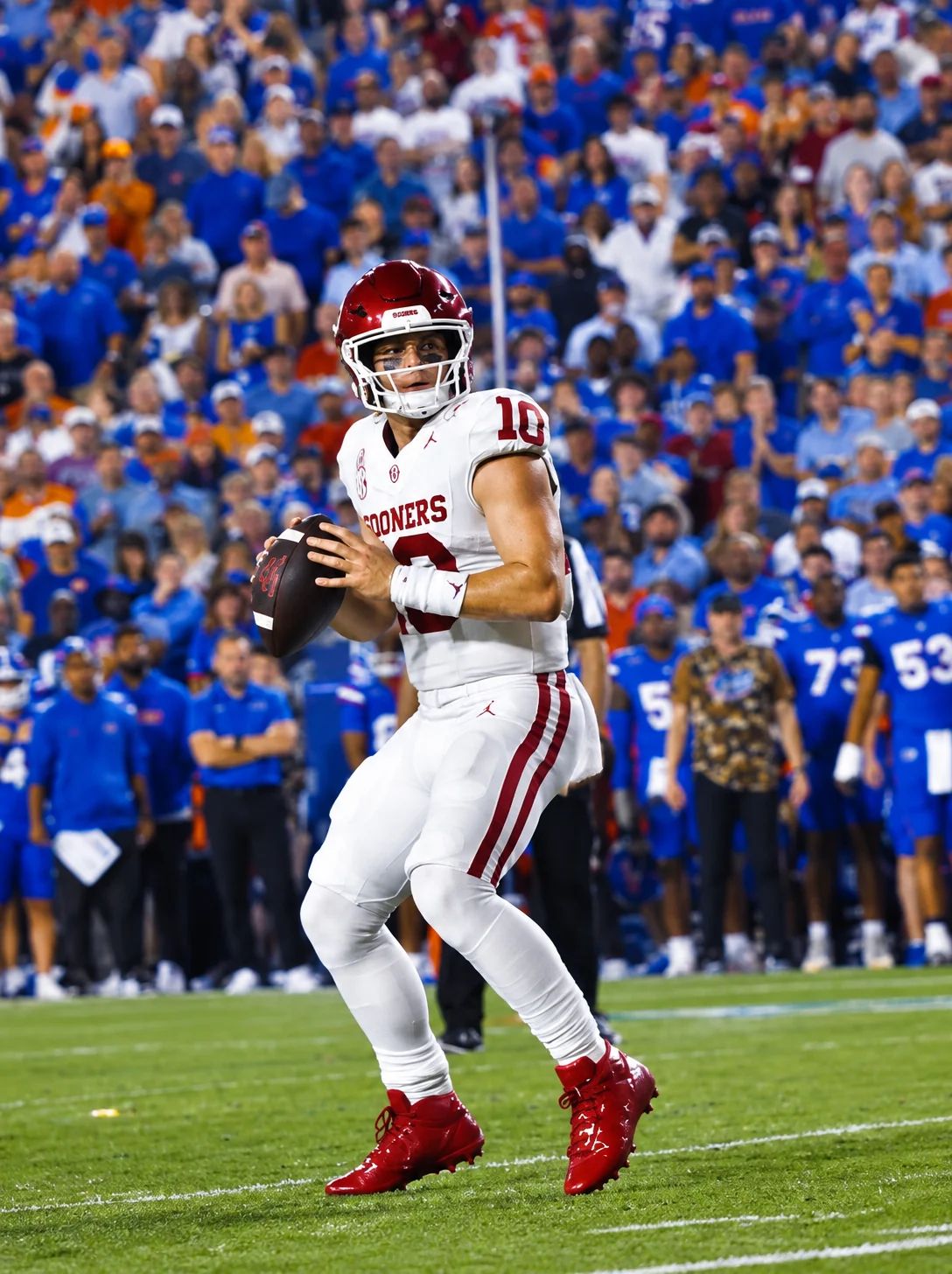
The most important adjustment Oklahoma made Saturday night in Gainesville wasn’t necessarily something that showed up in the box score. It was something that didn’t happen nearly as often as it had in previous weeks.
John Mateer wasn’t spending the evening waiting for routes to develop while defenders closed in around him.
After an offensive performance against South Carolina that exposed the Sooners’ inability to consistently protect their quarterback and sustain drives, Oklahoma needed a different approach. With Jason Witten taking over play-calling responsibilities, the Sooners entered The Swamp with a more deliberate offensive identity, one built around getting the football out of Mateer’s hands, finding favorable matchups underneath and making Florida defend the entire width of the field.
The results weren’t necessarily explosive from beginning to end. Oklahoma finished with 207 passing yards, 144 rushing yards and 351 total yards. Mateer completed 21 of 33 passes for two touchdowns without throwing an interception.
But the significance of the performance extended beyond those numbers.
Oklahoma found a way to keep its quarterback relatively clean, limit Florida’s opportunities to disrupt the passing game and, eventually, put together one of the most consequential offensive drives of its season.
The Sooners left Gainesville with a 23-7 victory. More importantly, they left with a blueprint for how this offense can function when its quarterback doesn’t have to carry the burden of making everything happen downfield.
1. The Adjustment: Changing the Clock
The challenge entering Saturday was straightforward.
Oklahoma needed to protect Mateer better.
That didn’t necessarily mean the offensive line suddenly needed to win every individual matchup. It meant the coaching staff needed to stop putting the quarterback in situations where the defensive front could dictate the outcome of a passing play.
Against South Carolina, the Sooners struggled to establish consistent offensive rhythm. Pressure disrupted the timing of the passing game, and too many possessions became dependent on Mateer extending plays and attempting to manufacture something after the initial design had broken down.
Witten’s approach against Florida offered a different solution.
Rather than consistently asking Mateer to attack vertically, Oklahoma incorporated a more accessible passing structure. Shorter throws, underneath options and opportunities to get the football into the hands of playmakers gave the quarterback answers before Florida’s defensive front could fully develop its rush.
There is an important distinction between eliminating pressure and neutralizing it.
Oklahoma didn’t completely eliminate Florida’s ability to generate pressure. Mateer was still sacked once. But the Sooners reduced the number of opportunities for the Gators to make the quarterback uncomfortable.
A defensive front can only affect a quarterback who still has the football.
By prioritizing quicker decisions and accessible targets, Oklahoma made Florida defend the play rather than allowing its defensive line to dictate it.
That was the first major victory of Witten’s offensive approach.
2. The Safety Valves: Beers and Sategna Give Mateer Answers
Two players became particularly important to Oklahoma’s adjusted passing attack: tight end Rocky Beers and wide receiver Isaiah Sategna III.
They offered different solutions, but both helped give Mateer reliable options when the Sooners needed to move the football without exposing the quarterback to extended passing situations.
Rocky Beers: The Middle-of-the-Field Answer
Beers continued to establish himself as an increasingly important component of Oklahoma’s passing game.
The tight end finished with four receptions for 72 yards, leading the Sooners in receiving. His 41-yard reception was particularly important, providing an explosive play and helping Oklahoma establish an early scoring opportunity.
His value, however, wasn’t limited to that one reception.
Beers gives Mateer a target who can operate between the numbers, work into available space and provide a different kind of matchup than Oklahoma’s outside receivers.
When defenses prioritize taking away vertical routes and keeping receivers in front of them, the middle of the field becomes an important area to attack.
A tight end who can find those openings provides the quarterback with a relatively accessible answer.
Beers’ production against Florida demonstrated why that position needs to remain central to the offense moving forward.
Isaiah Sategna III: Making the Perimeter Part of the Quick Game
Sategna provided another important dimension.
His ability to operate on the perimeter gives Oklahoma opportunities to move the football without asking Mateer to consistently challenge deeper coverage.
Quick throws to receivers in space can function almost like extensions of the running game. Instead of handing the football to a back, the offense gets it to a receiver and allows his athleticism to create additional yardage.
Sategna finished with four receptions for 34 yards and a touchdown.
His six-yard touchdown reception in the fourth quarter was the finishing touch on Oklahoma’s 20-play scoring drive.
The individual numbers don’t fully capture his importance to the offensive structure. His presence gives Witten another way to distribute the football, force defenders to respect the perimeter and prevent opposing defenses from concentrating exclusively on the interior passing game.
For Mateer, that means more available answers and fewer situations where he has to hold the football while waiting for something to open downfield.
The Numbers: Mateer’s Two Most Important Receiving Targets
| Player | Receptions | Yards | TD |
|---|---|---|---|
| Rocky Beers | 4 | 72 | 0 |
| Isaiah Sategna III | 4 | 34 | 1 |
| Combined | 8 | 106 | 1 |
Together, Beers and Sategna accounted for 106 of Mateer’s 207 passing yards.
That’s more than half of Oklahoma’s passing production coming from two players who provided complementary answers within the passing game.

Take A Deeper Dive Into Our Oklahoma Football Coverage On Our Facebook Subscription Hub
Friday The 13th Decision: Can Oklahoma Keep Kamieon Compton-Nero Home?
The Column: Turning Point – How Venables Rescued The Locker Room From The Brink
Key Notes & Storylines: Oklahoma Takes Its Search For Answers To The Swamp
Help support Heartland Sports by Unlocking Exclusive, data-driven film room breakdowns, recruiting Update, high-leverage personnel matrix updates you won’t find anywhere else, and More by subscribing to our premium Oklahoma Sooners football coverage today.
3. The Ground Game: Making Florida Defend More Than the Pass
There was another important component to Oklahoma’s adjustment that shouldn’t get overlooked.
The Sooners didn’t simply replace an aggressive vertical passing attack with a collection of short throws. They also established enough of a rushing presence to prevent Florida from treating every down as a passing situation.
Oklahoma finished with 144 rushing yards on 40 attempts.
Mateer contributed 56 yards on the ground, while Lloyd Avant added 47 and Tory Blaylock finished with 30.
That balance mattered.
When an offense can consistently threaten the defense with quarterback movement and traditional rushing concepts, linebackers and defensive backs have additional responsibilities. They can’t simply retreat into coverage or immediately attack the quarterback on every passing down.
The run game also helped Oklahoma avoid becoming predictable.
Witten could use the threat of the handoff to create opportunities for Mateer in the passing game, while Mateer’s mobility gave Florida another element to account for when defending the pocket.
The Sooners weren’t asking their quarterback to win the game with his arm alone.
Instead, they gave him multiple ways to move the offense, and that helped create a more manageable environment for the entire unit.
It was a complementary approach that Oklahoma had been missing.
4. The 12:45 Drive: The Ultimate Test of the Adjustment
If there was one possession that captured everything Oklahoma was attempting to accomplish offensively, it was the 20-play, 89-yard drive that effectively ended Florida’s chances of winning.
The Sooners took over with a seven-point lead and 17:41 to total game time remaining.
They didn’t need a quick strike. They needed to make Florida defend.
And defend the Gators did.
Oklahoma marched 89 yards down the field, converted five third downs and consumed 12 minutes and 45 seconds of that game time before Mateer connected with Sategna for a six-yard touchdown.
It was an exercise in offensive patience.
The Sooners didn’t need to manufacture an explosive play every time they snapped the football. They needed to consistently gain manageable yardage, stay ahead of the chains and avoid the negative plays that could put Mateer in obvious passing situations.
That’s where the quick-game philosophy became especially valuable.
Short completions and manageable gains kept the offense moving. The rushing attack provided another dimension, and Mateer was able to operate without constantly being forced into extended dropbacks.
Florida had to defend play after play, down after down.
Five third-down conversions on a single possession are particularly significant. Each one represented another opportunity for the Gators to get off the field. Each one instead extended Oklahoma’s control of the game.
By the time Sategna crossed the goal line, Florida’s defense had spent nearly an entire quarter of game time trying to get the football back.
The Gators went four-and-out on their next possession, and Oklahoma added another field goal to establish the final 23-7 margin.
That drive wasn’t just about scoring a touchdown.
It was about taking away Florida’s remaining opportunities.
It was also a powerful demonstration of how Oklahoma can use its offense to complement its defense. The Sooners had spent much of the evening controlling Florida defensively. In the fourth quarter, the offense gave that defense an opportunity to finish the job without having to return to the field immediately.
5. The Bigger Picture: A More Sustainable Version of Oklahoma’s Offense
One game doesn’t establish that Oklahoma has solved every problem that has plagued its offense this season.
There are still questions about consistency, explosive-play production and the ability to sustain this approach against better defensive fronts.
The Sooners also need to demonstrate that this wasn’t simply a one-week response to a particularly difficult situation.
But there were encouraging signs in Gainesville.
Mateer completed 63.6% of his passes, threw two touchdowns without an interception and was sacked only once. Beers emerged as a productive receiving option, Sategna found the end zone, and the running game contributed 144 yards.
More importantly, Oklahoma controlled the football for 37:50 and converted 10 of its 18 third-down opportunities.
Those numbers tell the story of an offense that was considerably more efficient at managing possessions.
The biggest question moving forward is whether Witten can maintain that balance while gradually reintroducing the explosive elements that made Oklahoma dangerous earlier in the season.
The Sooners still need to create explosive plays. They still need to stretch defenses vertically. And they still need Mateer to be aggressive when opportunities present themselves.
But aggression doesn’t have to mean holding the football.
Sometimes the best way to attack a defense is to take what it gives you, get the ball into the hands of your playmakers and make the defense execute for four quarters.
That’s what Oklahoma did against Florida.
The Verdict: The Best Adjustment Was Making Things Easier
The significance of Oklahoma’s victory over Florida extends beyond the fact that the Sooners won their first-ever game at The Swamp.
It was an important response to a difficult stretch offensively, and it offered a glimpse of what this unit can look like when the coaching staff puts its quarterback in a position to succeed.
Witten didn’t need Mateer to play hero ball. He needed him to be decisive, distribute the football and take advantage of what the defense provided.
Beers became a reliable option over the middle. Sategna provided a perimeter threat. The running game forced Florida to respect multiple dimensions of the offense, and the offensive line benefited from a system that didn’t consistently ask it to sustain protection indefinitely.
The 20-play touchdown drive was the culmination of that approach.
Oklahoma didn’t overwhelm Florida with explosive offense. It overwhelmed the Gators with execution, patience and the willingness to keep doing what was working.
That’s an important distinction for a team trying to find its offensive identity in November.
The Sooners don’t need to abandon their playmakers or turn Mateer into a conservative quarterback. They need to give him an offensive structure that allows his playmaking ability to become an advantage rather than a necessity on every snap.
Against Florida, they took a meaningful step in that direction.
The best protection Oklahoma gave John Mateer wasn’t necessarily another blocker. It was a football that left his hands before the defense could get to him.