By the time Sunday afternoon arrived at Gaylord Family–Oklahoma Memorial Stadium, the weekend had already gone sideways.
Friday’s nationwide FAA ground stop disrupted Ole Miss’s travel plans, forcing a marquee SEC matchup to move from Saturday to Sunday. The schedule changed. The preparation changed. And when the teams finally took the field, the weather offered little incentive to believe this would be a day for offensive fireworks.
Cold temperatures, steady rain and swirling wind turned the football into a different kind of challenge. Every throw carried additional risk. Every cut required extra care. Every possession became an opportunity to either manage the conditions or let them dictate the game.
For Oklahoma, the answer came from the ground.
Interim offensive coordinator Jason Witten recognized that Sunday wasn’t going to be won by forcing the football downfield. Instead, he leaned into the physicality of his offensive line, the mobility of John Mateer and a collection of running backs capable of grinding out the yards that mattered.
The result was Oklahoma’s most productive rushing performance of the season—188 yards on the ground, 36 minutes and 31 seconds of possession, nine third-down conversions and a 24–17 victory over No. 19 Ole Miss.
The Sooners didn’t need to dominate every statistical category. They needed to dictate the pace.
And for much of the afternoon, they did exactly that.
The Adjustment Index: Turning Ugly into Unstoppable
There is a difference between abandoning your offensive identity and adapting it to the circumstances.
On Sunday, Witten didn’t ask Oklahoma to become something it wasn’t. He simply recognized what the game was offering and stopped trying to force what it wasn’t.
The Sooners finished with just 111 passing yards. Under normal circumstances, that number might raise questions about offensive efficiency or the inability to consistently move the ball through the air. In this game, it told a different story.
Oklahoma understood the conditions, recognized the risks and built its offensive plan around a simple premise: make Ole Miss defend the run until it proves it can stop it.
The Sooners ran the football 49 times, averaging 3.8 yards per carry. Those numbers aren’t particularly explosive, but they were effective in the context of the game. Oklahoma didn’t need a 20-yard gain every time it touched the ball. Four yards on first down, another manageable gain on second down and a conversion on third down were enough to keep the offense moving.
That was the formula.
The Sooners converted nine of their 16 third-down opportunities, a 56.3% success rate. In a game where throwing the football became increasingly difficult, staying out of obvious passing situations was essential. Witten’s ground-heavy approach kept the playbook alive and prevented Ole Miss from consistently dictating the terms of the matchup.
Oklahoma also protected the football. Neither team committed a turnover, but the Sooners never gave the Rebels the mistake they needed to change the complexion of the game.
There were no unnecessary risks. No desperate attempts to manufacture explosive plays. No insistence that the offense had to win the game through the air.
Witten was willing to let the game become a battle of patience.
And Oklahoma had the personnel to win it.
John Mateer: The Quarterback Became the Running Game
The adjustment started with John Mateer.
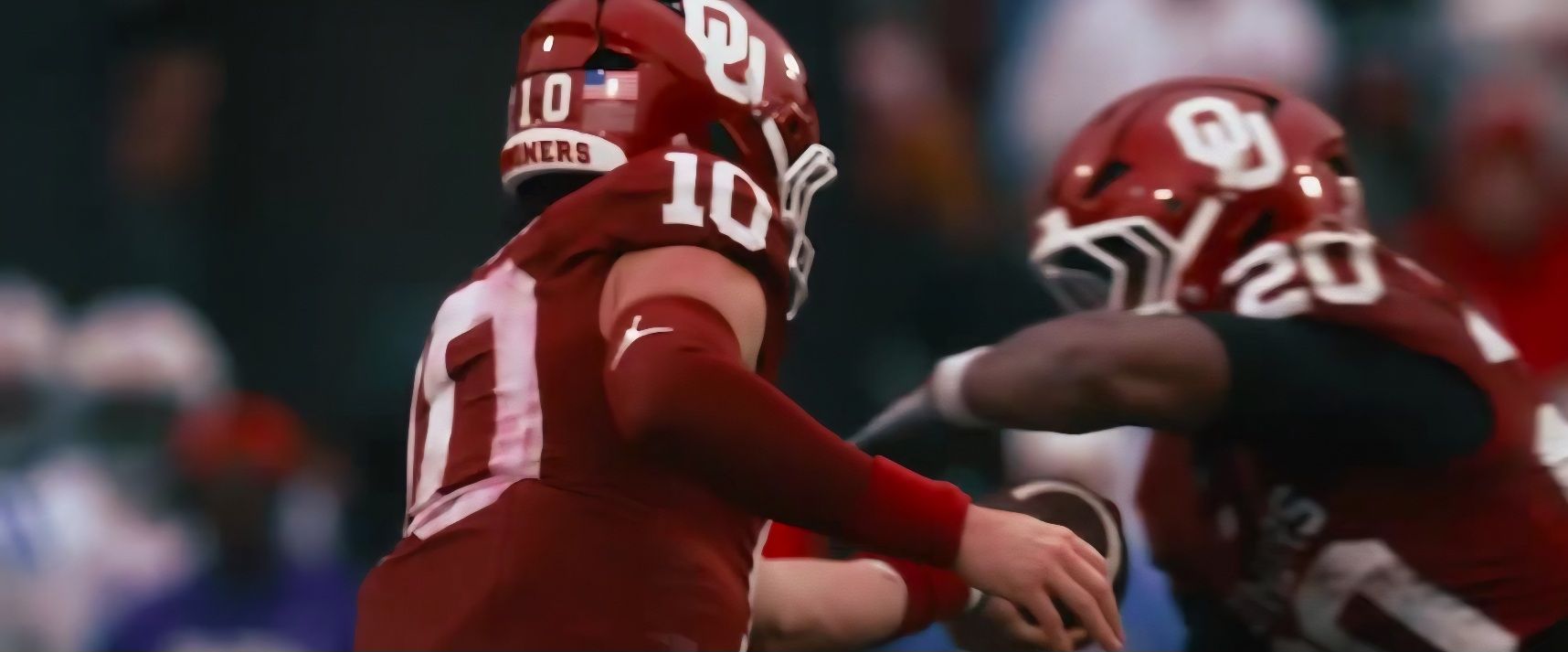
Oklahoma’s quarterback accounted for 181 yards of total offense, throwing for 111 yards while rushing for 70 yards on 16 carries. He also scored a touchdown on the ground.
Mateer wasn’t simply a quarterback occasionally keeping the football on a designed play. His presence became a central part of Oklahoma’s rushing identity.
When the Sooners opened the game with a 13-play, 74-yard drive that consumed 7:40 of the first quarter, they immediately established that Ole Miss would have to account for Mateer’s legs. After opening the possession with four straight handoffs to Lloyd Avant, Mateer broke loose on a 22-yard keeper up the middle to put Oklahoma inside the red zone at the 8-yard line. On the very next snap, he finished the job himself, taking a designed run around the right side eight yards into the end zone to give Oklahoma a 7–0 lead.
That opening drive set the tone.
The quarterback run game forced Ole Miss to defend an additional dimension. Every time the Rebels committed to the running back, they had to remain conscious of Mateer keeping the ball. Every time a defender hesitated, Oklahoma had another opportunity to create space.
In weather that made conventional passing difficult, Mateer’s ability to become an additional running threat was particularly valuable.
He wasn’t asked to rescue the offense with his arm. He was asked to make the defense account for him, take the available yards and keep the chains moving.
That willingness to embrace the physical side of the game became one of the defining elements of Oklahoma’s afternoon.
Mateer’s 16 carries were not incidental to the game plan. They were the game plan.

Take A Deeper Dive Into Our Oklahoma Football Coverage On Our Facebook Subscription Hub
What Oklahoma Is Getting In Kenyon Sweat: Elite Speed, Versatility, And A Homegrown Playmaker
The Film Room: Caging Chambliss-How Venables & Bates’ Defense Survived the Scramble Drill
The Column: Built For The Mud-Venables Forged a Team That Refuses to Blink
Help support Heartland Sports by Unlocking Exclusive, data-driven film room breakdowns, recruiting Update, high-leverage personnel matrix updates you won’t find anywhere else, and More by subscribing to our premium Oklahoma Sooners football coverage today.
Jonathan Hatton Jr. Delivered the Body Blow
If Mateer established the tone, freshman Jonathan Hatton Jr. helped Oklahoma deliver the kind of punch that changed the game.
Hatton finished with five carries for 18 yards, numbers that won’t immediately stand out in a box score. But his contribution came at a critical moment, when Oklahoma needed to turn possession into points and create separation from Ole Miss.
The Sooners opened the third quarter with a long, physical drive, keeping the football for more than six minutes and moving 70 yards in 12 plays.
Hatton finished it.
On the five-yard touchdown run, Oklahoma leaned into a heavy formation and trusted its offensive line to create the necessary space. It was the kind of play that fit the afternoon perfectly—physical, uncomplicated and unwilling to concede an inch.
The touchdown pushed Oklahoma’s lead to 21–7.
More importantly, it came after the Sooners had already spent a significant portion of the third quarter controlling the football. Hatton’s touchdown rewarded that possession and gave Oklahoma the two-score cushion it would need when Ole Miss finally found its footing in the fourth quarter.
Hatton wasn’t the only running back contributing to the workload.
Tory Blaylock finished with 48 yards on nine carries, while Lloyd Avant added 46 yards on 15 carries. Together, they helped Oklahoma distribute the workload, continue to run the football and avoid becoming dependent on one player to carry the offense.
The ground game was a collective effort.
Mateer provided the quarterback threat. Blaylock and Avant handled much of the between-the-tackles work. Hatton brought the physicality when Oklahoma needed to finish a drive.
That combination gave Witten options without forcing him to abandon the identity he had established.
The Clock Was Oklahoma’s Most Effective Weapon
The most important number from Sunday may not have been the 188 rushing yards.
It was 36:31.
Oklahoma held the football for more than 13 minutes longer than Ole Miss, which finished with 23:29 of possession. Against a Rebels offense built to create rhythm, tempo and explosive opportunities, that disparity mattered.
The Sooners didn’t simply move the football. They kept Trinidad Chambliss and the Ole Miss offense on the sideline.
That was particularly evident in the third quarter.
Oklahoma held the ball for 12 minutes and 41 seconds of the 15-minute period. Hatton’s touchdown capped the possession, and Ole Miss had little opportunity to establish any rhythm coming out of halftime.
A team built around tempo cannot operate at tempo when it doesn’t have the football.
That is where Witten’s approach became more than an offensive adjustment. It became a defensive strategy.
Every first down extended Oklahoma’s possession. Every successful third-down conversion forced Ole Miss to wait longer. Every additional minute spent grinding through the ground game reduced the number of opportunities the Rebels had to make something happen.
The Sooners didn’t have to shut down Ole Miss on every possession to control the game.
They had to limit the opportunities.
Oklahoma finished with 299 total yards, while Ole Miss had 306. The Rebels actually outgained the Sooners, but the yardage advantage never translated into control of the game.
Oklahoma won the possession battle. It won the third-down battle. It won the battle of the clock.
And that was enough to overcome the slight deficit in total yardage.
The Offense Protected the Defense
The fourth quarter reminded everyone that controlling a game and finishing a game are two different things.
Oklahoma entered the final period with a 21–7 lead, but Ole Miss found an opening. Chambliss scrambled for 32 yards on third-and-15, then connected with Caleb Odom for a 26-yard touchdown. Suddenly, the two-score cushion had become a seven-point game.
After Tate Sandell’s 41-yard field goal gave Oklahoma a 24–14 lead, Ole Miss continued to push. The Rebels added another field goal with 42 seconds remaining, recovered an onside kick and drove into Oklahoma territory.
The Sooners were forced to defend one final possession.
But this is where the earlier work mattered.
The defense had spent much of the afternoon watching Oklahoma methodically move the football and drain the clock. It hadn’t been asked to defend Ole Miss’s tempo for the entire game. It had been given time to regroup, breathe and prepare for the next possession.
That doesn’t mean the final defensive stand was easy. Chambliss still found a way to move the football, and the recovered onside kick created a final opportunity that could have turned a comfortable afternoon into a devastating loss.
But Oklahoma survived.
The defense knocked down the final Hail Mary as time expired, preserving a 24–17 win and clinching bowl eligibility.
The offense had put the defense in a position to finish the game. The defense ultimately did.
That is complementary football—and Witten’s ground game played a significant role in making it possible.
A Blueprint Oklahoma Can Carry Forward
Oklahoma’s victory over Ole Miss wasn’t perfect. The Sooners still have work to do offensively, particularly in the passing game, and 111 passing yards won’t be enough against every opponent on the schedule.
But Sunday offered something more valuable than a single statistical achievement.
It offered proof that Oklahoma can win a game without relying on the passing game to carry the offense.
That matters.
The Sooners have spent much of the season trying to find consistency, trying to establish an identity and trying to figure out how to put four quarters of football together against SEC competition. Sunday’s performance provided a different answer.
When the conditions dictated a physical game, Oklahoma responded with physicality.
When the passing game wasn’t going to be the primary weapon, the Sooners leaned on Mateer, their offensive line and the running backs.
When Ole Miss needed the football to get back into the game, Oklahoma’s offense spent the third quarter taking it away.
The Sooners rushed for a season-high 188 yards, converted 56.3% of their third downs, committed no turnovers and held the ball for more than 36 minutes.
That isn’t flashy football.
It is winning football.
Oklahoma improved to 6–4 overall and 4–3 in SEC play, secured bowl eligibility and earned consecutive victories over ranked SEC opponents following its win at Florida.
The weather won’t always look like it did Sunday. The Sooners won’t always need to run the football 49 times. And Witten won’t necessarily call every game the same way.
But opposing defenses now have another version of Oklahoma to prepare for.
A quarterback willing to run. A freshman capable of finishing drives. A ground game that can keep the chains moving. An offense that understands it doesn’t have to score quickly to win.
Jason Witten didn’t just adjust to the weather.
He gave Oklahoma another way to control a game.