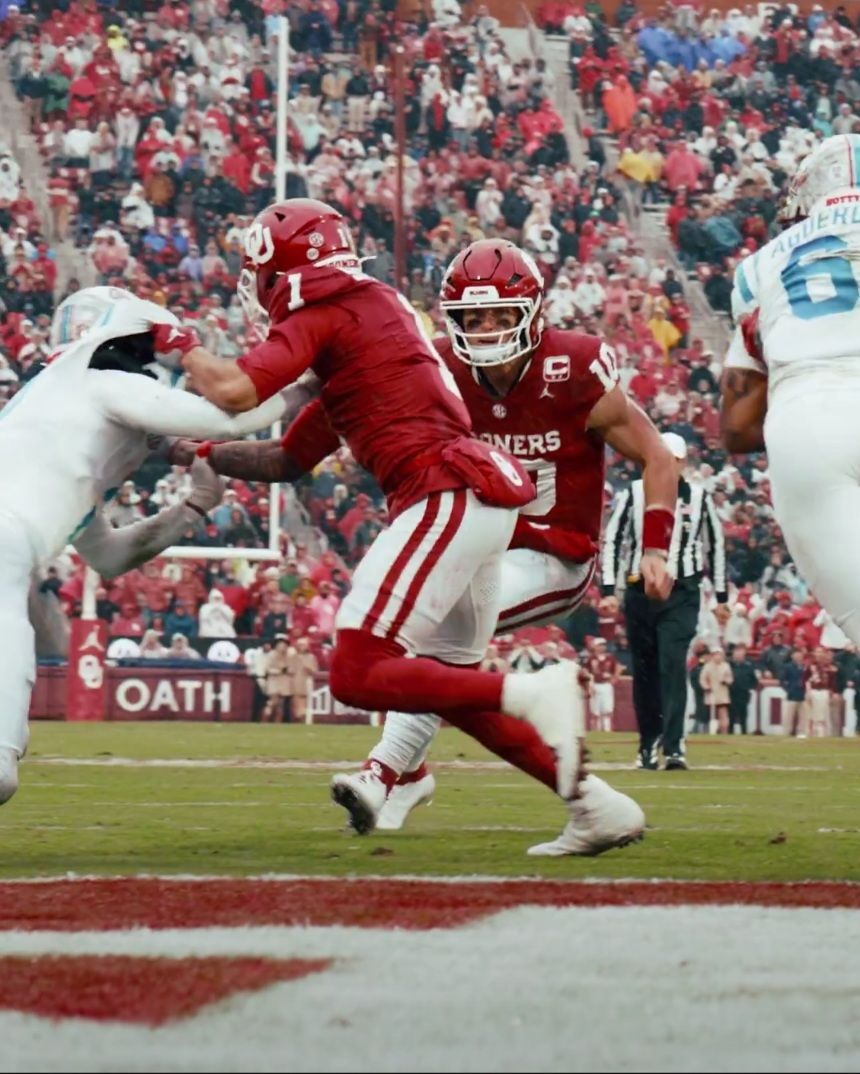
Oklahoma didn’t need a spectacular passing performance to beat Ole Miss. It didn’t need to win a shootout, either. And when the Rebels made one final push in the fourth quarter, the Sooners found a way to keep the game from slipping away.
That might be the most encouraging part of Sunday’s 24–17 victory.
A week after beating Florida 23–7, Oklahoma followed up with another physical performance against a ranked SEC opponent. The circumstances were unusual, with FAA-related travel disruptions pushing the game from Saturday to Sunday, but the result was familiar: the Sooners found a way to win.
Since Jason Witten took over as interim offensive coordinator, Oklahoma has won consecutive games against ranked opponents. The offense has become more comfortable leaning on the ground game, John Mateer has protected the football, and Brent Venables’ defense has continued to give the Sooners a chance to win.
The turnaround has not been perfect. Oklahoma still has limitations, and the Ole Miss game offered a reminder that a narrow lead can disappear quickly.
But with Texas A&M coming to Norman for Senior Day, the Sooners have some important questions answered—and one they still need to address.
1. Can Oklahoma Win When the Passing Attack Isn’t Carrying the Offense?
The answer: Yes, and the Sooners are becoming increasingly comfortable doing it.
For much of the season, Oklahoma needed John Mateer and the passing game to provide the offensive spark. Against Ole Miss, however, the Sooners demonstrated that they don’t have to rely on explosive passing plays to move the football.
Weather conditions and Ole Miss coverage limited opportunities to attack vertically. Rather than forcing the issue, Witten leaned into the physical identity that has begun to emerge over the last two weeks.
Oklahoma ran the ball 49 times for 188 yards, controlling possession for 36:31. The Sooners converted nine of 16 third-down opportunities, allowing them to sustain drives and keep the Rebels’ offense on the sideline.
Mateer was an important part of that approach. He completed 10 of 19 passes for 111 yards, but added 70 rushing yards on 16 carries. His production wasn’t spectacular through the air, but he helped Oklahoma control the game with his legs and decision-making.
Most importantly, he didn’t turn the ball over.
Mateer has now gone four consecutive starts without a turnover, throwing 124 passes without an interception over that span. That’s a significant development for an offense that struggled with ball security earlier in the season.
The formula was similar against Florida, when Mateer rushed for 56 yards and Oklahoma put together a 20-play, 89-yard touchdown drive that consumed 12:45 of the fourth quarter.
The Sooners are learning how to dictate the terms of a game instead of simply reacting to what the opposing defense gives them.
That doesn’t mean Oklahoma should abandon its passing game. It still needs to create explosive plays and keep defenses honest. But Witten has demonstrated that the Sooners can win when the passing attack isn’t producing big numbers.
Against Texas A&M, that could be important. The Aggies allow 19.0 points per game and have been effective in the red zone. Oklahoma may need another patient, physical performance to move the football.
The difference is that the Sooners no longer appear dependent on one particular way of moving it.
2. Has Special Teams Become a Genuine Weekly Weapon?
The answer: The return game has, and that’s a significant development.
There was a time this season when Oklahoma’s special teams weren’t generating much confidence. The expectation was often that the unit simply needed to avoid making a mistake.
Against Ole Miss, it helped change the game.
Isaiah Sategna III returned a punt 75 yards for a touchdown, giving Oklahoma a major momentum swing and another example of how the third phase can contribute beyond simply handling routine responsibilities.
It was Sategna’s second punt-return touchdown of the season. He also returned a punt 88 yards for a score against UTEP in the season opener.
Those plays matter because they provide points without requiring the offense to put together a sustained drive. In a game where Oklahoma’s passing attack produced only 111 yards, the value of a special-teams touchdown becomes even more apparent.
There is still room for improvement.
Tate Sandell connected on a 41-yard field goal against Ole Miss but missed attempts from 39 and 51 yards. The Sooners cannot overlook those missed opportunities, particularly when playing close games against quality opponents.
The return game has become a legitimate weapon. The kicking operation still needs greater consistency.
That matters heading into today. Oklahoma is favored by 7.5 points, but Texas A&M has a defense that allows the same 19.0 points per game as the Sooners. Field position and points outside the offense could again become important.
Sategna has shown that he can change a game with one return. Now Oklahoma needs the rest of its special-teams operation to complement that ability.

Take A Deeper Dive Into Our Oklahoma Football Coverage On Our Facebook Subscription Hub
Key Notes & Storylines: Five Things To Watch As No. 22 Oklahoma Hosts Texas A&M
Five-Star Seneca Driver Headlines Major Recruiting Surge for Oklahoma’s 2027 Class
What Oklahoma Is Getting In Kenyon Sweat: Elite Speed, Versatility, And A Homegrown Playmaker
Help support Heartland Sports by Unlocking Exclusive, data-driven film room breakdowns, recruiting Update, high-leverage personnel matrix updates you won’t find anywhere else, and More by subscribing to our premium Oklahoma Sooners football coverage today.
3. Can Oklahoma’s Defense Sustain Its Physicality for Four Quarters?
The answer: Mostly, but the finish against Ole Miss showed there’s still work to do.
Brent Venables’ defense has been Oklahoma’s most consistent strength throughout the season. The Sooners are allowing just 19.0 points per game and 294.6 total yards per contest.
Against Ole Miss, they held the Rebels to 306 total yards and just 127 passing yards, their lowest passing output in three seasons.
For much of the afternoon, Oklahoma dictated the physical terms of the game. The defense limited explosive passing opportunities, made Ole Miss work for yards, and kept the Rebels from finding much offensive rhythm.
The third-down numbers were another encouraging sign. Ole Miss converted just four of 12 attempts, while Oklahoma continued to demonstrate why it ranks among the nation’s best in opponent third-down conversion percentage.
But the fourth quarter wasn’t entirely comfortable.
The Rebels eventually found some life, scoring on a 26-yard touchdown pass from Trinidad Chambliss to Caleb Odom before adding a 41-yard field goal with 42 seconds remaining. Then came the onside kick, which Ole Miss recovered with 38 seconds left and no timeouts.
Suddenly, Oklahoma was facing the possibility of a stunning finish.
The Sooners ultimately survived, stopping the final Hail Mary attempt to secure the victory. But the sequence deserves attention.
Holding a dangerous offense to 17 points is an accomplishment. Allowing it to make a late push and recover an onside kick is a reminder that games aren’t over until the clock reaches zero.
Oklahoma’s defense has shown that it can play physically and consistently for most of a game. The next step is making sure opponents don’t find a late opening.
That will be especially important against Texas A&M, a team desperate to keep its bowl hopes alive. The Aggies have struggled offensively, but Oklahoma cannot give them inexpensive opportunities or allow a close game to become unnecessarily dramatic.
The Lingering Worry: Can Oklahoma Finish Drives With Touchdowns?
The most encouraging part of Oklahoma’s recent turnaround is that the offense has found a way to sustain possessions.
The most concerning part is that sustaining possessions and finishing them are two different things.
The Sooners are averaging 22.3 points per game this season. That’s not an especially high scoring average for a team with postseason aspirations, and it leaves relatively little margin for error when the defense or special teams gives up a score.
Oklahoma’s ground game has improved considerably under Witten. The Sooners rushed for 188 yards against Ole Miss, converted nine third downs, and controlled the clock for more than 36 minutes.
But those numbers need to translate into more points.
Texas A&M presents a particularly interesting challenge in that regard. The Aggies allow 19.0 points per game and rank second in the SEC in red-zone defense, allowing opponents to score on just 69.2% of their trips inside the 20-yard line.
That means Oklahoma cannot assume that long drives will automatically produce touchdowns.
The Sooners need to be more efficient when the field gets shorter. They need to finish possessions, avoid settling for field goals, and make the most of opportunities created by the defense and special teams.
The Aggies also have their own uncertainty at quarterback. Marcel Reed’s status is in question after he was benched in favor of Brady Hart, who is reportedly expected to make his first career start. Oklahoma’s defense should have opportunities to pressure a young quarterback, but the Sooners cannot afford to let offensive mistakes give Texas A&M a path back into the game.
A desperate opponent can become dangerous when it hangs around long enough.
Oklahoma has found a formula that works. Now it needs to make that formula more productive.
Today Is Another Opportunity to Prove It
The Sooners have answered three important questions over the last two weeks.
They can win without a prolific passing performance. Their return game can create points and swing momentum. And their defense can hold up against quality SEC competition, even when the fourth quarter gets uncomfortable.
Those are meaningful developments for a team that was 4–4 following the loss to South Carolina.
But the next step is just as important.
Texas A&M arrives in Norman at 4–6, riding a three-game losing streak and needing victories over Oklahoma and Texas to become bowl eligible. The Sooners are 6–4, have won two straight, and already have their postseason secured.
The circumstances favor Oklahoma, but the Aggies still have a capable defense and plenty of motivation.
For the Sooners, the objective should be straightforward: keep running the football, protect Mateer, take advantage of special-teams opportunities, and finish drives with touchdowns.
Oklahoma has shown it can win ugly.
Now it’s time to show it can win decisively.