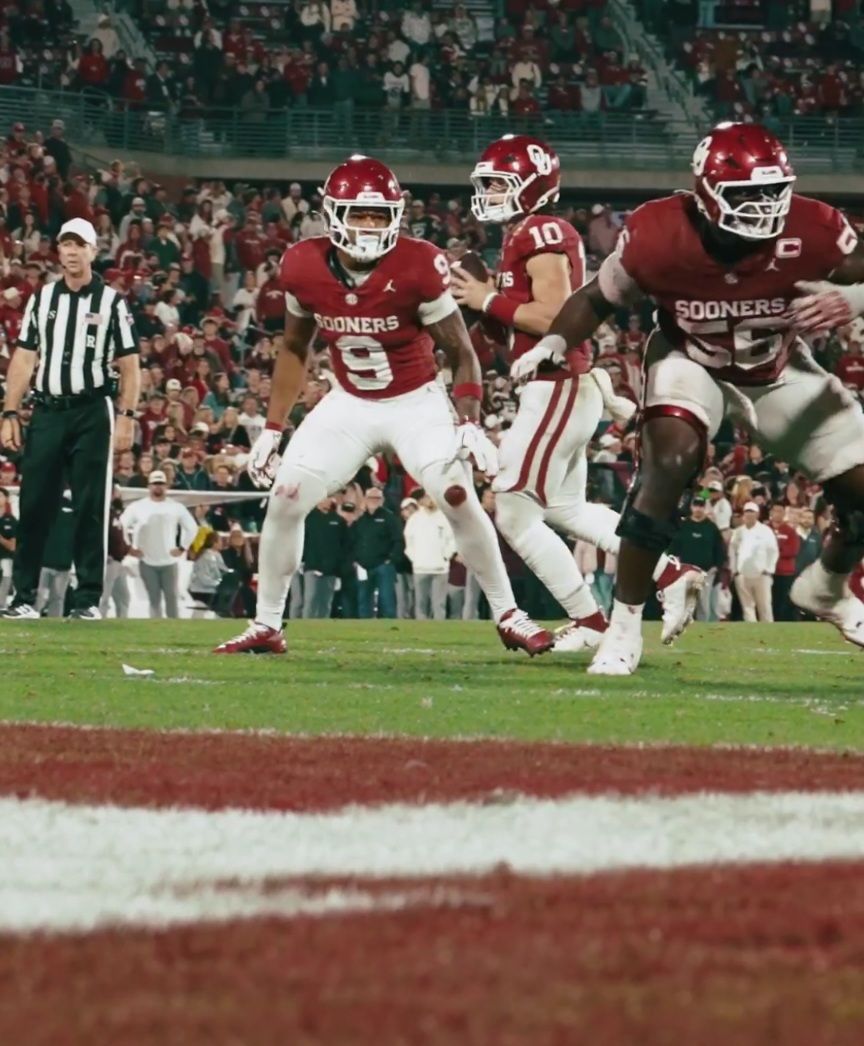
The first half of Oklahoma’s home finale was not exactly the offensive showcase the Sooners envisioned.
John Mateer threw an interception. He lost a fumble. Oklahoma’s first three possessions ended in punts, and Texas A&M took advantage of the opportunity to grab a 7–0 lead. For an offense that had started to find its rhythm during consecutive wins over Florida and Ole Miss, the opening half offered a reminder that progress doesn’t always mean eliminating mistakes.
But Oklahoma’s response was more important than the mistakes themselves.
The Sooners eventually defeated Texas A&M 28–7, scoring 21 unanswered points in the fourth quarter. Mateer finished with 269 passing yards, three touchdown passes and a rushing touchdown. More importantly, he didn’t allow the early turnovers to dictate the rest of his afternoon.
Interim offensive coordinator Jason Witten deserves considerable credit for that response.
Witten didn’t ask Mateer to become a different quarterback. He didn’t abandon the physical identity Oklahoma has been building over the last several weeks. Instead, the Sooners continued to lean on balance, gave their quarterback opportunities to settle back into the game and capitalized when Texas A&M’s defense gave them opportunities to attack.
The result was an offense that finished with 421 total yards, 24 first downs and four touchdowns.
The adjustment wasn’t simply throwing the football more often. It was making the passing game more effective by keeping the defense accountable at every level.
Adjustment No. 1: Don’t Let the Turnovers Change the Identity
The easiest response to two first-half turnovers would have been to become conservative.
Oklahoma could have tried to shorten the game, limit Mateer’s opportunities to make mistakes and rely almost exclusively on the running game. That approach might have protected the Sooners from another giveaway, but it also would have allowed Texas A&M to tighten its defensive approach.
Witten chose a different path.
Oklahoma continued to operate with a balanced offensive approach, eventually finishing with 152 rushing yards and 269 passing yards. The Sooners didn’t need to abandon the run to get the passing game going, and they didn’t need to force the ball downfield simply to make up for the early mistakes.
Witten acknowledged that the first half was far from clean.
“It was kind of a dirty game in the first half,” he said.
But he was proud of how his players handled the adversity.
“Really proud of our football team and our players for embracing the new approach to things and they haven’t flinched.”
That part matters.
Oklahoma’s offense has shown a different personality over the last three games. The commitment to running the football has helped create a more manageable environment for Mateer, while the passing game has remained capable of producing explosive plays. Against Texas A&M, that balance allowed the Sooners to keep attacking without letting two mistakes become the defining story of the afternoon.
Adjustment No. 2: Use the Run Game to Keep the Defense Honest
The vertical passing game doesn’t operate in isolation.
Defenses have to respect the possibility of a handoff, quarterback run or play-action opportunity before they can consistently commit resources to defending the passing game. Oklahoma’s recent commitment to physical football has helped create that dynamic.
The Sooners rushed for at least 140 yards in each of their last three games, including 152 against Texas A&M. They also controlled possession for 34:03, giving their defense time to rest and keeping the Aggies from establishing much offensive rhythm.
Mateer recognized the importance of that balance after the game.
“Yeah, I think as an offense in general, you know, it’s easier when you have the balance. That’s just football 101, right? But we committed to it, and the linemen and tight ends and running backs—and even the receivers on the perimeter—have had a great…”
The thought behind Mateer’s comments is reflected in the production. Oklahoma didn’t have to choose between running effectively and throwing effectively. It did both.
The Sooners also had contributions from multiple positions. Rocky Beers caught seven passes for 69 yards and a touchdown. Isaiah Sategna III added six receptions for 94 yards and a score. Parker Livingstone contributed four catches for 47 yards, while Tory Blaylock caught his first career touchdown pass.
That distribution matters because it makes Oklahoma harder to defend. Opponents cannot simply concentrate on one receiver or one aspect of the offense and expect to shut everything else down.

Take A Deeper Dive Into Our Oklahoma Football Coverage On Our Facebook Subscription Hub
OU Recruiting: What The Sooner Are Getting In Running Back Ben Rogers
The Column: No Longer Surviving – How Venables Turned a 4-4 Brink into a November Juggernaut
Senior Day Notebook: Tears, Tributes, and a Defense That Slam-Shut the Door
Help support Heartland Sports by Unlocking Exclusive, data-driven film room breakdowns, recruiting Update, high-leverage personnel matrix updates you won’t find anywhere else, and More by subscribing to our premium Oklahoma Sooners football coverage today.
Adjustment No. 3: Rebuild Mateer’s Confidence Before Delivering the Knockout
Perhaps the most important offensive sequence of the afternoon came before halftime.
After throwing an interception and losing a fumble, Mateer had every reason to feel the pressure of the situation. Texas A&M had taken a 7–0 lead, and the Sooners needed an answer before going into the locker room.
They got one.
Starting at their own eight-yard line, Oklahoma marched 92 yards in eight plays. Mateer completed the drive by finding Beers for a four-yard touchdown with 22 seconds remaining in the half.
It was a significant response, both on the scoreboard and for the quarterback’s confidence.
Mateer explained his mindset afterward.
“Honestly, I knew… last game in Norman, I’m not going out sad. We’re going to make it happen.”
That drive didn’t erase the turnovers, but it changed the conversation heading into halftime. Oklahoma was no longer chasing the game. The score was tied, and the Sooners had demonstrated that they could move the football even after an uneven start.
Witten’s approach was not to panic or pull back from the offense’s identity. It was to keep the players engaged and trust them to execute.
That trust was especially important for Mateer. A quarterback who knows he still has the confidence of his coaching staff can continue playing aggressively rather than pressing to compensate for earlier mistakes.
Venables recognized that response, praising Mateer’s ability to remain composed.
“He had a pep in his step. There’s something to be said about not flinching at that position, and everybody kind of follows your lead.”
Adjustment No. 4: Turn Possession Football Into Explosive Opportunities
The most revealing sequence of Witten’s afternoon came in the fourth quarter.
Oklahoma opened the final period with finishing a 15-play, 96-yard touchdown drive that consumed 8:24 of time off the clock. Mateer connected with Tory Blaylock for a five-yard score, giving the Sooners a 14–7 lead with 13:13 remaining.
That drive was a demonstration of patience and execution. Oklahoma moved the chains, sustained possession and eventually finished in the end zone.
But the Sooners weren’t limited to grinding out long possessions.
After the defense forced a turnover, Courtland Guillory intercepted Texas A&M quarterback Brady Hart and returned the ball 20 yards to the Aggies’ 25-yard line. Oklahoma needed only one play to capitalize.
Mateer found Sategna for a 25-yard touchdown, extending the lead to 21–7.
That was the vertical element Oklahoma needed: a willingness to attack immediately when the opportunity presented itself.
The distinction between those two touchdown drives is important. The first required 15 plays and more than eight minutes. The second required one snap. Both were products of an offense that understood when to be patient and when to strike.
Oklahoma finished with 269 passing yards, its second-highest passing output of the afternoon, and Sategna’s six catches for 94 yards provided a major contribution to that production.
The Sooners didn’t turn the game into a contest of deep shots. They simply demonstrated that the defense couldn’t afford to focus exclusively on stopping the run or defending short throws.
Adjustment No. 5: Finish With Confidence, Not Caution
By the time Oklahoma reached its final possession, the outcome was all but decided. But Witten’s offense wasn’t content to simply run out the clock.
On fourth-and-four from the seven-yard line, Mateer kept the football, ran left and hurdled a defender into the end zone with 22 seconds remaining.
It was an appropriate ending to his final game at Owen Field.
Mateer finished the afternoon responsible for all four Oklahoma touchdowns. His 302 total yards included 269 through the air and 66 on the ground, and his final touchdown put an emphatic stamp on a game that had begun with two costly mistakes.
The sequence also reflected the confidence Oklahoma has developed in its offensive identity. The Sooners were willing to remain aggressive, trust their quarterback and finish the game on their terms.
Witten wasn’t interested in pretending the offense had played a perfect game.
“Plenty to clean up, and we can play better football, but I was proud of our fight.”
He also pointed to the physical mentality that has become increasingly visible.
“There’s grit, there’s fight, there’s ‘last shells,’ there’s ‘push the pile’—all those things that Coach [Venables] talks about—and I’m proud that that’s showing up.”
That combination of physicality and confidence is what makes the recent offensive progress encouraging.
The Verdict: Witten Is Finding the Right Balance
Jason Witten’s performance against Texas A&M shouldn’t be judged solely by the 28 points Oklahoma scored or the 421 yards it accumulated. The more meaningful takeaway was how the offense responded when its quarterback made mistakes.
The Sooners didn’t abandon their identity. They didn’t panic. They continued to run the football, spread the production among their playmakers and take advantage of opportunities when the defense gave them room to attack.
Mateer was responsible for four touchdowns despite committing two first-half turnovers. Beers provided a dependable presence over the middle. Sategna delivered the explosive scoring play. Blaylock contributed his first career receiving touchdown. And Oklahoma’s offensive line and supporting cast helped sustain a physical approach that has now produced three consecutive games with at least 140 rushing yards.
There is still room for improvement. The early turnovers were costly, and Witten acknowledged that the offense can be more precise with its footwork, routes and overall execution.
But the larger trend is difficult to ignore.
Oklahoma has scored 28 points against Texas A&M, 24 against Ole Miss and 23 against Florida during its three-game winning streak. The Sooners have found a more dependable offensive balance, and Witten has shown an ability to keep the offense moving even when the game doesn’t unfold according to plan.
The biggest adjustment wasn’t finding a new way to throw the football. It was building an offense that could run when it needed to, throw when the opportunity appeared and trust its quarterback to keep attacking after a mistake.
Against Texas A&M, that approach turned a frustrating first half into a dominant finish.
And with one regular-season game remaining, Oklahoma’s offense is beginning to look more comfortable with the identity Witten is building.