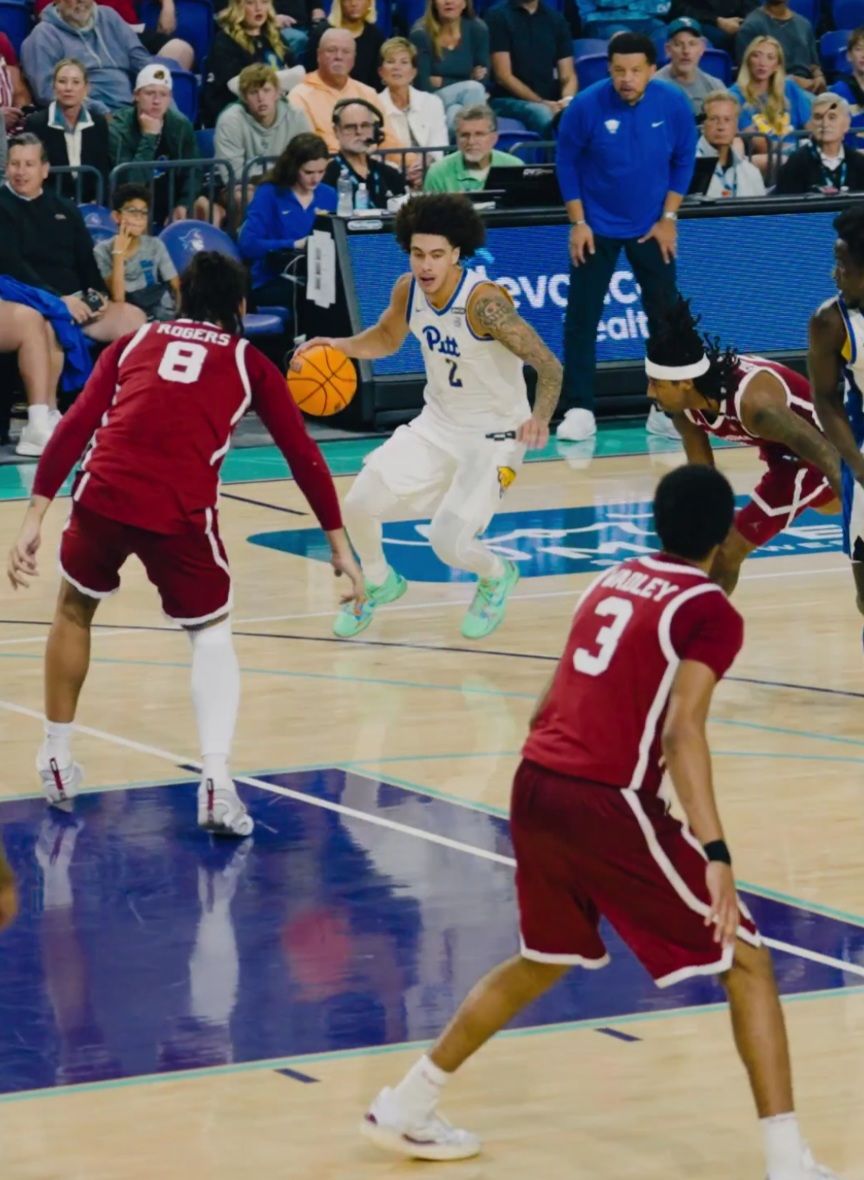
There is a difference between a team that doesn’t have enough fight and a team that hasn’t figured out how to put itself in position to win.
After watching Oklahoma fall 79–68 to Pittsburgh in the opening round of the Skechers Fort Myers Tip-Off, I’m leaning toward the latter.
The Sooners didn’t quit Tuesday. Down 23 in the second half, they found a way to make the game interesting again. They tightened things up defensively, made Pittsburgh work for every possession, and held the Panthers without a field goal for 7 minutes and 18 seconds.
That kind of response says something about this team’s competitiveness.
Unfortunately, it also says something about a problem that has become increasingly difficult to ignore.
For the third time in four games, Oklahoma spent the first half digging itself out of a double-digit hole. The Sooners survived that habit against North Alabama and Campbell. Against an unbeaten Pittsburgh team, the margin for error finally disappeared.
And after sleeping on it, I don’t think the biggest issue is effort, toughness, or even shooting.
I think Oklahoma is still searching for its identity without Duke Brennan, and Porter Moser can no longer afford to spend the first 20 minutes figuring out what works.
Stop Searching for Size and Start Searching for Fit
Let’s start with the lineup.
With Brennan unavailable, Moser has turned to Kai Rogers to provide a more traditional center presence. There’s nothing inherently wrong with that decision. Teams need size, rebounding, and interior defense, particularly when facing quality opponents.
But the question isn’t whether Oklahoma needs a big man. It’s whether the current lineup gives the Sooners their best chance to function offensively.
Rogers played just nine minutes against Pittsburgh, finishing with no points and one rebound. Those numbers don’t make him responsible for the loss, and they certainly aren’t enough to make a definitive judgment about his potential.
They do, however, raise a question worth asking.
What exactly is Oklahoma gaining from that lineup offensively?
The Sooners opened the game with a 5–0 lead before enduring an eight-minute stretch in which they made just one of 12 shots. By halftime, they were shooting 27.6% from the floor. The offense looked congested, the driving lanes weren’t consistently available, and Oklahoma struggled to create anything resembling a reliable rhythm.
Some of that was simply poor shooting. Some of it was Pittsburgh’s defense. But the lineup deserves scrutiny, too.
Without Brennan’s presence, Oklahoma may not have the same interior passing and offensive gravity it had when he was available. If the traditional center look isn’t creating advantages, Moser has to be willing to explore other options.
This isn’t about abandoning size. It’s about recognizing that size doesn’t automatically translate into better basketball.
Oklahoma needs to play to the strengths of the players it has available. Right now, that may mean prioritizing versatility, spacing, and pace over a traditional frontcourt alignment.
Khani Rooths Has Earned a Bigger Role
If there’s one positive to take away from Tuesday’s loss, it’s the continued emergence of Khani Rooths.
The junior forward finished with 10 points on 5-of-7 shooting and four rebounds in 27 minutes. More importantly, he brought an element of energy and versatility that Oklahoma desperately needed.
Rooths was productive without needing the offense to revolve around him. He finished around the basket, moved well, and gave Moser another player capable of contributing in a smaller, more mobile lineup.
The team numbers reinforce the point.
Despite playing without Brennan, Oklahoma matched Pittsburgh on the glass, 32–32, and tied the Panthers in points in the paint, 30–30. The Sooners also won the bench scoring battle 27–16.
That doesn’t mean Oklahoma has discovered a perfect formula. It does suggest that playing smaller doesn’t necessarily mean surrendering the physical battle.
Rooths gives Moser options. He provides athleticism and flexibility while allowing Oklahoma to play with a little more freedom offensively. His performance against Pittsburgh should make it difficult to view him as simply a reserve who provides an occasional spark.
Whether he belongs in the starting lineup is a decision for Moser and his staff. But his minutes need to reflect how valuable he can be to this particular group.
The Sooners don’t necessarily need to play small for 40 minutes. They do need to stop treating it like an emergency measure.
Xzayvier Brown Can’t Keep Playing Firefighter
There is another problem that needs to be addressed, and it starts with the player Oklahoma can least afford to wear down.
Xzayvier Brown scored 23 points against Pittsburgh, with 18 coming in the second half. He was the Sooners’ most consistent offensive weapon and once again demonstrated his ability to carry a significant scoring burden.
But Brown shouldn’t have to spend every game cleaning up the mess created during the opening 20 minutes.
Oklahoma needs more from the players around him.
Richard “Pop” Isaacs finished with six points on 2-of-8 shooting. Derrion Reid managed just two points and went 0-of-3 from the floor. B.J. Edwards scored 10 points but needed 14 attempts to get there.
Those performances aren’t necessarily indicative of what those players can provide over the course of a season. But they illustrate the problem Oklahoma faced Tuesday: Brown was producing while too many of the other offensive pieces struggled to find their footing.
The coaching staff has to find ways to get those players involved earlier.
Isaacs needs opportunities to get comfortable from the perimeter. Reid needs touches that allow him to use his athleticism and attack. Edwards needs opportunities to create without being forced into difficult attempts.
Brown should be the engine of this offense. He cannot also be the emergency response team every time Oklahoma falls behind.
The Sooners need a more balanced offensive approach, and that starts with establishing better rhythm before halftime.
Purdue Is the Next Test, Not an Excuse
The timing of this loss makes the next game particularly interesting.
Oklahoma gets little time to dwell on Tuesday’s disappointment before facing Purdue tomorrow morning. The Boilermakers present another significant challenge, particularly with their size and interior presence.
That creates an important decision for Moser.
Does he try to match Purdue’s size with a traditional lineup, or does he lean into the versatility that helped Oklahoma make its late push against Pittsburgh?
I would prefer to see the latter.
That doesn’t mean Oklahoma should ignore Purdue’s size or willingly surrender the paint. It means the Sooners need to make Purdue defend them, too.
Play with pace. Create space. Put pressure on the perimeter. Give Rooths an expanded role. Find ways to get Brown and the other guards downhill before the defense gets comfortable.
Most importantly, don’t wait until the game is slipping away to make those adjustments.
Purdue will provide another opportunity to see whether Oklahoma can establish an identity against a quality opponent. The Sooners don’t have to win the game with one particular lineup, but they do need to understand what they want to be before the opening tip.
The Identity Has to Come Before the Crisis
I’m not ready to panic over a November loss to an unbeaten Pittsburgh team. Oklahoma is 4–2, and there is plenty of basketball left to play.
But I’m also not interested in pretending Tuesday was simply an off shooting night.
The recurring slow starts are becoming a pattern. The lack of offensive rhythm is becoming a concern. And the absence of Brennan has forced Moser to make some decisions about the frontcourt that deserve a closer look.
The encouraging part is that Oklahoma showed what it can look like when it plays with energy, versatility, and defensive urgency. The late push wasn’t enough to erase a 23-point deficit, but it offered a glimpse of a different approach.
Now Moser has to decide whether that approach deserves more than a few minutes when the game is already out of hand.
The Sooners don’t need to become a completely different team overnight. They need to recognize which version of themselves gives them the best chance to win and commit to it.
Because the next time Oklahoma falls behind by double digits, Xzayvier Brown might not be able to rescue them.
And eventually, the deficit will be too deep to climb out of.
Having slept on it, my biggest takeaway is this: Oklahoma doesn’t need to play harder in the second half. It needs to figure out how to play like itself in the first half.