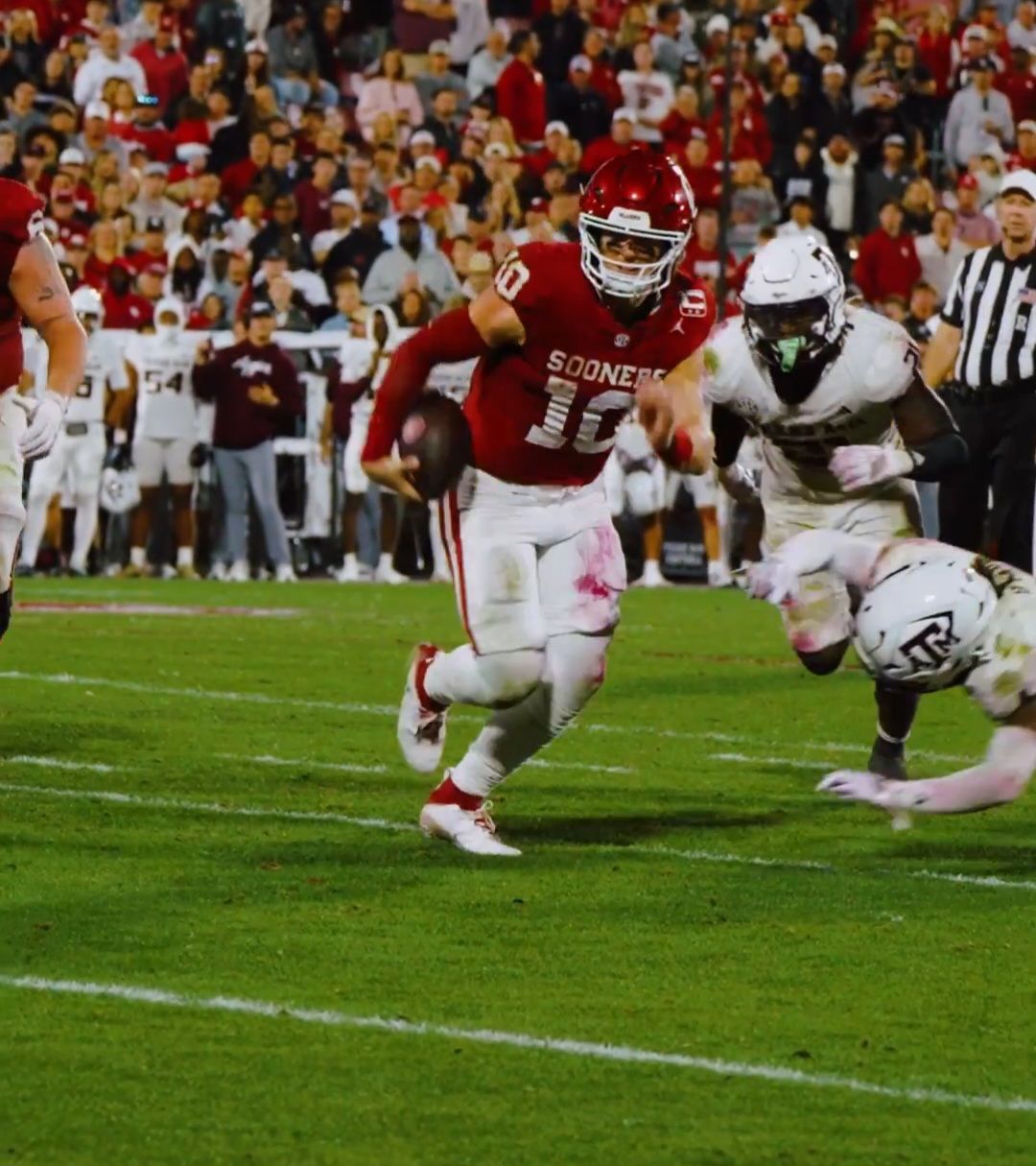
For much of the season, Oklahoma’s identity was difficult to pin down.
The Sooners could defend. They could make games uncomfortable. They could find ways to survive when the offense struggled. But could they put all the pieces together and beat a quality opponent without relying on the defense to carry them across the finish line?
Three consecutive victories have changed that conversation.
Oklahoma’s 23–7 win over Florida showed the Sooners could establish control. The 24–17 victory over Ole Miss demonstrated they could close a competitive game. Then came last Saturday’s 28–7 dismantling of Texas A&M, a performance that offered the most complete evidence yet that this team is developing an identity under interim offensive coordinator Jason Witten.
The Sooners threw for 269 yards, rushed for 152, controlled the football for more than 34 minutes, and held an opponent that entered the game with legitimate SEC aspirations to just seven points.
More importantly, they did it after giving Texas A&M two early turnovers.
That performance answered several important questions about Oklahoma heading into Saturday’s regular-season finale against Missouri. The Sooners have shown they can win through the air, impose their will physically, and lean on a defense that gets increasingly difficult to move as the game progresses.
There is still one question that hasn’t gone away, though.
Can John Mateer protect the football for 60 minutes?
That concern becomes particularly important on the road against a Missouri team that has won five of six games at Faurot Field. Oklahoma has not won in Columbia since 2006, and if the Sooners want to end that drought, they will need to carry the strengths they displayed against Texas A&M while eliminating the mistakes that nearly undermined them.
1. Can Oklahoma Win Convincingly When the Passing Game Has to Carry the Load?
Answer: Yes. The Sooners have a vertical passing game capable of changing the complexion of a game.
Oklahoma’s offensive turnaround under Witten has been built around balance, but last Saturday provided an important reminder that balance doesn’t mean the Sooners have to run the football to be successful.
Against Texas A&M, Mateer completed 23 of 34 passes for 269 yards and three touchdowns. The Sooners added 152 yards on the ground, giving them 421 total yards in a game they controlled from the opening kickoff to the final whistle.
The passing production was especially encouraging because it came with several different elements working together.
Mateer showed poise when Oklahoma needed a response two possessions ended in turnovers. Trailing 7–0, he directed a 92-yard touchdown drive before halftime, completing seven of eight passes and finding Rocky Beers for a four-yard touchdown with 22 seconds remaining.
That drive mattered beyond the points on the scoreboard. It demonstrated that the offense could respond to adversity without abandoning its approach.
The Sooners also showed they could create explosive plays. A defensive penalty gave Oklahoma a free play on third-and-25, and Mateer took advantage with a 38-yard completion to Elijah Thomas. Later, Isaiah Sategna III turned a one-play opportunity into a 25-yard touchdown reception.
Sategna finished with six catches for 94 yards and a score. Beers added seven receptions for 69 yards and another touchdown, continuing a productive season that has made him one of the most reliable options in the passing game.
Beers now has 626 receiving yards, putting him among the most productive Oklahoma tight ends in recent program history. The last Sooner tight end to surpass that mark was Mark Andrews, who finished with 958 yards in 2017.
The significance heading into Missouri is straightforward: Oklahoma doesn’t have to depend on one dimension of its offense.
The Sooners have averaged 161.3 rushing yards per game over their last three contests, but they have also demonstrated that Mateer can deliver when the passing game needs to take center stage. Against a Missouri defense that will have to account for Oklahoma’s improving ground attack, the ability to punish defensive attention through the air could be decisive.
Witten’s offense is becoming more difficult to defend because opponents cannot simply take away one option and expect the rest of the operation to disappear.
2. Does Oklahoma’s Defense Have a Fourth-Quarter Closing Gear That Can Travel?
Answer: Yes. The numbers and the Texas A&M performance suggest this defense is built to finish games.
Oklahoma’s defense has been the most dependable part of this team for much of the season. The difference during this November surge is that the offense is doing enough to give the unit opportunities to dictate the game rather than constantly defend short fields and unfavorable situations.
Against Texas A&M, the defense faced an early challenge when the Sooners turned the ball over twice in the first half. The Aggies capitalized on one of those opportunities with a touchdown, but they never found a way to consistently move the football afterward.
Texas A&M finished with just 185 total yards and 54 rushing yards on 32 attempts. That’s 1.7 yards per carry against a defense that increasingly looks comfortable controlling the line of scrimmage and forcing opponents into difficult passing situations.
The Sooners allowed seven points despite the early offensive mistakes. They also continued a stretch of defensive production that has placed them among the nation’s best units.
Oklahoma enters the Missouri matchup ranked:
- No. 3 nationally in third-down defense, allowing conversions on just 27.4% of attempts.
- No. 7 in passing defense, surrendering 163.1 yards per game.
- No. 12 in total defense, allowing 284.6 yards per game.
- No. 18 in scoring defense, giving up 17.9 points per game.
Linebacker Owen Heinecke has been central to that consistency, recording 91 tackles and 11.5 tackles for loss. His production reflects a defense that has found reliable leadership and playmaking at every level.
But the next challenge is different.
Missouri brings an offense averaging 29.2 points and 400.9 total yards per game. Quarterback Austin Simmons has thrown for 2,693 yards and 25 touchdowns with only four interceptions. Wide receiver Cayden Lee has 71 receptions for 940 yards and five touchdowns.
That combination will test Oklahoma’s secondary, particularly with Reggie Powers III unavailable. Jeremiah Newcombe and Cole Sullivan will have increased responsibility at the Cheetah position, and the Sooners will need their communication and discipline to hold up in a difficult road environment.
The defense has already demonstrated that it can close games. The question now is whether it can do so away from Norman against an offense capable of making explosive plays.
The Texas A&M performance offers plenty of confidence. Missouri will provide a different kind of examination.

Take A Deeper Dive Into Our Oklahoma Football Coverage On Our Facebook Subscription Hub
The Next Blueprint: Taking Witten’s Balanced Attack on the Road to Faurot Field
Key Notes & Storylines: Oklahoma Looks To Extend Winning Streak Against Missouri In Regular-Season Finale
OU Recruiting: The Final Piece? Oklahoma Makes Its Closing Push For Elite 2028 DL Landen Wade
Electric Atmosphere Pays Immediate Dividends On The Trail
The Film Room: The 89-Yard Clampdown – How Oklahoma’s Front Seven Suffocated Texas A&M
Help support Heartland Sports by Unlocking Exclusive, data-driven film room breakdowns, recruiting Update, high-leverage personnel matrix updates you won’t find anywhere else, and More by subscribing to our premium Oklahoma Sooners football coverage today.
3. Can Oklahoma Sustain Its Physicality and Control the Game in the Trenches?
Answer: Yes. The improvement in the running game and third-down offense is more than a short-term statistical bump.
The most encouraging part of Oklahoma’s three-game winning streak might be how dramatically the offense has changed its ability to stay on the field.
Through the first eight games, the Sooners averaged 106.8 rushing yards per game. Over the last three, that number has climbed to 161.3.
The improvement has also shown up on third down. Oklahoma converted approximately 36.2% of its opportunities through the first eight games, compared with 52.1% over the last three.
Those numbers tell an important story. The Sooners are staying ahead of the chains, finding more manageable third-down situations, and sustaining drives instead of repeatedly asking Mateer to manufacture something on passing downs.
The running game has become a shared responsibility.
Lloyd Avant has emerged as a productive option, totaling 469 rushing yards on the season. Tory Blaylock has provided another capable option, while Mateer’s legs have become a much larger part of the offensive equation.
Mateer has rushed for 192 yards over the last three games, accounting for 57% of his season total of 337 yards. His 64.0 rushing yards per game during that stretch represent a substantial increase from the 18.1-yard average he posted over the first eight contests.
That added dimension changes the math for opposing defenses. When the quarterback is a legitimate rushing threat, defensive players must account for another potential ball carrier. It also gives Oklahoma another way to extend drives when the initial play breaks down.
The offensive line deserves credit for the overall improvement, too. The Sooners have been more effective creating opportunities for their running backs and giving Mateer enough time to operate.
There is, however, a personnel concern heading into Columbia.
With right tackle E’Marion Harris doubtful, Ryan Fodje is expected to step into the starting lineup. That’s a significant assignment against an SEC opponent, particularly on the road. Oklahoma will need sound communication and dependable protection from the right side to maintain the offensive rhythm it has established.
Still, the larger trend is encouraging. Oklahoma has become a more physical, more efficient offense, and that development gives Witten several ways to approach the Missouri defense.
The Sooners no longer have to win one specific kind of game. They have shown they can run the football, throw it effectively, and control possession.
The Lingering Worry: Can John Mateer Protect the Football for 60 Minutes?
The concern: Oklahoma’s recent improvement is real, but turnovers remain the quickest way to give Missouri an opening.
For all the progress Oklahoma has made offensively, Mateer’s first-half performance against Texas A&M offered a reminder that the Sooners cannot afford to become careless.
His interception and lost fumble came on consecutive possessions, giving the Aggies opportunities to establish control of a game Oklahoma ultimately dominated.
To Mateer’s credit, the response was impressive. He settled down, led the 92-yard scoring drive before halftime, and finished with 335 total yards and four total touchdowns when accounting for his rushing score.
But the early mistakes still matter.
Mateer enters the regular-season finale with 2,422 passing yards, 18 passing touchdowns, and eight interceptions. The season-long numbers are productive, but the more encouraging development has been the team’s improvement in ball security.
Oklahoma committed 14 giveaways over its first six games. Over the next five, that number dropped to just three.
That is a substantial improvement and one of the reasons the Sooners have won three straight games. However, two of those three giveaways came against Texas A&M, both courtesy of Mateer.
The timing of those mistakes is particularly relevant this week.
Missouri is averaging 29.2 points per game and has the offensive personnel to capitalize on short fields. Simmons has been efficient with the football, throwing 25 touchdowns against four interceptions, while running back Jamal Roberts has rushed for 1,200 yards and nine touchdowns.
Giving that offense extra possessions or favorable field position could quickly change the atmosphere at Faurot Field.
Oklahoma’s defense is good enough to keep the Sooners competitive, but asking it to repeatedly defend short fields on the road is an unnecessary risk. The offense has finally found a rhythm, and the fastest way to disrupt it would be to hand Missouri opportunities it hasn’t earned.
This doesn’t mean Mateer needs to become conservative. Oklahoma needs his aggressiveness, his ability to extend plays, and the rushing threat that has become such an important part of the offense.
It means making the right decisions when the play isn’t there.
Throw the ball away. Take the checkdown. Protect the football when a scramble ends. Avoid turning a manageable situation into a possession-changing mistake.
The Sooners have shown they can recover from turnovers. The next step is proving they can play an entire game without giving the opponent those opportunities.
The Verdict: Oklahoma Has the Ingredients. Now It Needs a Clean Performance.
Three consecutive victories have given Oklahoma something it lacked earlier in the season: a recognizable offensive identity.
The passing game is producing explosive plays. The running game is more consistent. Third-down efficiency has improved. The defense continues to rank among the nation’s best, and the Sooners have demonstrated an ability to close out opponents rather than simply hang around.
Those are meaningful developments heading into a difficult road game.
Missouri presents a legitimate challenge. The Tigers are 5–1 at home, possess an offense capable of scoring in bunches, and will be playing in an environment where Oklahoma has struggled historically.
But the Sooners have answered the biggest questions about their ability to compete.
They can win through the air. They can control the line of scrimmage. They can lean on their defense when the game gets tight.
The lingering concern is whether they can avoid giving Missouri a shortcut.
If Mateer protects the football, Oklahoma has demonstrated that it possesses the offensive balance and defensive toughness to win in Columbia. Ending the regular season at 8–4 would be a fitting reward for the progress made during this November turnaround.
The Sooners have answered three questions.
Now they need to eliminate the one that could undo everything.