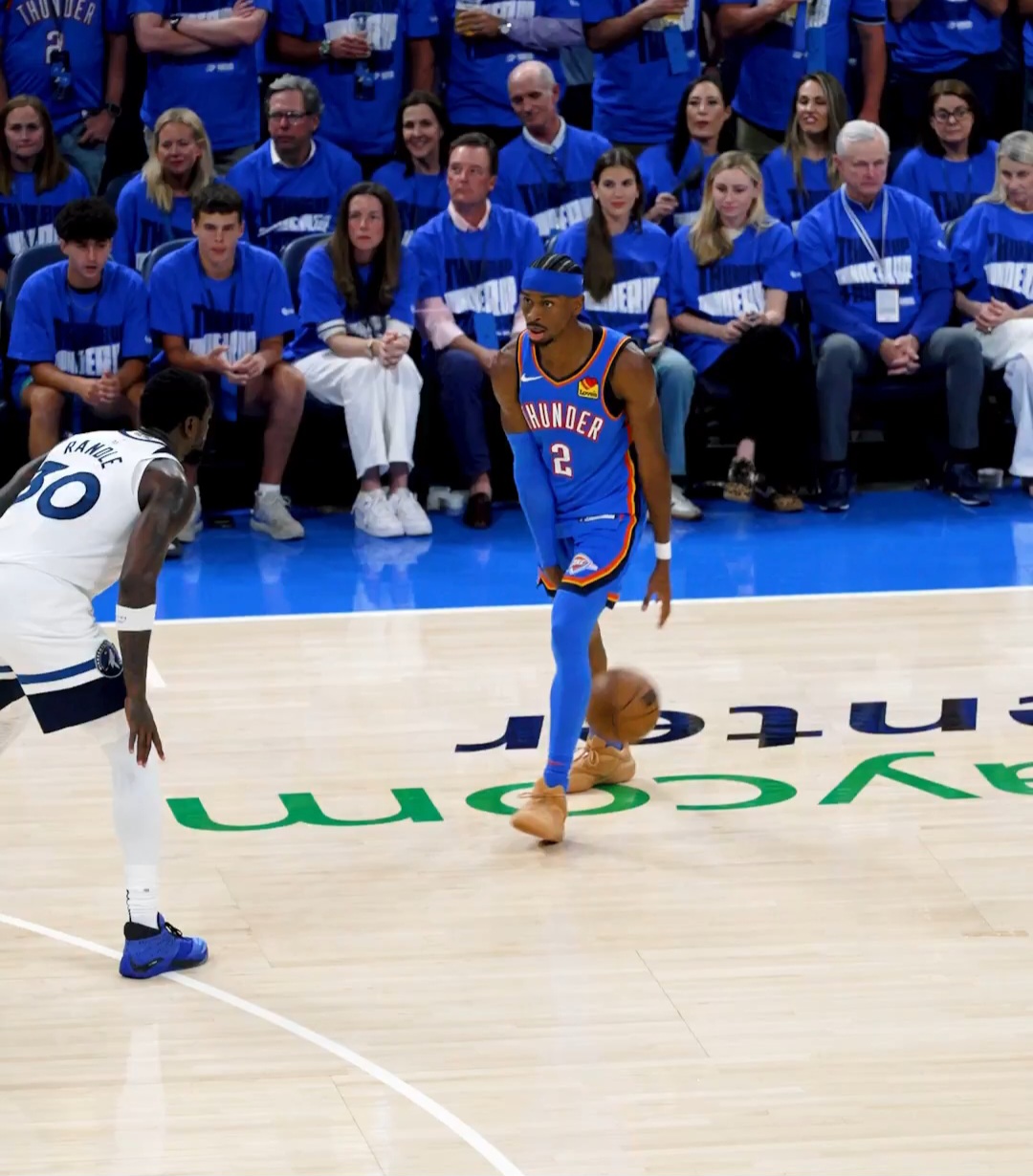
After a commanding Game 1 win, the Oklahoma City Thunder doubled down on their dominance with another wire-to-wire win in Game 2 of the Western Conference Finals, overwhelming the Minnesota Timberwolves and taking a 2-0 lead in the best-of-seven series. While the final score will tell one story, the way the Thunder dismantled the Wolves—again—reveals something much bigger: this team isn’t just surviving the moment. They’re owning it.
Here are five hot takes that sum up a night where OKC proved it’s not just a good team. It’s a great one.
1. Shai Gilgeous-Alexander is the best player in this series—and it’s not close
There’s no more debating it. No need to parse box scores or dig into advanced metrics. Through two games, Shai Gilgeous-Alexander has been the most impactful player on the floor by a wide margin. His Game 2 performance built on a brilliant second-half display in Game 1, and he once again dictated the game at his own pace.
SGA’s ability to score in iso, beat doubles with timely passes, and bait defenders into fouls isn’t new. What is new is the level of control he now exhibits in playoff basketball. He’s not just putting up points—he’s tilting the court. Against one of the NBA’s best defenses, he’s unbothered, composed, and surgical. He’s also defending at an elite level, helping force Anthony Edwards into tough shots and disrupting passing lanes.
Forget narratives. Right now, Gilgeous-Alexander is outplaying everyone on the court.
2. Mark Daigneault is coaching circles around Minnesota
Game 2 cemented what we saw glimpses of in Game 1: Daigneault has figured this matchup out. Whether it’s mixing up coverages on Edwards and Randle, trapping early, or rotating fresh legs to keep Minnesota off balance, he’s playing a coaching masterclass. The Timberwolves, by comparison, seem slow to adjust.
Minnesota has now gone through two games without finding consistent offensive rhythm. Their sets lack creativity. Their decision-making has looked reactive. Meanwhile, Daigneault has pulled all the right strings—including throwing Kenrich Williams and Aaron Wiggins into key stretches, tweaking defensive assignments to shut down passing lanes, and keeping the Timberwolves’ shooters from getting into a groove.
This is a young coach playing like a seasoned playoff veteran.
3. Cason Wallace is growing up before our eyes
No one expected a second-year player to swing a playoff series. But Wallace is steadily becoming one of OKC’s most valuable postseason contributors.
His poise is remarkable. On defense, he’s taking tough assignments and making things miserable for ball handlers. Offensively, he’s showing a level of vision and decision-making beyond his years. His seven assists in Game 1 weren’t a fluke, and in Game 2, he continued to make the extra pass, slide into open pockets, and keep the offense humming.
Wallace doesn’t need to score 20 points to make an impact. He plays with a calm tenacity that fits perfectly within OKC’s identity. He’s not just surviving playoff basketball. He’s elevating within it.
4. The Wolves have no answer for OKC’s tempo
Minnesota entered this series with one of the NBA’s top defenses. It hasn’t mattered.
Oklahoma City’s pace and versatility have turned Minnesota’s size and rim protection into a liability rather than a strength. The Thunder constantly push the ball, space the floor with shooters like Isaiah Joe and Jalen Williams, and attack closeouts. Whether it’s a quick hit-ahead pass from one of the bigs or a secondary break led by Caruso or Wallace, the Wolves are always a step behind.
More importantly, when the game slows down, OKC still maintains tempo by moving without the ball, running clean actions, and making defenders work every second of the shot clock. This isn’t just running-and-gunning. This is smart, relentless, layered offense.
Add in the fatigue from chasing versatile wings and you get what we saw in Game 2: Minnesota legs going dead by the fourth quarter.
5. The Thunder are weaponizing depth like a contender should
This series has been a shining example of what happens when a team trusts its full rotation.
While Minnesota leans heavily on its stars, Oklahoma City keeps coming in waves. Daigneault has used 9 to 10 guys effectively, with players like Kenrich Williams, Aaron Wiggins, and Alex Caruso giving valuable minutes. Isaiah Joe has hit timely threes, and Holmgren’s continued evolution as a shot-blocker and facilitator has allowed OKC to stretch the floor and protect the rim.
The Thunder don’t need to ride one or two stars to win. They can beat you in any number of ways—through lockdown defense, through transition play, through bench scoring. That kind of versatility is rare, and it’s a huge reason they’re now two wins away from the NBA Finals.
Conclusion: Thunder Rolling into Game 3 with Full Momentum
Two games in, it’s hard to overstate just how good Oklahoma City has looked. They’ve exposed Minnesota’s weaknesses, capitalized on every slip in focus, and answered every punch with two of their own. It’s not just the wins—it’s how they’re winning.
They’re playing fearless, smart basketball. They’re trusting each other. And they’re putting the league on notice that they’re no longer ahead of schedule.
They’re right on time.
Game 3 shifts to Minnesota, where the Timberwolves will look to respond in front of their home crowd. But unless they find a way to match OKC’s pace, depth, and discipline, the Thunder just might wrap this up sooner than initially expected.
Follow us on X: @SportsHeartland & Instagram