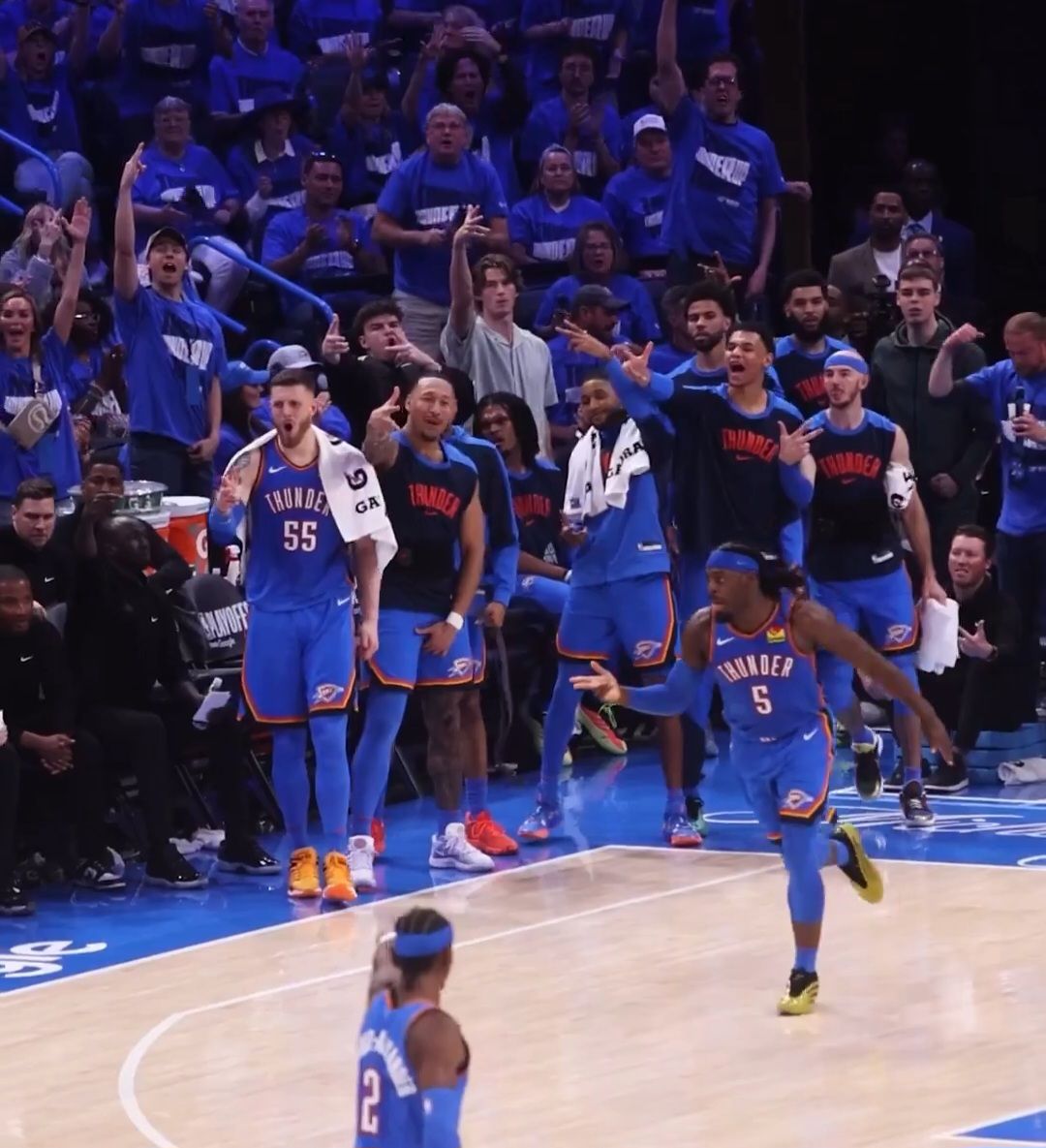
On a night where the stars aligned for Shai Gilgeous-Alexander—quite literally—Oklahoma City didn’t just protect home court. They made a thunderous statement. With the newly minted MVP leading the charge, the Thunder dismantled the Minnesota Timberwolves 118-103 in Game 2 of the Western Conference Finals, seizing a 2-0 series lead and sending a message to the rest of the NBA: this young core is no longer a team on the rise—they’ve arrived.
A Night to Remember
From the moment NBA Commissioner Adam Silver handed Shai Gilgeous-Alexander the 2025 NBA MVP trophy in front of a raucous Paycom Center crowd, the energy was electric. The 25-year-old superstar soaked in the moment—but didn’t bask in it for long. Once the ball was tipped, he got right to work. His 38 points on 12-of-21 shooting (plus 13-of-15 from the line) were a clinic in midrange mastery, clutch shot-making, and composure.
“Special moment,” Gilgeous-Alexander said after the game. “I’m happy we won so I can really enjoy the last couple days and soak it up. That really helps.”
It wasn’t just about the scoring. It was the how and when. Gilgeous-Alexander closed the second quarter with 11 straight points, including a cold-blooded three and a pair of free throws that extended OKC’s lead to 58-50 heading into the break. It was emblematic of how Oklahoma City approaches this postseason: seize the moment, close the quarter strong, and never let the opponent breathe.
Williams, Holmgren & Dort Bring the Blueprint to Life
This isn’t a one-man show. Jalen Williams continued to play Robin to Gilgeous-Alexander’s Batman, pouring in 26 points, 10 rebounds, and five assists. Williams was smooth, methodical, and unbothered by Minnesota’s defense, slicing through the Timberwolves’ schemes with midrange jumpers and intelligent cuts. His confidence is peaking—and it’s terrifying for opposing defenses.
Chet Holmgren, the third piece of Oklahoma City’s star trio, added 22 points. Though he struggled from deep (1-for-6), Holmgren made timely plays—none more emphatic than his soaring two-handed slam on a lob from Cason Wallace that ignited the crowd and pushed the Thunder’s lead to 82-65 late in the third quarter.
And then there’s Lu Dort—the heart of OKC’s defense. Named to the All-Defensive First Team earlier in the day, Dort did what he always does: make life miserable for his matchup. His physicality, anticipation, and discipline are central to a Thunder defense that held Minnesota to 41.4% shooting and forced 14 turnovers.
The Wolves of Winter
To Minnesota’s credit, Anthony Edwards looked far more like himself after a sluggish Game 1. He scored 32 points and was relentless in attacking the rim. But his 1-for-9 shooting from three exemplified the Wolves’ recurring issue: they can’t buy a bucket from deep.
Through two games, Minnesota is 24-for-82 (29.3%) from beyond the arc. That’s not just cold—that’s catastrophic, especially against an Oklahoma City team that feasts on long rebounds and runouts.
Jaden McDaniels chipped in 22 points, and Nickeil Alexander-Walker gave a solid 17 off the bench, including 11 in the fourth quarter. But it wasn’t enough. Rudy Gobert was largely ineffective, struggled with decision-making and inconsistent defense. Despite being named as a member of the NBA’s All-Defensive Team (2nd Team) he has been rendered ineffective due to Oklahoma City’s pace and spacing.
Minnesota is learning the hard way: it’s not just about having talent. It’s about fit, flow, and resilience—and Oklahoma City has more of all three right now.
Third-Quarter Thunderstrikes
In both Games 1 and 2, the Thunder have turned the third quarter into their personal playground. That trend continued on Thursday as OKC outscored Minnesota 35-21 in the third. It started with Gilgeous-Alexander’s gravity bending the defense, but it was punctuated by Williams and Holmgren pushing the lead to 22 entering the final frame.
Coach Mark Daigneault has pressed the right buttons all series long. His rotations have been crisp, his defensive schemes suffocating, and his players’ buy-in absolute. There’s no fear—only belief—and that starts at the top.
Where Do the Wolves Go From Here?
For Chris Finch and the Timberwolves, the script is running out of space. They return to Minneapolis down 2-0 and in desperate need of answers.
Edwards must be great—but he also needs help. McDaniels has stepped up, but the rest of Minnesota’s vaunted top-eight rotation has largely gone missing. Donte DiVincenzo’s postseason woes continued with a brutal -27 in Game 2. Gobert looks ill-suited for the speed of this series, and Mike Conley has yet to impact the game meaningfully.
The Wolves may have to look deeper down the bench. Could rookie Terrence Shannon Jr. provide a spark? Can Naz Reid offer more than spot-up threes? Can Finch find a lineup that isn’t constantly scrambling to recover defensively?
Minnesota needs to play with pace—but controlled pace. Too often, Oklahoma City’s defense has forced them into early, rushed shots or sloppy passes that ignite transition. When the Wolves execute in the half-court, they can be effective. But that window has been narrow, and OKC keeps slamming it shut.
The Verdict: A New Power Has Risen
Two games in, the Thunder have proven they are not just precocious—they’re potent. This is not the feel-good story of a young team getting hot. This is the story of a franchise that has been meticulously rebuilt and is now bearing fruit.
Gilgeous-Alexander isn’t just MVP in name—he’s MVP in execution. Williams and Holmgren are not just complementary stars—they’re foundational pieces who can win now and dominate later. And behind it all, Oklahoma City plays connected, gritty, intelligent basketball.
This series is far from over, but the onus is squarely on Minnesota to respond. Game 3 looms large—both as an opportunity and a reckoning. But right now, Oklahoma City isn’t flinching.
They’re flourishing.
Follow us on X: @SportsHeartland & Instagram
One Reply to “MVP, Mastery, and the Making of a Contender: Here’s How The Thunder Rolled Past Minnesota in Game 2”